








The topic in a nutshell
- Two layers, one logic: CRM provides segments and consent. The Loyalty Engine uses these to generate points, status, and rewards in real time. Only together do they create measurable activation.
- Limitations of pure CRM modules: Integrated loyalty modules quickly hit their limits: rigid rule sets, lack of POS integration, and no real-time sync. For omnichannel retailers, this is structurally insufficient.
- Personalized incentives work: Translating CRM segments into segment-specific rewards measurably increases repeat purchases, basket value, and identification rates. Generic emails fizzle out, even with a clean data foundation.
- Convercus as a loyalty layer for your CRM: Convercus complements Salesforce, SAP, or Emarsys via an API-first approach, adding the missing incentive logic in real time across POS, app, and webshop.
Your CRM is full: purchase histories, segments, consent status, lifecycle phases. Yet, your repeat purchase rate is stagnating, campaigns are generating little response, and segments are receiving the same generic emails. Why aren't all these data points turning into genuine customer loyalty? The answer lies in the gap between your data foundation and activation. A CRM knows who should be contacted. It doesn't decide which incentive will actually work. This is exactly where a dedicated loyalty engine like Convercus comes in: acting as the bridge between CRM signals and measurable customer behavior.
Why doesn't a CRM alone create customer loyalty?
A CRM stores who bought what, but not why someone comes back. The result: silent churn in profitable segments, a shrinking share of wallet despite active contact journeys, and consent pools that go unused and expire. Without a targeted customer loyalty initiative , every segment remains just a mailing list. The data is there, but the response is missing because communication without a concrete benefit gets lost in the inbox.
Typical symptoms of a setup limited to a CRM include:
- delayed or missing point credits
- generic emails without personalized rewards
- lack of POS integration
- a broken connection between action and reward.
- no real-time mechanics
The CRM provides the data foundation and segmentation. A loyalty engine turns this into incentives, status, and rewards in real time, across POS, app, and webshop. Without this second layer, you don't create measurable loyalty—only documented interaction.
How is CRM loyalty structured? The CRM provides the segment, the loyalty engine provides the incentive
CRM loyalty consists of two interlocking layers: The CRM provides the data foundation, segments, CLV scores, and consent status that Convercus Loyalty Engine translates into points, status, and personalized rewards.
The interaction follows a clear five-step process:
- Segmentation in the CRM
- Incentive logic in the Loyalty Engine
- Omnichannel delivery via POS, app, and webshop
- Measuring behavior in the engine
- Optimizing segments and incentives
This architectural decision determines time-to-value, IT effort, and future scalability.
CRM as a data foundation: Which signals really count?
Not every data field in the CRM drives loyalty behavior. What matters are signals that predict genuine purchase intent and lifecycle position, not just master data.
Relevant signals for loyalty activation include:
- Purchase history and frequency, as the strongest indicator for repeat purchases and CLV development.
- Basket value, as the basis for status and threshold mechanics.
- Channel preference, for the correct delivery of coupons and triggers.
- Consent status, as a prerequisite for any personalized communication.
- Lifecycle phase, to distinguish between activation, retention, and reactivation.
Without a clean foundation, any set of rules remains ineffective. Dirty CRM data—such as duplicates, outdated contacts, and incomplete histories—sabotages loyalty logic at its core: points are wasted on inactive accounts, segments become skewed, and triggers fire for the wrong profiles.
What does a loyalty engine do? The rules behind personalized rewards
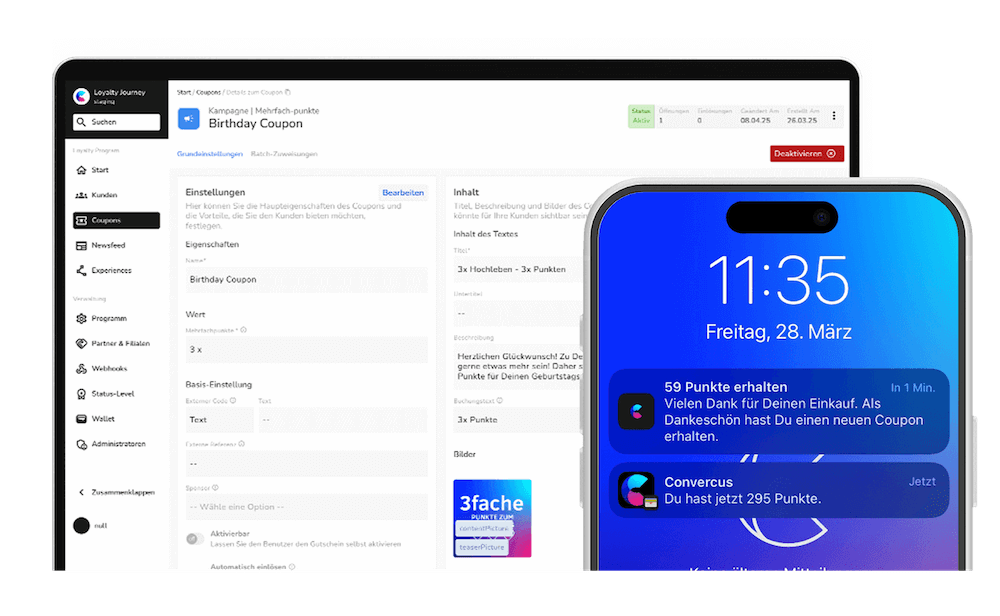
A loyalty engine is the set of rules that translates CRM signals into concrete customer behavior. It manages flexible point systems, status models, personalized coupons, and real-time triggers across all touchpoints. A powerful engine must seamlessly convert segments, CLV scores, and consent status into incentives that work identically at the POS, in the webshop, and in the app.
A modular rule set, low latency, and consistent mechanics across all channels are crucial. Convercus operates as an API-first loyalty engine with real-time processing at the POS, in the webshop, and in the app, ensuring that point credits, coupon redemptions, and status changes take effect without delay.
How do you integrate a loyalty platform into your CRM, POS, and app—and what matters most?
A loyalty platform must meet four requirements simultaneously:
- API-first architecture
- Real-time sync between CRM, POS, app, and webshop
- Offline capability for the POS system
- consistent mechanics across all channels.
Offline capability is not just a nice-to-have: If the connection at the store checkout fails, points, coupons, and status recognition must continue to function locally; otherwise, you end up with anonymous transactions and frustration at the omnichannel interface.
Typical integration paths use connectors to Salesforce, SAP Emarsys, or other systems like Braze and Dymatrix – Convercus supports a wide range of these via its integrations. The best-of-breed architecture keeps CRM and marketing automation as the leading systems, complemented by dedicated loyalty logic with the advantage that there is no vendor lock-in and the customer retains control over their roadmap.
CRM extension or dedicated loyalty platform: How to make the right decision
The architectural decision has long-term effects: it determines not only IT effort and time-to-value, but also how quickly mechanics can be adapted and who retains control over customer data. Anyone facing this decision should also structure their vendor selection early on. A loyalty RFP helps you ask the right questions.
The following overview compares the three common implementation models.
For mid-market and enterprise retail four criteria are decisive:
- Transaction volume
- Omnichannel requirements across POS, app, and webshop, and the speed of rule changes per campaign cycle
- GDPR compliance with European hosting and clean consent management.
The higher these values, the clearer the trend toward a dedicated platform. Clear warning signs against relying solely on a CRM extension include millions of transactions per year, heterogeneous POS landscapes with offline requirements, weekly campaign cycles with new mechanics, and high app relevance with wallet passes. As soon as two of these points apply, built-in loyalty reaches its structural limits, and a dedicated loyalty layer becomes a strategic necessity.
Convercus without CRM: When is the loyalty engine enough on its own?
Convercus includes its own segmentation and trigger logic. Thresholds, rules, and segments can be configured directly within the platform, allowing loyalty mechanics to function completely independently based on transaction data, purchase frequency, and tier status.
CRM integration is not a mandatory component, but an amplifier. It provides the most value where requirements go beyond transaction data: consent management across multiple channels, lifecycle-based communication, or segmentation based on CLV scores. The more complex the data landscape, the more the combination pays off, as Convercus can then translate CRM signals into real-time purchase incentives at the POS, in the app, and in the webshop.
CRM-loyalty integration: How to avoid the most common implementation mistakes
Even well-planned integrations rarely fail because of the technology, but rather due to recurring operational errors. These six occur most frequently in practice:
- "Dirty CRM data": Duplicates and outdated contacts lead to incorrect point credits. Solution: Data hygiene and identity resolution before go-live.
- Data silos between CRM and loyalty platform: Personalization remains generic. Solution: Bidirectional real-time sync.
- Generic rewards: Segment-specific incentives instead of a one-size-fits-all approach.
- Delayed real-time sync: Points appear too late, trust declines. Solution: API-first with low latency.
- Overemphasis on earn-and-burn: Engagement mechanics instead of pure transaction logic.
- Measuring enrollment instead of engagement: Active usage as the lead KPI.
The fundamental prerequisite for any integration is GDPR-compliant data collection. Three principles are non-negotiable:
- active opt-in consent before any data processing
- clear purpose limitation for every data category
- consistent data minimization.
The official GDPR regulatory text defines rights of access, rectification, and erasure, which must be technically implementable. Additionally, data processing agreements, European hosting, and granular consent management across all touchpoints are mandatory components of a viable CRM-loyalty architecture.
Getting more out of your CRM data: How Convercus measurably increases repeat purchases and engagement
Convercus is a specialized loyalty engine that works alongside your existing CRM and marketing automation systems, rather than replacing them. While CRM and marketing automation manage who is contacted and when, Convercus handles the incentive logic: determining which incentive works for which segment, in real time at the point of sale, in your webshop, and in your app.
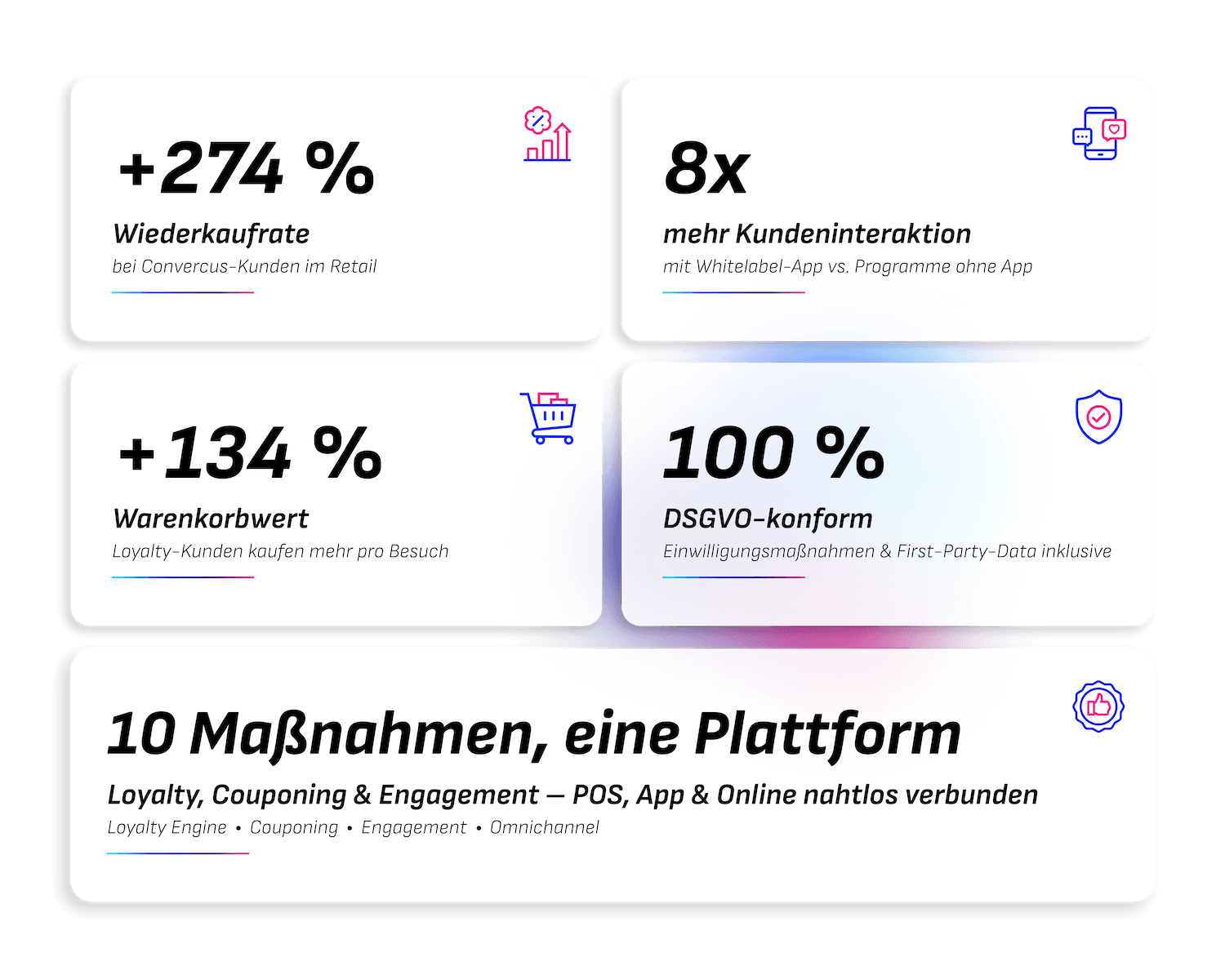
The impact is reflected in concrete program metrics: For one client, Convercus registered over 6 million customers in a loyalty program in a very short time, operating across 3 countries and over 1,100 POS locations. Programs with a white-label app achieve up to 8 times higher customer engagement than programs without an app. These results are achieved when CRM segments are consistently translated into personalized incentives instead of ending up as generic mailings.
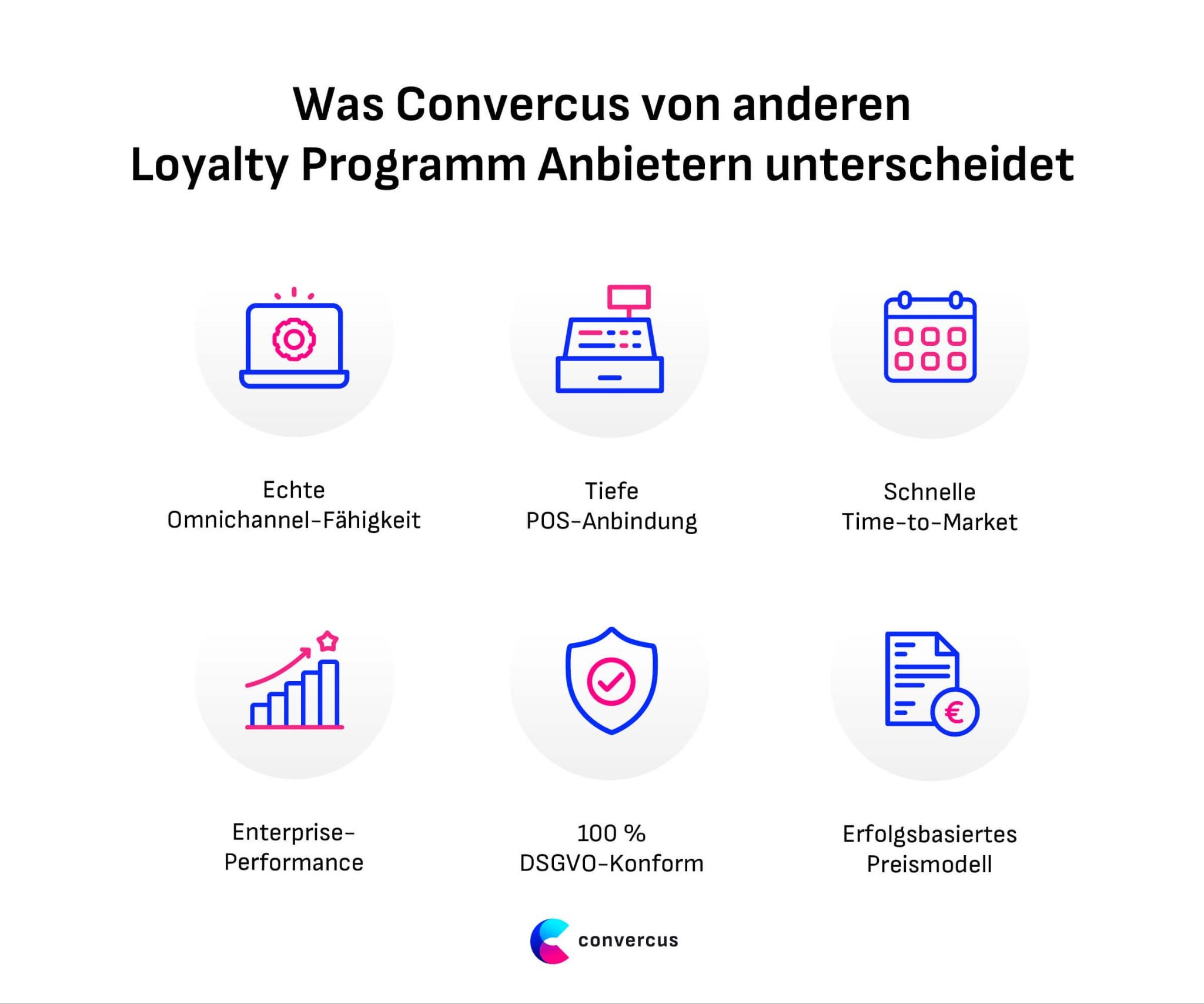
The target audience fit is clearly defined: a focus on the DACH region, deep experience in sectors including fashion retail and hospitality, API-first integration with minimal IT burden, and a usage- and performance-based pricing model. This keeps the initial investment predictable and ensures it scales with measurable program success, not license size.
Successfully implementing CRM loyalty: Your next step with Convercus
True customer loyalty only emerges when CRM data is consistently translated into personalized incentives via a dedicated loyalty engine. The specialized solution provided by Convercus delivers its greatest impact when three conditions are met:
- a transaction volume beyond simple pilot scales
- clear omnichannel requirements across POS, app, and webshop
- reliable data quality in the CRM with clean identity resolution and documented consent.
If you meet these requirements, you should take the next concrete step: In a personal live demo , loyalty experts from Convercus will review your CRM landscape with you, show you suitable integration paths, and provide a realistic assessment of your loyalty potential.
FAQ
What is the difference between a CRM and a loyalty platform?
A CRM manages customer data, segments, communication preferences, and consent status as a central data foundation. A loyalty platform , on the other hand, manages points, status, coupons, and rewards in real time across POS, app, and webshop, and translates CRM signals into measurable behavioral activation at the touchpoint.
Can I connect Salesforce to a loyalty platform?
Yes. Using an API-first integration , Salesforce or SAP Emarsys can be connected bidirectionally to a loyalty platform. Four requirements are crucial: real-time sync of points and status, clean transfer of consent per contact, consistent mechanics across POS, app, and webshop, and event triggers back into the CRM for journeys.
How long does it take to implement a CRM loyalty program?
Modern API-first deployments significantly shorten traditional large-scale projects: When launching a loyalty program initial channels often go live within a few weeks, while a full rollout across CRM, POS, app, and webshop typically takes three to six months. The exact duration depends on your system landscape, data quality, and scope.
How do I collect customer data for a loyalty program in compliance with GDPR?
Active opt-in consent is required before any data processing, along with clear purpose limitation for each data category and consistent data minimization. Additionally, you must provide rights for access, correction, and deletion, and have written data processing agreements in place with all service providers. The original GDPR text defines these obligations as binding for every loyalty program in the European market.
In a personal demo, we will analyze your system landscape together and show you exactly what an integration with Salesforce, SAP Emarsys, Braze, or Dymatrix looks like.

Talk to a Convercus loyalty expert about what is missing in your setup.