











Key Facts
- API loyalty program: A loyalty engine exposed through a RESTful API, allowing points, tiers, and rewards to plug into POS, app, and CRM independently rather than being locked into a single checkout flow or vendor ecosystem.
- Three technical factors decide omnichannel scale: API response time, real-time sync across channels, and POS coverage determine whether the program performs consistently at every touchpoint or stalls at the store door.
- Integration is the main blocker in practice: Most loyalty rollouts don't fail on strategy. They stall on system integration. Legacy POS formats, middleware gaps, and data mapping between the till and engine are where timelines slip.
- Convercus at enterprise scale: Approx. 50 ms API response time and 20,000 connected POS terminals in production, built through repeated omnichannel deployments across DACH enterprise retail.
Your e-commerce team has a working loyalty program. Points accrue, rewards redeem, the dashboard looks healthy. Then a customer scans a receipt at the till, and the cashier sees nothing. The balance lags, the offer doesn't apply, the moment is lost. An API loyalty program is often pitched as a commodity layer, but in omnichannel retail, the architecture decides whether the program scales across every POS or stalls at the checkout. Convercus is the API-first loyalty platform built for this reality. This article covers what to evaluate, how the integration works, and what enterprise retail actually needs.
Why Your Loyalty API Architecture Determines Omnichannel Performance
The loyalty API architecture you choose decides what happens at every touchpoint downstream. POS terminals, mobile apps, CRM systems, and partner platforms all depend on the same engine responding consistently. When the architecture is built for e-commerce checkouts first, the store till becomes an afterthought.
Most providers grew up serving online-first brands, so their APIs assume a single transactional flow. For omnichannel retailers running physical stores, that creates integration friction: delayed point updates at the till, mismatched balances between app and POS, and rule changes that require a developer ticket instead of a configuration update. The API-first loyalty stack addresses exactly this gap by treating every channel as a first-class integration target.
REST, Webhooks, and Batch: When to Use Which
Three integration patterns dominate loyalty API work, each fitting a different operational need.
A genuine API-first loyalty platform supports all three rather than forcing one pattern. REST handles the till, webhooks push events to marketing automation, and batch keeps analytics pipelines fed without slowing transactional flows.
API-First vs. Bolted-On API
Exposing an endpoint does not make a platform API-first. Many legacy vendors wrap a thin REST layer around a monolithic core, so transactions can be posted but program configuration, rule changes, and reporting still require admin consoles or vendor tickets. The industry calls this pattern "digital washing": API access on the surface, manual workflows underneath.
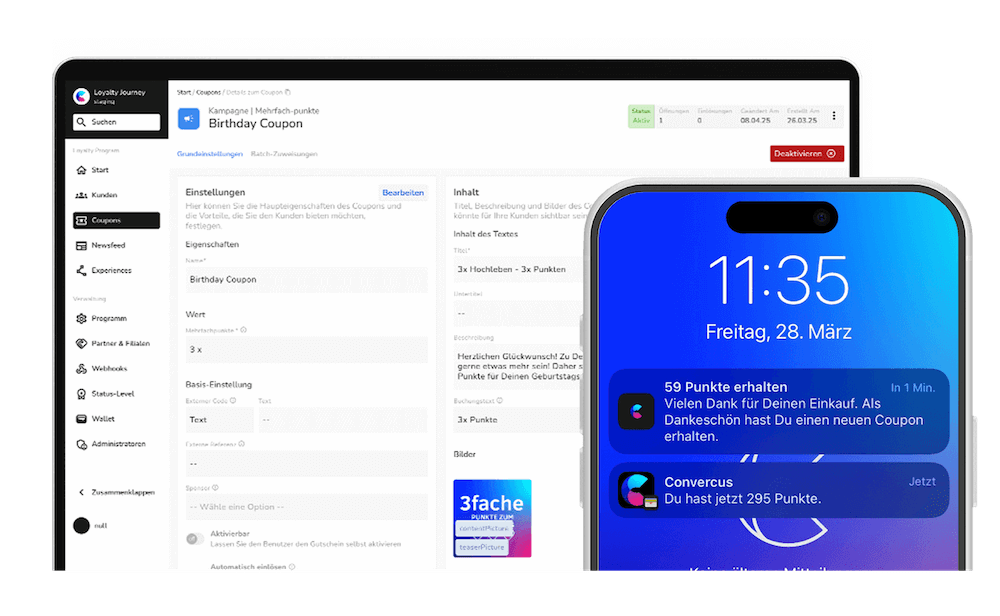
In a genuine API-first architecture, every operation is programmatically accessible, from creating tiers and editing earn rules to pulling member analytics. Convercus exposes the entire loyalty engine through its API, so configuration changes, coupon assignments, and member operations run through the same interface as transactional calls. That means marketing and IT can automate the full program lifecycle, not just point accruals.
This pattern is particularly common among platforms that started as marketing suites or e-commerce tools and added loyalty functionality later. The API exists, but the program logic still runs through a vendor-managed admin layer.
How an API Loyalty Program Works in Practice
Three terms get used interchangeably but mean different things. The loyalty engine is the rules layer that calculates points, evaluates tier thresholds, and applies redemption logic. The loyalty API is the interface that exposes those operations to outside systems. The loyalty platform is the full product, including the engine, the API, the admin UI, analytics, and connectors.
In practice, a customer hands over their card at checkout. The POS sends an API call with the transaction and customer ID. The engine calculates points against the active rules, returns the response, and the till displays the updated balance, all within the time it takes to print a receipt.
The contrast between legacy and API-first flows is easiest to see across four operational dimensions.
What Does a Loyalty API Need to Cover in Omnichannel Retail?
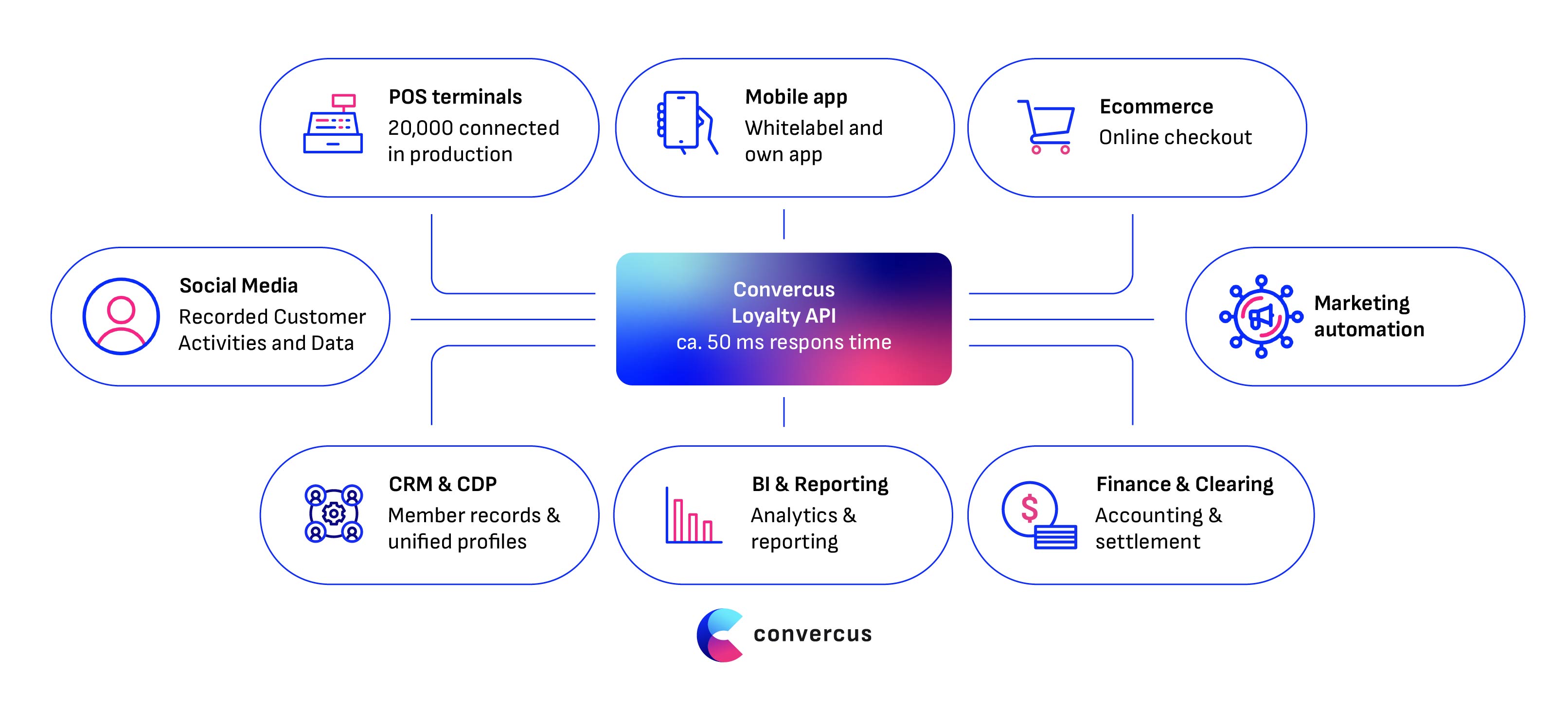
Most provider pages quietly assume an e-commerce-first setup, where the API serves a single online checkout. Omnichannel retail works differently. The API has to reach every touchpoint a customer uses, from the till and the mobile app to the CRM and partner systems, and it has to do so with the same response quality at each one. That scope, not raw endpoint count, is what separates a workable loyalty API from one that stalls at the store door.
Touchpoint Coverage
A loyalty API in omnichannel retail has to reach every system the customer and the brand touch, not just the online checkout:
- POS systems at every store and till
- eCommerce platform and online checkout
- Mobile app
- CRM for member records and segmentation
- CDP for unified customer profiles
- Partner systems and external loyalty ecosystems
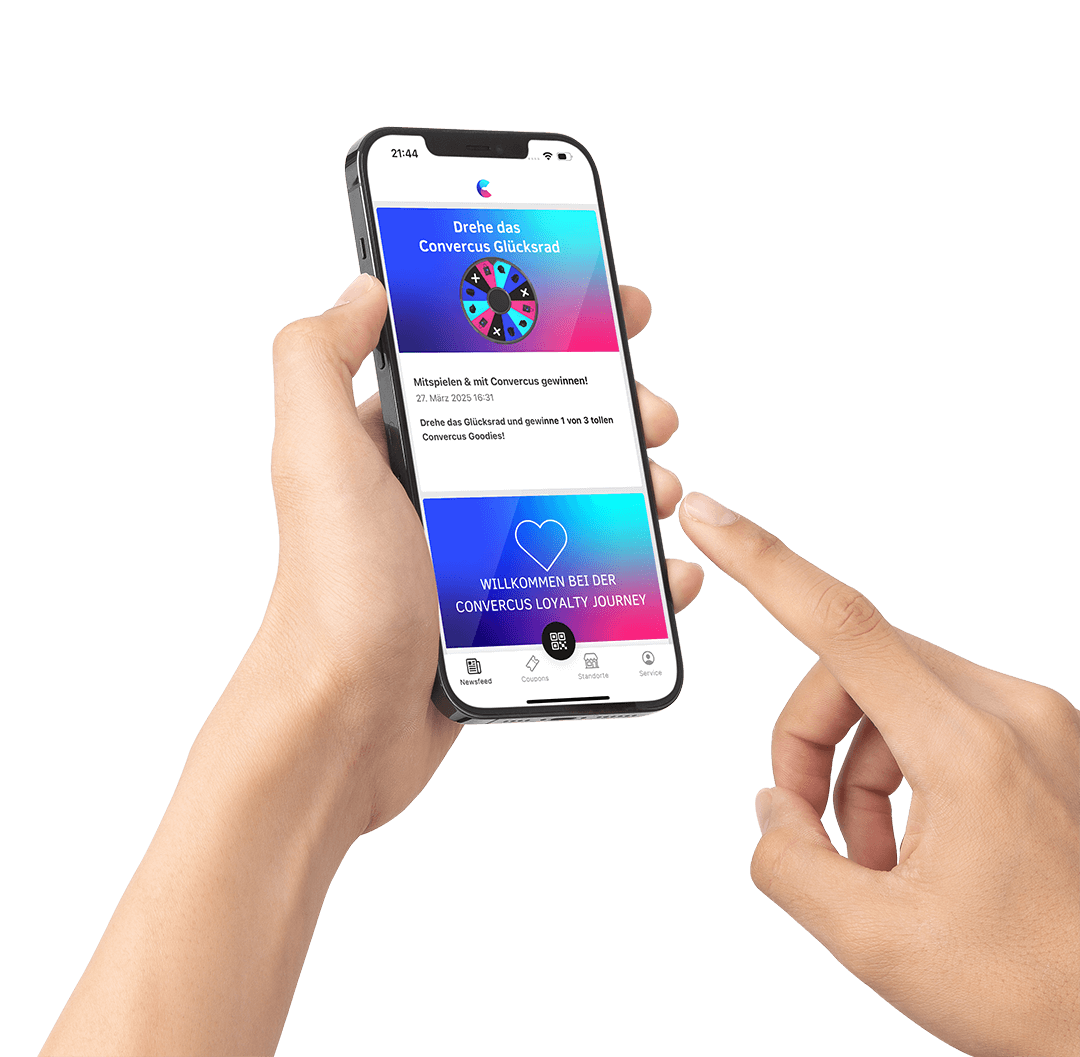
Convercus connects across all of these with approximately 20,000 POS terminals live in production, and programs running its whitelabel app see 8x higher customer interaction compared to loyalty programs without one.
Legacy POS and Middleware
Legacy POS systems are the number one real-world blocker for omnichannel loyalty rollouts. Replacing the entire checkout infrastructure is rarely an option, and most retailers run a mix of older terminals alongside newer ones. The more relevant question is not whether an API loyalty platform can connect to your POS, most can. The question is how much custom integration work that connection requires, and whether the platform has done it before.
Middleware connectors and webhook adapters let older systems participate in the loyalty program without ripping out hardware, by translating between the till's native protocol and the loyalty API. The realistic blocker is usually data format mapping: field structures, transaction codes, and customer identifiers vary by POS vendor, and that mapping work decides timelines. A platform with reusable connectors for common POS systems shortens that work significantly. Convercus runs 20,000 connected POS terminals in production across enterprise omnichannel deployments, that connector library is a direct result of having solved this problem repeatedly at scale.
Performance, Security, and Data Privacy
Three trust factors tend to dominate technical evaluations in DACH enterprise retail, and all three have direct implications for how the loyalty API is architected.
Response time and uptime come first. Convercus delivers approx. 50 ms API response times, fast enough that the till never waits on the loyalty engine during checkout. For high-footfall retail, that latency ceiling is non-negotiable.
Authentication and encryption sit at the protocol level. OAuth 2.0 secures every API call, and TLS protects data in transit between POS, app, and engine. These are table stakes for any enterprise integration, but worth verifying explicitly in vendor evaluations, not every platform applies them consistently across all endpoints.
GDPR-compliant data handling is where architecture decisions have the most downstream compliance impact. The transfer of personal data is kept to a minimum, reducing the compliance surface and simplifying data subject requests. Convercus handles EU hosting and OAuth 2.0 by default, which means these requirements do not require custom configuration on your side.
What Enterprise Retailers Need From an API Loyalty Platform at Scale
An API loyalty program only delivers business value when its architecture matches the real operating environment: physical POS, real-time sync between channels, and enterprise-grade transactional load. Convercus runs 40M+ loyalty accounts and 116M+ transactions, the scale at which architectural shortcuts surface as missed scans, mismatched balances, and stalled rollouts. Convercus is the API-first loyalty platform proven in DACH omnichannel retail, with approx. 50 ms response time and 20,000 connected POS terminals in production.
The right next step is a focused scoping conversation with a loyalty architect who can map the platform to your existing POS, CRM, and middleware landscape, before any procurement decision is on the table.
FAQ
How quickly can I integrate an API loyalty program like Convercus into my existing POS infrastructure?
Timelines depend on POS complexity, the number of terminal types in scope, and middleware needs for legacy systems. Omnichannel rollouts spanning multiple POS systems typically run 2 to 3 months when the platform is genuinely API-first and connectors are reusable rather than custom-built per till. Convercus runs 20,000 connected POS terminals in production and typically completes omnichannel rollouts within this timeframe.
Should we build a loyalty engine in-house or use an API platform?
Treat this as a risk and resource question, not a technical one. Building a comparable engine in-house requires significant engineering investment, and that only covers the initial build. Ongoing maintenance, security patching, GDPR compliance, scaling for peak POS traffic, and roadmap evolution all sit on your team indefinitely. A proven API-first platform absorbs that burden and shortens time to value.
How does an API loyalty program stay GDPR-compliant?
Compliance rests on a clear lawful basis with explicit consent capture at sign-up, data minimization through PII separation so the engine only holds IDs and rule-relevant fields, EU hosting for data sovereignty, OAuth 2.0 authentication, and audit-ready logging of access and changes. Convercus handles EU hosting, OAuth 2.0, and PII separation by default.
Can a loyalty API integrate with legacy POS systems?
Yes. Middleware connectors and webhook adapters let older POS terminals participate in the loyalty program without replacing the checkout infrastructure. The realistic blocker is usually data format mapping between the till's native protocol and the API, not the API itself. A genuinely API-first platform provides the flexibility to handle that translation.
How is an API loyalty platform like Convercus typically priced?
API loyalty platforms are typically priced on a usage-based model, meaning costs scale with actual program activity rather than a fixed licence fee. Convercus operates on a usage- and success-based model with low implementation costs, the exact structure depends on program scope and transaction volume. To get a pricing indication relevant to your setup, speak with a Convercus loyalty architect.
Find out whether your POS and CRM infrastructure is compatible with an API-first loyalty platform. Speak with a Convercus loyalty architect in a focused scoping call that maps your existing systems against the integration requirements.

See how Convercus connects to 20,000 POS terminals in production across DACH enterprise retail.


.jpg)

.jpg)