








The topic in brief
- Bidirectional Data Flow: The CDP delivers segments, churn scores, and CLV values. The loyalty engine translates these signals into points, status, or coupons and feeds back structured earn, burn, and consent events. Only this cycle makes personalization measurably effective.
- Real-time Activation instead of Data Congestion: If a churn score exceeds a defined threshold or a customer approaches the next CLV tier, the CDP automatically triggers an event. The loyalty engine reacts immediately: bonus points, status upgrade, or coupon, visible in app, wallet, and at the POS.
- Identity Resolution as a Prerequisite: Without a clean linkage of loyalty ID, email, and POS data, shadow profiles emerge, which distort segments and incorrectly deliver incentives.
- Convercus as an Activation Layer: Convercus receives CDP signals, translates them into concrete incentives, and feeds back structured coupon, transaction, and consent data. Each activation makes the next segmentation more precise.
The CDP is running, segments are clean, churn scores and CLV values are available. Yet, the next purchase impulse fails to materialize. The reason is structural: A CDP unifies profiles, but it doesn't trigger rewards at the POS, doesn't award points, and doesn't trigger coupons. So, the activation channel is missing. Whoever wants to increase customer loyalty needs more than clean segments; they need a channel that translates CDP signals into concrete purchase incentives. A loyalty engine closes precisely this gap by translating CDP signals into concrete incentives and feeding back earn, burn, and consent events bidirectionally. Convercus operationally enables precisely this connection.
CDP and Loyalty Engine: What role does each system play?
The CDP is the data hub: It unifies profiles, calculates segments, churn scores, and CLV values. The Loyalty Engine is the activation layer, which awards points, manages statuses, deploys coupons, and redeems rewards at the POS.
Without an activation channel, the CDP remains blind at the moment of purchase, because it cannot book points or trigger status upgrades at checkout. Loyalty platforms like Convercus do not replace the CDP; they receive its intelligence and feed back behavioral data in a structured way.
The following table contrasts the three architectural components and their respective limitations:
When is a CRM module sufficient, and when is a dedicated loyalty engine needed?
A CRM module is sufficient for simple punch cards without real-time POS requirements. For Omnichannel mechanics, complex status and couponing logic , as well as structured first-party data feedback into the CDP, a dedicated loyalty engine is required, and typically a structured selection process along with it. A Loyalty RFP helps to systematically compare providers and make the right decision.
Convercus without a CDP: When does the loyalty engine function independently?
While the question above weighs CRM against a loyalty engine, another question arises for companies with an existing CDP landscape: Does Convercus absolutely require a CDP as a data source?
No, because Convercus comes with its own segmentation and trigger logic. This means thresholds, rules, and segments can be configured directly within the platform. For companies that want to manage loyalty mechanics based on transaction data, purchase frequency, or tier status, the loyalty engine functions independently.
The CDP integration fully demonstrates its value where data requirements become more complex: multiple data sources, cross-system identity resolution, and behavior-based scores from web and email data. In this setup, Convercus acts as the activation layer, translating CDP intelligence into real-time purchase incentives and delivering structured behavioral data back.
Data Exchange Between CDP and Loyalty: What Flows Where – and Why?
Every functioning CDP-Loyalty architecture is built upon three layers:
- Data Capture captures profiles, transactions, and consent.
- Decisioning evaluates segments, scores, and triggers.
- Activation translates this logic into points, statuses, or coupons at the touchpoint.
CDP and Loyalty Engine share this logic collaboratively and exchange signals bidirectionally . The following sections show which data flows in which direction and where the transition is crucial both technically and strategically.
From CDP to Loyalty Engine: Which data signals flow where?
The CDP provides four central signal types to the Loyalty Engine: segment affiliation, churn score, CLV proximity, and it takes over campaign control by sending different triggers depending on the situation. These signals control which mechanism the Loyalty Engine deploys, not whether it is activated at all.
A specific example: An existing customer approaches the defined CLV threshold for the next tier. The CDP recognizes this approach based on the last three transactions and sends a trigger to the Loyalty Engine. This automatically sends a message that informs the customer about the almost reached target value and further incentivizes them with an automatically assigned coupon. These are classic Gamification mechanics, which can immediately become visible in the wallet, in the app, in the online shop, and at the POS. Thus, a score becomes a concrete purchase incentive.
From Loyalty back to the CDP: What first-party data is generated by earn, burn, and consent events?
A loyalty engine generates data pointsthat a CDP alone never sees from web or email tracking. Every touchpoint in the program becomes a structured event that enriches the first-party data foundation in the CDP.
Specifically, the following data flows back: Earn events with shopping cart, store, and timestamp, burn events during coupon and point redemption at the POS, tier status changes, wallet pass interactions, as well as granular consent signals from loyalty onboarding. In the post-cookie world, this data flow becomes the most strategically valuable data source for RFM segmentation, propensity models, and retail media audiences, because it combines identity, behavior, and consent in a consistent stream.
Identity Resolution: What happens if loyalty IDs are not merged?
Identity resolution is the prerequisite for every personalization use case. Loyalty data such as loyalty ID, email, and POS transactions provide a strong foundation for this. However, as soon as many data sources converge and customers are created multiple times in various systems, the CDP offers its decisive advantage: It consolidates all identifiers through deterministic and probabilistic matching into a unified "Golden Profile". Only this profile makes segments, scores, and triggers robust.
If resolution is missing, a customer fragments into multiple shadow profiles with concrete consequences: distorted CLV values due to fragmented transaction history, double-addressing via email and push, incorrect segment assignment, and irrelevant incentives that damage tier logic and trust. A practical example from the CDP Institute: After unification, it turned out that 23% of supposedly unique customers were duplicates across email, loyalty, and POS systems.
CDP Loyalty in Practice: How a Churn Signal Automatically Becomes a Loyalty Incentive and Drives Repurchase
A loyal customer in the fashion segment hasn't made a purchase in 62 days, a typical case for customer win-back. The CDP calculates from days of inactivity, a decreasing email engagement rate, and a declining RFM position a churn score above the defined threshold. The customer automatically moves into the "Reactivation Loyal Customers Tier Silver" segment.
The CDP calls via API the Loyalty Engine from Convercus and passes the customer ID, segment, and recommended mechanic. Convercus then books a category-specific coupon into the whitelabel app and the wallet pass. The customer makes a purchase within a week. The earn event, including shopping cart, store, redeemed coupon, and consent status, flows back into the CDP in a structured manner, updates the CLV, and closes the data loop for the next iteration.
GDPR Requirements in the CDP Loyalty Data Loop
The processing of loyalty data within the CDP requires a robust legal basis under Art. 6 GDPR. In practice, profiling, segmentation, and personalized communication rely on the member's consent (Art. 6 para. 1 lit. a), while the execution of program mechanics is partly covered by contract fulfillment (lit. b). In parallel, Art. 13 GDPR mandates transparent information regarding purposes, recipients, and storage duration before earn, burn, or consent events flow into the CDP.
The legal soundness of the data loop is determined by consent management. The loyalty onboarding is the central point of consent: members provide granular consent per purpose, can revoke their consent at any time, and the consent status is synchronized across systems with the CDP. Purpose limitation, as well as rights of access and erasure, must apply along the entire chain, from the POS to the data flowing back into the CDP.
CDP Meets Loyalty Engine: How Convercus Translates Customer Data into Revenue
Segments, CLV scores, and churn probabilities only generate a measurable revenue impact when translated into concrete incentives: bonus points, status upgrades, category-specific coupons. This translation layer is precisely what the CDP lacks. The loyalty engine closes this gap and, in turn, delivers structured earn, burn, and consent events back to the CDP. This creates a closed data loop where each activation makes the next segmentation more precise and systematically increases the share of wallet.
Segments, scores, and churn triggers only unlock their value when translated into a concrete purchase incentive at the right moment. Convercus is the API-first loyalty engine that does exactly that: CDP triggers are processed in real-time, points are booked, tier statuses are elevated, and coupons are delivered to the app, wallet, and POS. Earn, burn, and consent events flow back into the CDP in a structured manner, making the next segmentation more precise. Thus, the share of wallet grows not just through better data, but through what is made of it.
FAQ
Can a CDP replace my loyalty platform?
No. A CDP unifies profiles, calculates segments and scores, and activates data across channels. The loyalty engine manages the mechanics: points, tier status, coupons, and earn-and-burn logic at the POS. Both systems are complementary and only unlock their full value through bidirectional interaction.
How does real-time activation work in a CDP-loyalty setup?
The CDP detects an event or a threshold being crossed, such as a churn score or proximity to CLV, and sends the trigger via API to the loyalty engine. Additionally, highly specific selections for campaigns can be created in the CDP and purposefully transferred to the loyalty engine. This automatically awards points, upgrades status, or issues a coupon, immediately visible in the wallet, app, and at the POS.
What data does the loyalty engine send back to the CDP?
The loyalty engine provides structured first-party events back to the CDP:
- Earn events with shopping cart details, store, and timestamp
- Burn events for point and coupon redemptions at the POS
- Status changes between tiers
- Wallet pass interactions
- Granular consent signals from loyalty onboarding
Do I need a complete loyalty program before connecting to a CDP?
No. A phased launch with data-driven coupons or reactivation campaigns is sufficient to establish the data loop. Convercus also works without a CDP – if you are currently launching a loyalty program, you can add CDP integration later, once identity resolution, consent flow, and initial use cases are running stably.
Is the use of loyalty data in the CDP GDPR-compliant?
Yes, with robust consent management, clear purpose limitation, and a documented legal basis according to Art. 6 GDPR. Loyalty onboarding bundles consent granularly per purpose, the CDP adopts this consent status across systems, and consistently manages access and deletion rights across all touchpoints.
Segments, scores, and churn triggers are in place, but there's no channel to convert them into purchase incentives. A Convercus Loyalty Architect will analyze with you where the leverage lies in your system landscape.
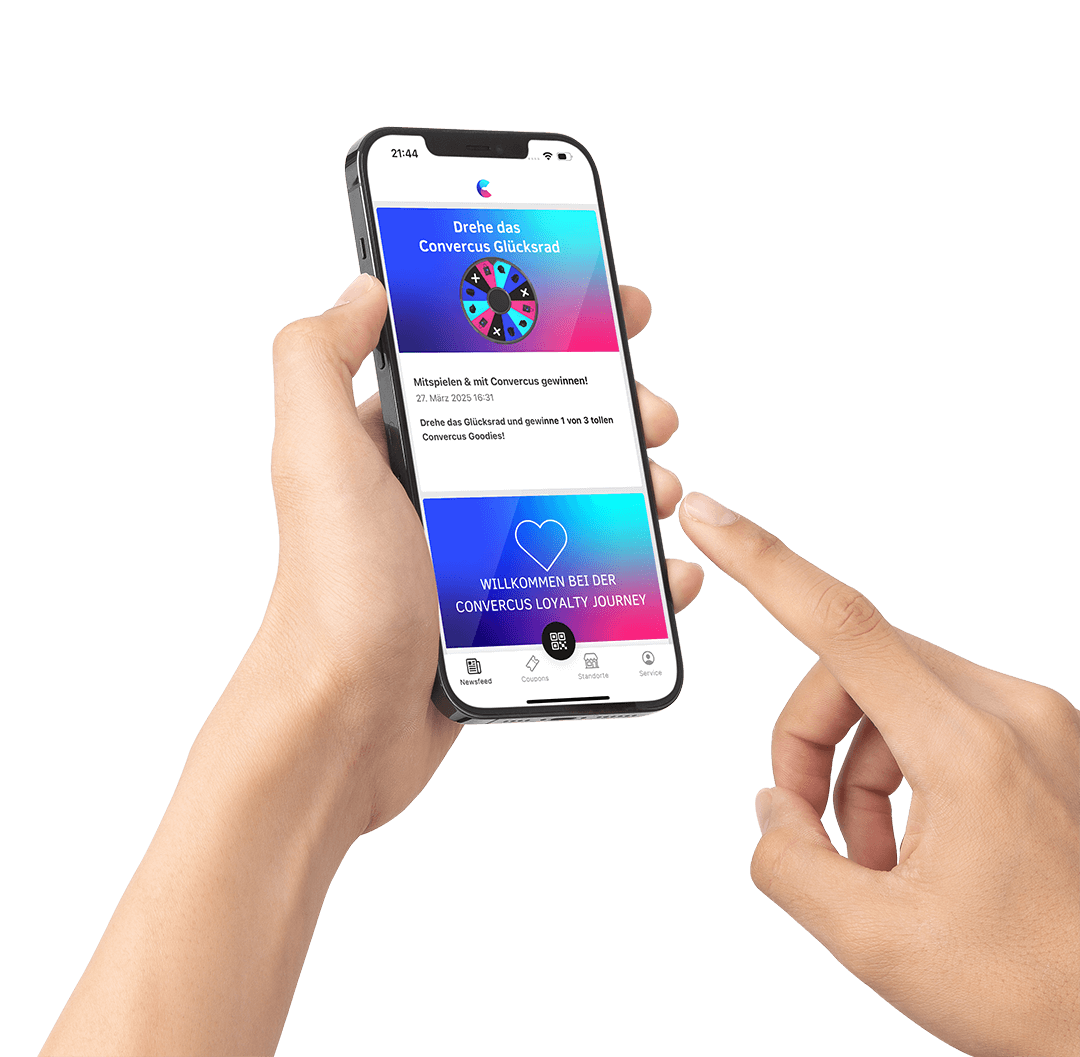

Data privacy is crucial for the program's foundation and customer trust. Convercus, as a platform, is designed from the ground up to be GDPR-compliant set up: Consent is collected granularly for each purpose, can be revoked at any time, and is synchronized across systems into the CDP, ensuring the entire data lifecycle runs on a sound data privacy foundation.
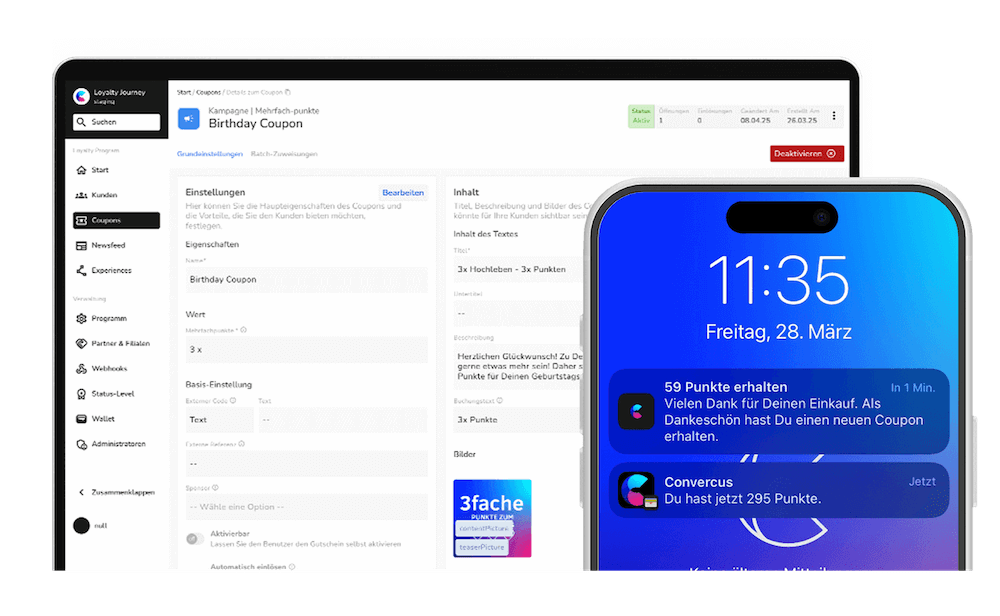
Convercus translates your CDP signals into points, status, and coupons – in real-time at every touchpoint.