








Key Facts
- Enterprise loyalty software: purpose-built platform managing complex programmes across brands, regions, and channels from a single rules engine.
- POS integration depth: the most underestimated selection criterion for omnichannel retailers running thousands of terminals.
- ROI measurement gap: 41% of corporate loyalty leaders struggle to quantify programme impact, according to EY's Loyalty Market Study.
- Architecture fit beats feature breadth: channel coverage and post-launch agility outweigh long feature lists.
- Convercus scale anchor: 40M+ accounts, ~50ms API response times, 20,000 connected POS.
You're a CRM or loyalty manager building a shortlist, and halfway through vendor demos a pattern emerges: most platforms marketed as "enterprise" are built for pure e-commerce or global suite buyers, not for omnichannel retail running thousands of POS terminals. The decisive criterion isn't feature count, it's channel fit. This guide compares eight platforms, including Convercus as a POS-native option built for this reality, by architecture archetype and channel coverage rather than marketing claims.
What Actually Determines Enterprise Loyalty Platform Fit?
Stop asking which platform has the most features and start asking which one fits your channel mix and scale. Three architecture archetypes drive fit:
- omnichannel POS-native
- digital-first API engine, and
- global enterprise suite.
The risk most buyers underestimate is POS integration complexity at scale and the post-launch agility tax when marketing teams need engineering tickets for every rule change.
The table below maps each archetype to its typical buyer profile, core strength, and hidden risk.
How to Evaluate Enterprise Loyalty Platforms: 6 Criteria That Actually Change Platform Fit
Six criteria materially change platform fit for enterprise buyers:
- architecture model (POS-native, API-first, or suite)
- channel coverage including POS integration depth
- governance and multi-market support
- post-launch rule agility
- performance at scale, and
- total cost transparency.
For pure e-commerce buyers without physical retail, API composability and promotion engine depth outweigh POS depth in the weighting, a separate consideration covered in depth for online loyalty software. Reorder criteria to match your channel reality, not the vendor's marketing emphasis.
Beyond these six, confirm a compliance baseline: GDPR alignment per EU Regulation 2016/679, SOC 2 or ISO 27001 certification, and points liability reporting. Treat compliance as a gate, not a differentiator.
Use this pre-shortlist checklist before booking demos:
- Can marketing change earning rules post-launch without engineering tickets?
- Does the platform reconcile POS transactions in real time?
- What offline fallback applies when terminals lose connectivity?
- How are Loyalty Point liabilities managed and reported?Which cash register systems and hardware stacks are natively supported?
- What SLA coverage applies in real-time POS environments?
8 Enterprise Loyalty Software Platforms Compared
Each platform below represents a distinct architecture archetype or fit profile relevant to enterprise retail and e-commerce buyers: omnichannel POS-native, digital-first API engine, global enterprise suite, and ecosystem-native loyalty embedded in broader commerce stacks. The shortlist deliberately spans DACH-focused specialists and global vendors so buyers can map each option against their own channel mix, regional footprint, and integration constraints rather than feature-count rankings.
The table below compares all eight platforms across architecture, channel fit, regional presence, key trade-off, and ownership status.
Convercus: Omnichannel Loyalty for Retail & E-Commerce
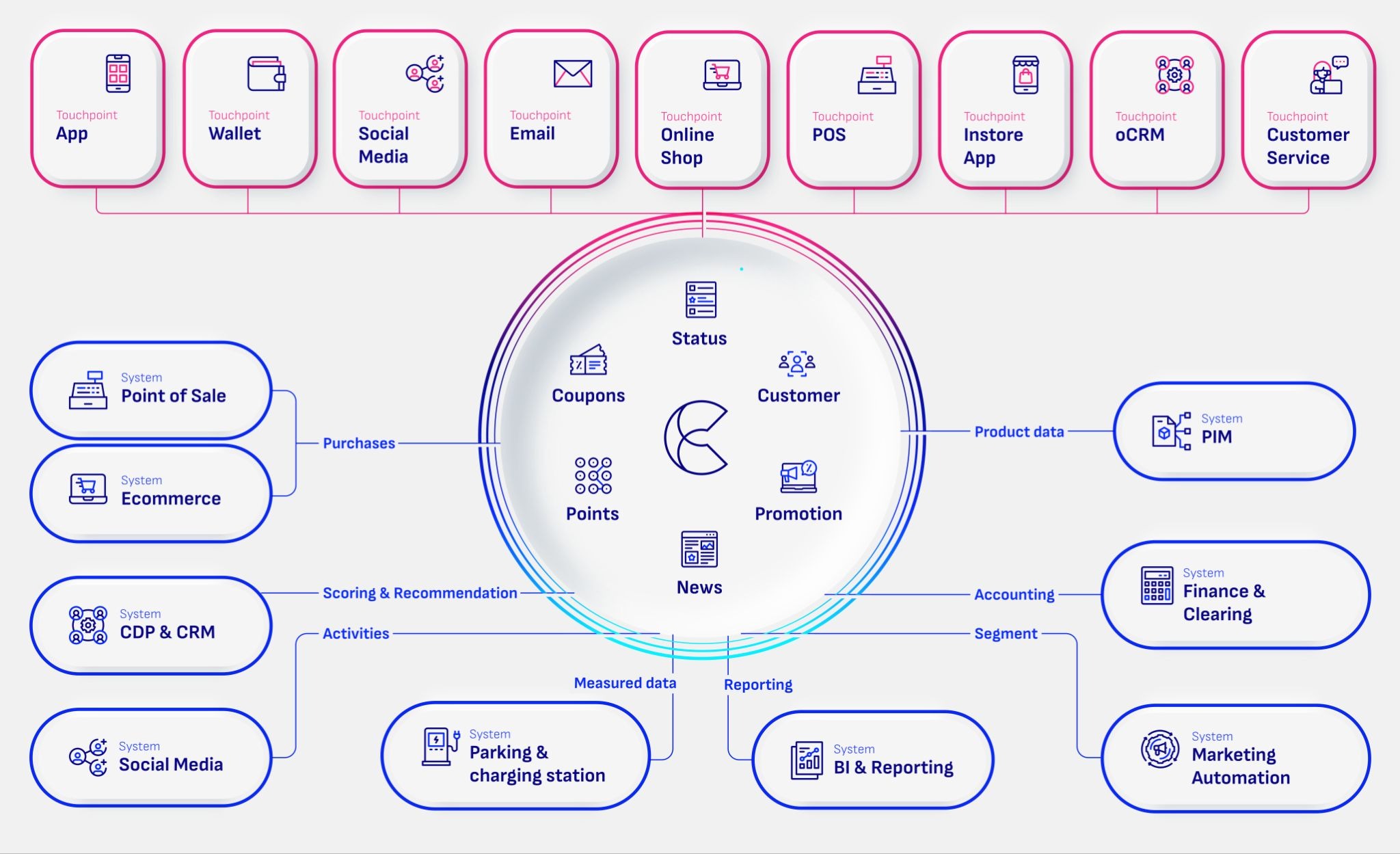
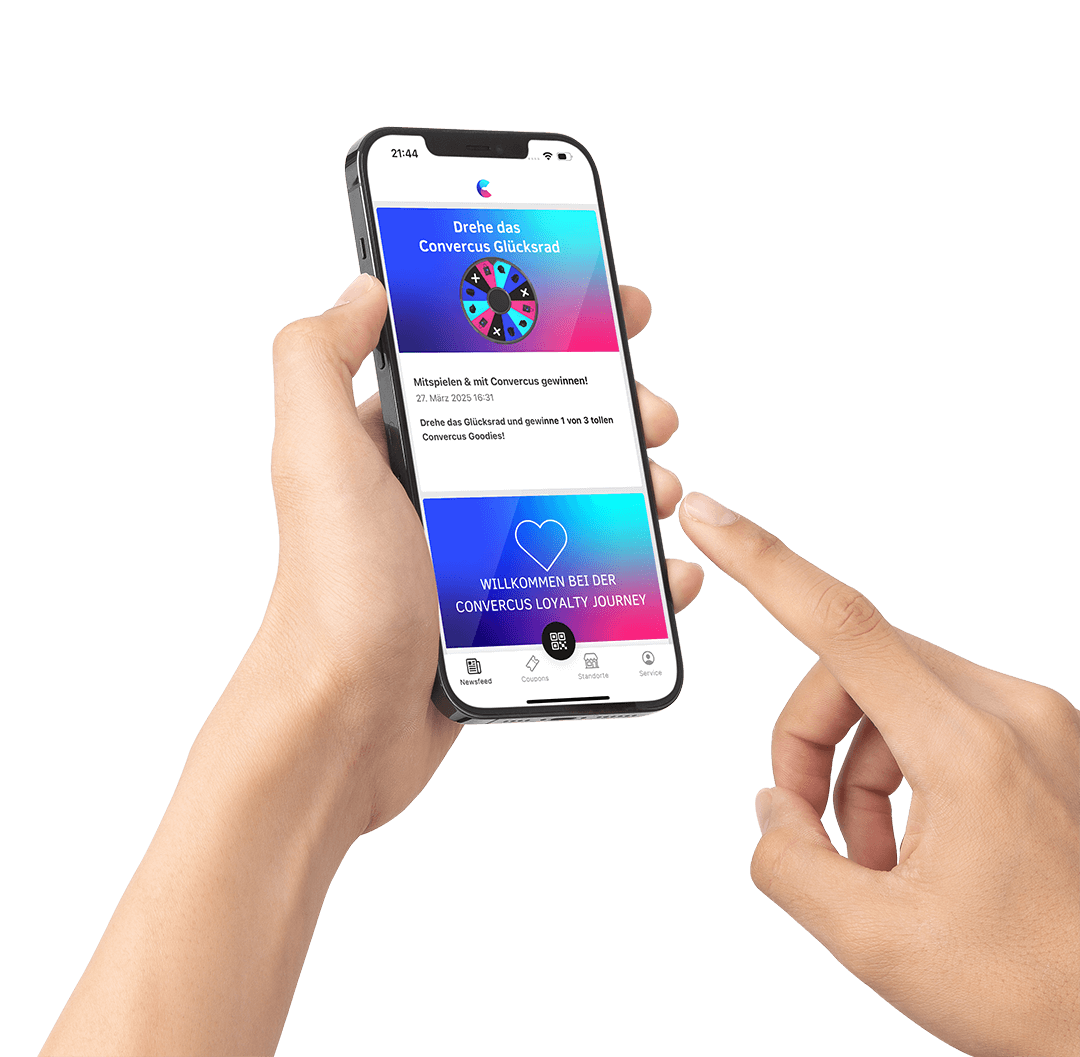
Running a loyalty programme across thousands of POS terminals and a digital channel simultaneously means real-time earn-and-burn at every checkout, synchronisation between app and till, and offline fallback when connectivity drops. Convercus is built for this reality: integration work structured through proven onboarding playbooks rather than pushed back to the buyer, no single-vendor lock-in, and meaningful roadmap influence. The trade-off: stronger in DACH and POS-heavy omnichannel than in pure global digital-first scenarios. Best-fit profile: omnichannel retail and e-commerce enterprises in the 100M+ EUR revenue range, DACH market.
Core Features
- Real-time earn-and-burn across physical and digital touchpoint
- Synchronisation between online-shop, app and POS, including offline fallback
- Multi-cash-system support for diverse hardware/software stacks
- Loyalty point liability reporting and clearing features
- Structural Success Management for post-launch retention accountability
Strengths
- Purpose-built for omnichannel retail with thousands of POS terminals
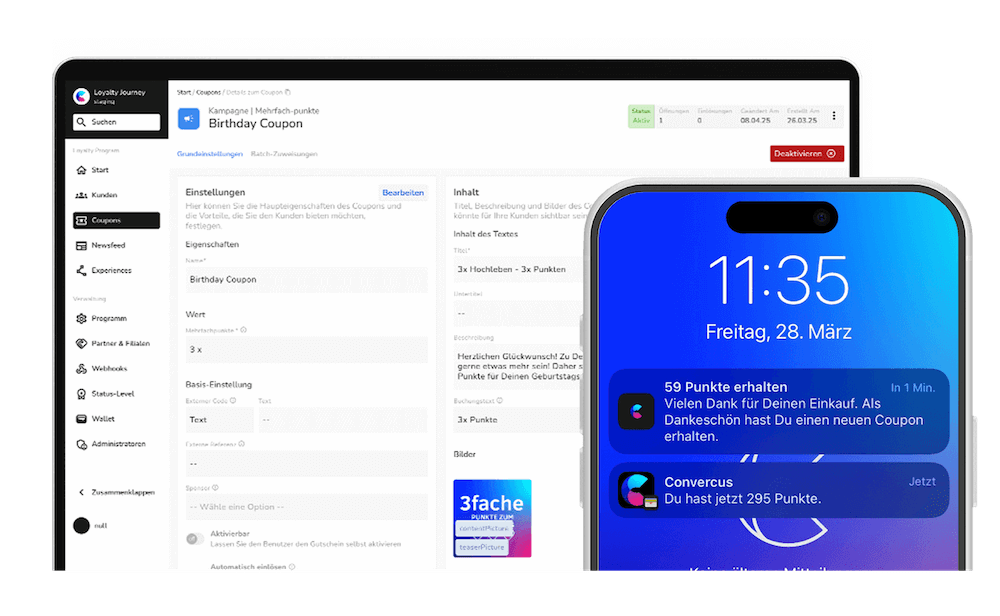
- Marketing can change earning rules post-launch and implement flexible loyalty features and automations without engineering tickets
- Fast integration into complex IT architectures
Limitations
- Less depth in pure global digital-first scenarios
Talon.One: API-First Promotion and Loyalty Engine
Talon.One targets digital-first teams with in-house engineering resources. It provides a composable rules engine for loyalty and promotions, with full control over logic. The Adyen acquisition may affect long-term roadmap direction. The trade-off: UI layer and POS integration must be implemented by the buyer’s team.
Core Features
- Composable rules engine for loyalty, promotions, and coupons
- Real-time promotion testing (A/B)
- Headless architecture for digital-native commerce
Strengths
- Full control over promotion logic and rule flexibility
- Open API
Limitations
- UI and POS integration are the buyer’s responsibility
Antavo: AI Loyalty Cloud with Tier and In-Store Tooling
Antavo targets marketing-led teams needing tier structures, gamification, and a pre-built admin UI. The no-code interface allows CRM teams to configure rules independently. The Promotion Engine (launched May 2025) adds promotion depth.
Core Features
- No-code rule configuration for tiers, gamification, and rewards
- Pre-built admin UI for marketing teams
- AI-driven personalisation tools
Strengths
- Marketing-led configuration without engineering dependency
- Focus on tiered loyalty and gamification
Limitations
- Limited publicly available DACH enterprise retail references
Capillary Loyalty+: Global Enterprise Footprint
Capillary Loyalty+ targets multi-region enterprises and large brands requiring managed services and global reach. The SessionM acquisition (May 2026) expands personalisation capabilities. The trade-off: heavier services model and longer implementation timelines.
Core Features
- Managed-service model for global loyalty programmes
- Multi-region support
- Personalisation tools (enhanced by SessionM)
Strengths
- Global reach and managed-service depth
- Suitable for complex, multi-market needs
Limitations
- Longer implementation timelines
- Less direct control over product roadmap
Voucherify: Composable Incentive and Promotion Engine
Voucherify targets composable commerce stacks needing promotions, coupons, and loyalty under one rules engine, particularly for digital-native or headless architectures. The trade-off: frontend and POS integration are the buyer’s responsibility.
Core Features
- Headless rules engine for promotions, coupons, and loyalty
- Composable architecture
- Real-time incentive validation
Strengths
- High flexibility for composable commerce
- Focus on promotions and coupons
Limitations
- Frontend and POS integration must be handled by the buyer
Comarch Loyalty Management: Suite for Airlines and Coalition
Comarch Loyalty Management targets airlines, fuel retail, financial services, and multi-country coalition programmes. The suite handles partner accrual logic, currency conversion, and regulatory variance. The trade-off: suite weight and longer implementation timelines reduce agility for rapid iteration.
Core Features
- Vertical specialisation for airlines, fuel, and coalition programmes
- Multi-country and multi-currency support
- Complex partner accrual logic
Strengths
- Global footprint for coalition and vertical-specific loyalty
- Handles complex regulatory and currency requirements
Limitations
- Less agile for omnichannel retail requiring rapid iteration
Salesforce Loyalty Management: Customer 360 Native
Salesforce Loyalty Management targets organisations embedded in the Salesforce ecosystem. It integrates loyalty with Sales Cloud, Service Cloud, Marketing Cloud, and Analytics, eliminating middleware. The trade-off: vendor lock-in to the Salesforce stack and limited fit for non-Salesforce architectures.
Core Features
- Native integration with Salesforce Sales, Service, Marketing, and Analytics Clouds
- Shared data models across Salesforce products
Strengths
- Seamless integration for Salesforce-native organisations
Limitations
- Vendor lock-in to the Salesforce stack
- Limited flexibility for non-Salesforce architectures
SAP Emarsys Loyalty: Embedded in Commerce Cloud
SAP Emarsys Loyalty targets SAP-aligned retailers. It embeds loyalty into SAP Commerce Cloud and Emarsys, enabling real-time point issuance and rule changes without code. The trade-off: tight coupling to the SAP product roadmap limits flexibility.
Core Features
- Embedded loyalty for SAP Commerce Cloud and Emarsys
- Real-time point issuance at checkout
- Rule changes without code
Strengths
- Tight integration with SAP Commerce Cloud and Emarsys
Limitations
- Tight coupling to SAP product roadmap
Does Your Shortlisted Platform Actually Handle POS at Scale?
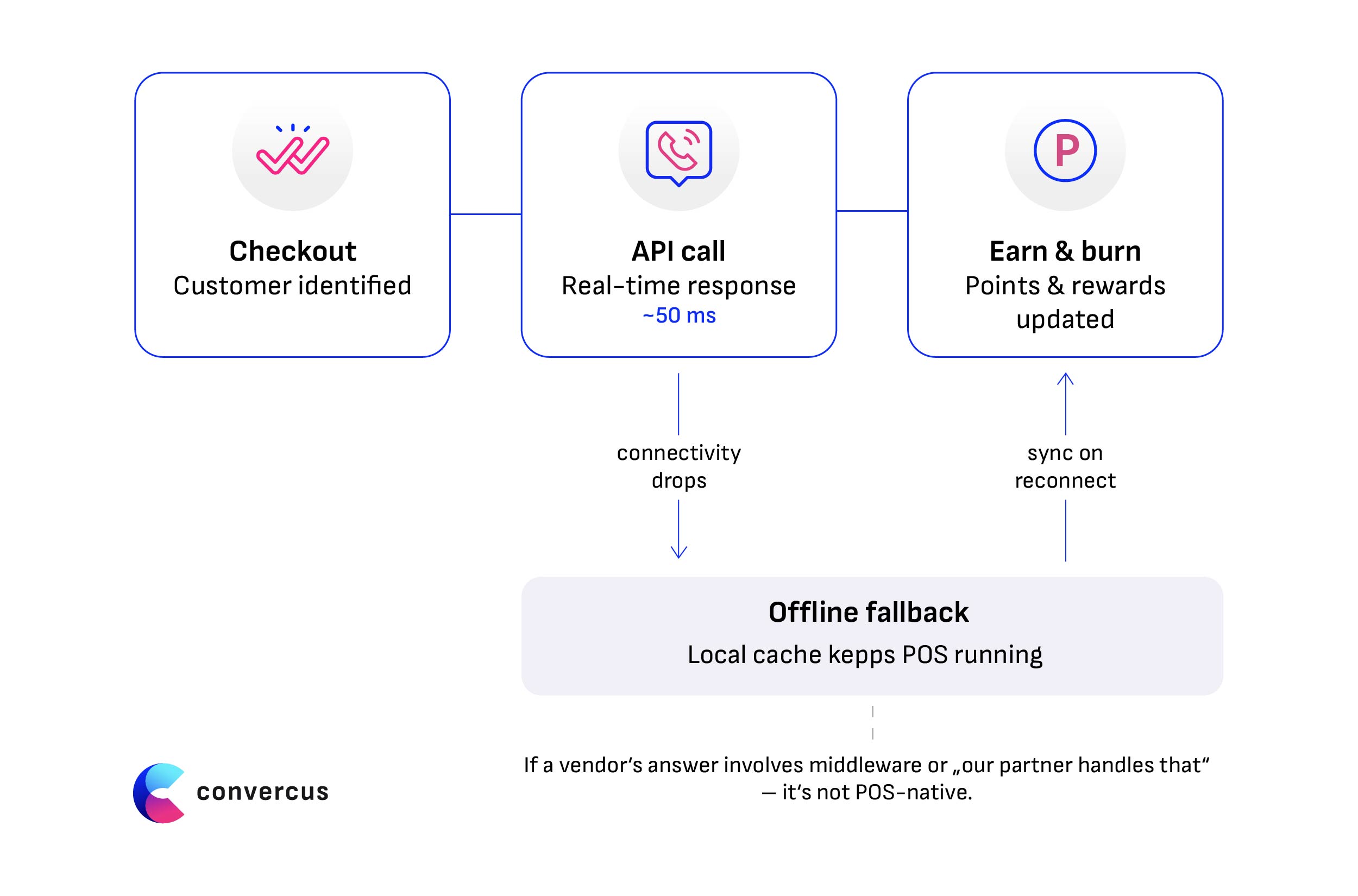
Enterprises running physical retail consistently underestimate POS integration complexity and overestimate how many platforms marketed as "enterprise" can actually handle it at scale. Real POS depth means real-time earn-and-burn across thousands of terminals, offline fallback when connectivity drops, and multi-cash-system support across diverse hardware and software stacks. Most demos skip this entirely.
The stakes are concrete. Fragmented accrual rules across channels cause silent margin leakage, while inconsistent identification at the till breaks customer-level reporting. Use this as a due-diligence lens, not a checklist: ask vendors to walk through a live offline transaction. If the answer involves middleware, custom development, or "our partner handles that," the platform is not POS-native at the depth omnichannel retail actually requires.
Choosing the Right Enterprise Loyalty Platform for Your Channel Mix
Channel fit drives the final shortlist decision. Three buyer situations map to three clear archetype recommendations, summarised in the table below.
For omnichannel retail and e-commerce enterprises looking to increase customer loyalty POS-native infrastructure, Convercus is a natural shortlist entry: structural Success Management drives retention accountability post-launch, and the usage-based pricing model keeps implementation cost low. The concrete next step is a scoping session that tests fit against your channel mix and POS landscape, not a generic demo.
Convercus in Practice: Enterprise Loyalty for Retail and E-Commerce
Platform scale is a key indicator of risk before any demo. For enterprise buyers, proven throughput under real-world transaction loads and low-latency performance across extensive POS networks reduce replatforming risk. The architecture has been tested in complex, high-volume retail environments, addressing the operational edge cases that shortlist evaluations aim to uncover.
The Convercus platform includes built-in Success Management tooling: performance dashboards, optimisation workflows, and retention tracking that remain active post-launch. The next step is a scoping session to assess fit against your channel mix and POS landscape.
FAQ
How much does enterprise loyalty software cost?
Enterprise loyalty platforms typically run on custom pricing in the tens to hundreds of thousands annually. Beyond the SaaS subscription, factor in implementation, rewards liability, admin overhead, and the post-launch agility tax when rule changes require engineering tickets. Convercus uses a usage-based model with low implementation costs.
How long does enterprise loyalty software take to implement?
Sales cycles typically run 3 to 12 months. API-first engines deploy fastest at the rules layer, but POS integration is the single biggest variable and can extend timelines significantly across thousands of terminals. Full suite deployments take longest. Convercus accelerates rollout through a proven onboarding playbook, see what launching a loyalty program involves at each stage.
API-first or suite: which architecture fits omnichannel retail?
API-first gives composability but shifts UI and POS integration work to the buyer's engineering team. Suites reduce integration overhead but limit control and roadmap influence. Omnichannel retail with a significant POS estate typically needs a purpose-built POS-native platform that handles both layers without pushing complexity back to the buyer.
What should I ask vendors before signing the contract?
- Can marketing teams change earning rules post-launch without engineering tickets?
- How does the platform handle safe A/B testing of promotions without margin leakage risk?
- What SLA coverage applies in real-time POS environments, including offline fallback?
- Which cash register systems and hardware stacks are natively supported?
How do I justify enterprise loyalty ROI internally?
Compare customer lifetime value uplift between programme members and non-members against total programme costs: platform fees, rewards liability, implementation, and admin time. According to EY, 41% of corporate loyalty leaders struggle to quantify programme impact, so anchor your business case to concrete benchmarks. Convercus cites 5x ROI and a +274% repeat purchase rate as reference points.
Book a demo with a loyalty expert. Bring your channel mix, transaction volume, and cash-system stack, and we'll map them against the Convercus architecture. No commitment required, no generic demo deck.

40M+ loyalty accounts, 116M+ transactions — see what enterprise-grade looks like.

.png)