







Key Takeaways
- Loyalty Software Online is now a strategic system. It not only manages points and rewards, but connects customer loyalty, first-party data, personalization, and omnichannel processes.
- The selection should not only be based on features. Crucial are TCO, API-first integration, POS capability, data portability, GDPR compliance, and a robust success model.
- A good business case is based on three levers. Repurchase rate, average order value, and churn reduction are the most important metrics to realistically evaluate the ROI of a loyalty program.
- Convercus is a specialized loyalty software for the DACH market. For mid-market and enterprise companies that want to combine loyalty, couponing, engagement, and omnichannel integration, this is a relevant option.
Loyalty Software Online: Why Cloud-Based Customer Loyalty is Business-Critical in 2026
Those searching for "Loyalty Software Online" are usually no longer in the orientation phase but in an active evaluation. They are not looking for simple points management, but a cloud-based platform for customer loyalty, personalization, and omnichannel management. This is understandable: According to Mordor Intelligence, the global loyalty management market is projected to reach approximately USD 16.44 billion by 2026 and is expected to grow to USD 32.52 billion by 2031. For companies in the DACH market, loyalty is no longer a side project but an integral part of their retention, data, and revenue strategies.
Market maturity is also high. According to ECC KÖLN, 86% of retailers already offer a customer loyalty program, and 66% plan to further increase their investments. Businesses that don't operate a modern program today or rely on outdated technology not only lose relevance with existing customers but often also valuable first-party data for personalization and marketing automation.
Market Pressure, Omnichannel, and First-Party Data
KPMG shows how deeply loyalty is embedded in consumers' daily lives: More than 90% of respondents use at least one loyalty program, and in Europe, more than half use such programs for almost every purchase. At the same time, according to ECC KÖLN, 21% of consumers are even bothered when a retailer doesn't offer a loyalty program at all. So, what's expected is not just a program itself, but one that is convenient, immediately understandable, and usable across all channels.
This is precisely where modern Loyalty Software Online distinguishes itself from older systems. Omnichannel orchestration is now a must-have: Collecting and redeeming points must work consistently at the POS, in the online shop, in the app, and ideally also via wallet passes. In parallel, the value of first-party data is massively increasing due to the end of third-party cookie logic. Loyalty thus becomes an infrastructure for data-driven marketing, not just for discounts.
What Current Studies Show for 2026
The Forrester Wave on Loyalty Platforms from Q4 2025 clearly shows where the market is heading: AI-powered personalization and differentiated brand experiences are becoming the new standard. Successful programs combine monetary incentives with status, relevance, timing, and intelligent triggers. While pure discount mechanisms remain important, they are increasingly insufficient as a differentiating factor.
Two other figures from the German market are particularly relevant for practical application: 73% of non-users expect easy registration, and 68% cite cross-channel usability as crucial. This is precisely why many programs fail not due to the idea itself, but due to complex processes, media discontinuities, and rigid legacy systems.
What Loyalty Software Online Must Deliver Today
In practice, Loyalty Software Online usually refers to a SaaS platform that enables companies to design, roll out, operate, and optimize customer loyalty programs. Crucial here is the combination of business logic and technical feasibility. Modern Loyalty Software is far more than a points system: It connects rules, rewards, coupons, segments, data flows, and customer communication within a central architecture.
Typical search triggers are three scenarios: new program launch, replacement of an existing solution, or a functional upgrade of a basic program. Especially in the mid-market and enterprise segments, migrating from legacy technology is the most common case. Here, it's rarely just about new features, but about better scalability, less manual work, and more control over data, rules, and deployment.
The Five Core Modules of a Modern Platform
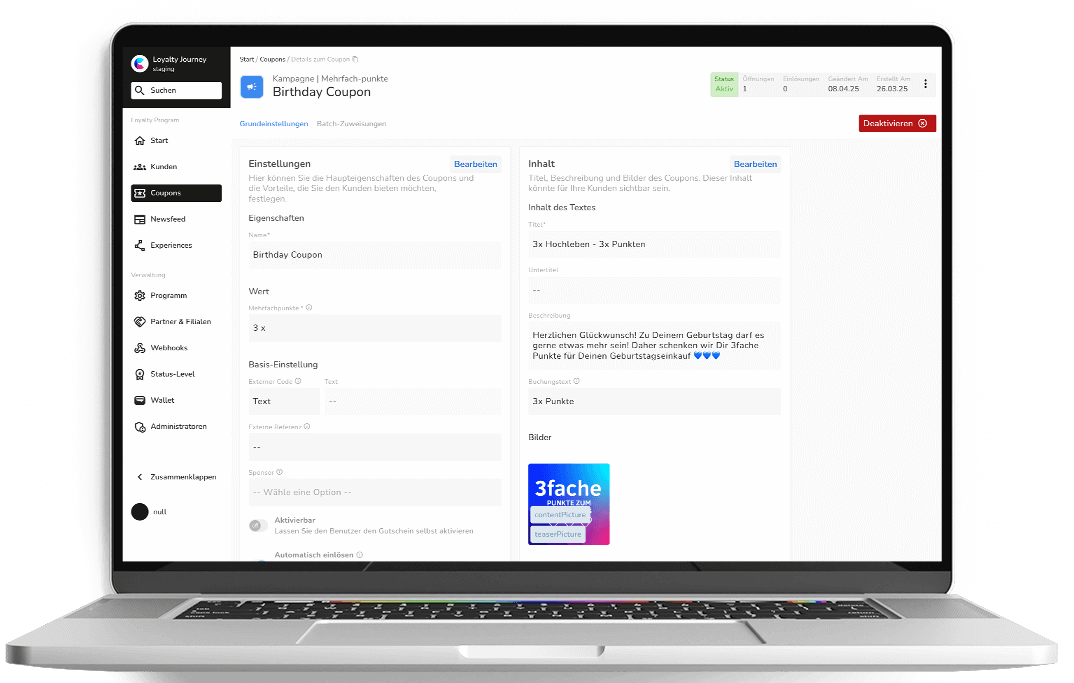
At its core, a good solution consists of five building blocks: Loyalty Engine, Couponing, Engagement, Analytics, and API-first Infrastructure. The Loyalty Engine manages points, status, benefits, and rules. Couponing adds personalized offers and discount mechanisms. Engagement functions activate members via triggers, challenges, wallet passes, or app communication. Analytics provide segmentation, redemption rates, and revenue contributions. The technical infrastructure ensures that all of this runs in real-time across existing systems.
If you wish to delve deeper into these building blocks, you can find further information on Loyalty, Couponing, Engagement and Tech & Integration. Additionally, the article on Customer Loyalty Softwareprovides a concise overview of the topic.
Loyalty Software vs. CRM vs. Marketing Automation
A CRM primarily stores customer master data, contacts, and interactions. Marketing automation orchestrates campaigns, messages, and journeys. Loyalty Software decides in real-time which reward, status, or coupon applies to which behavior. It is therefore the operational logic behind customer loyalty.
In practice, these systems must work together seamlessly. The CRM knows the customer, the loyalty platform knows the program behavior, and marketing automation implements the communication. Anyone attempting to manage loyalty exclusively within a CRM or via an email tool will quickly encounter limitations regarding rule sets, POS redemption, status management, or coupon lifecycle.
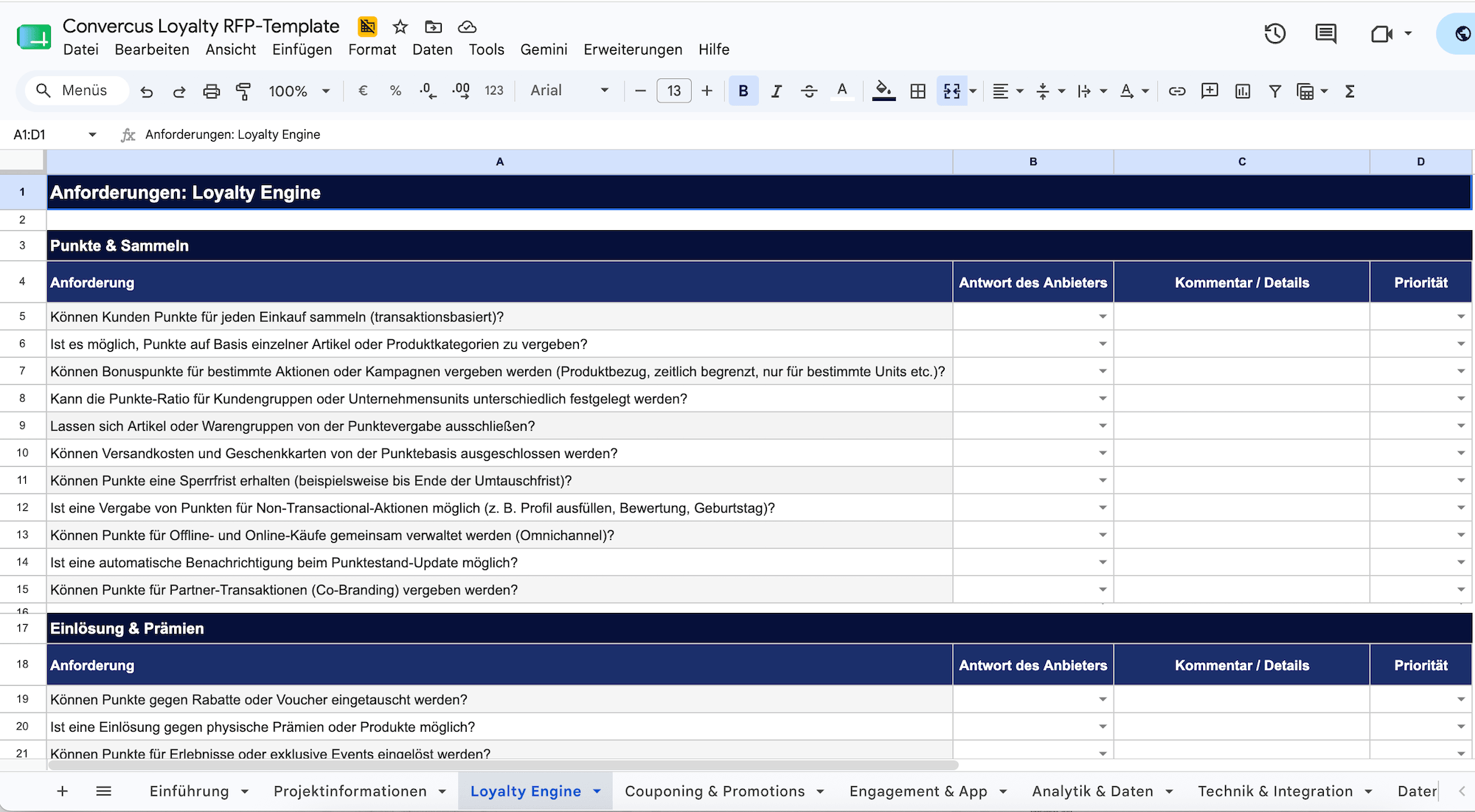
What Requirements Companies Should Place on Loyalty Software Online
The right platform heavily depends on company size, industry, and maturity level. An omnichannel retailer with 100 stores and 500,000 members has different requirements than a pure D2C brand. In an enterprise context, it's not just about features, but scalability, integration capabilities, and governance. In the mid-market, however, time-to-value, low IT burden, and usability are often more prominent.
Business Requirements for Marketing, CRM, and Operations
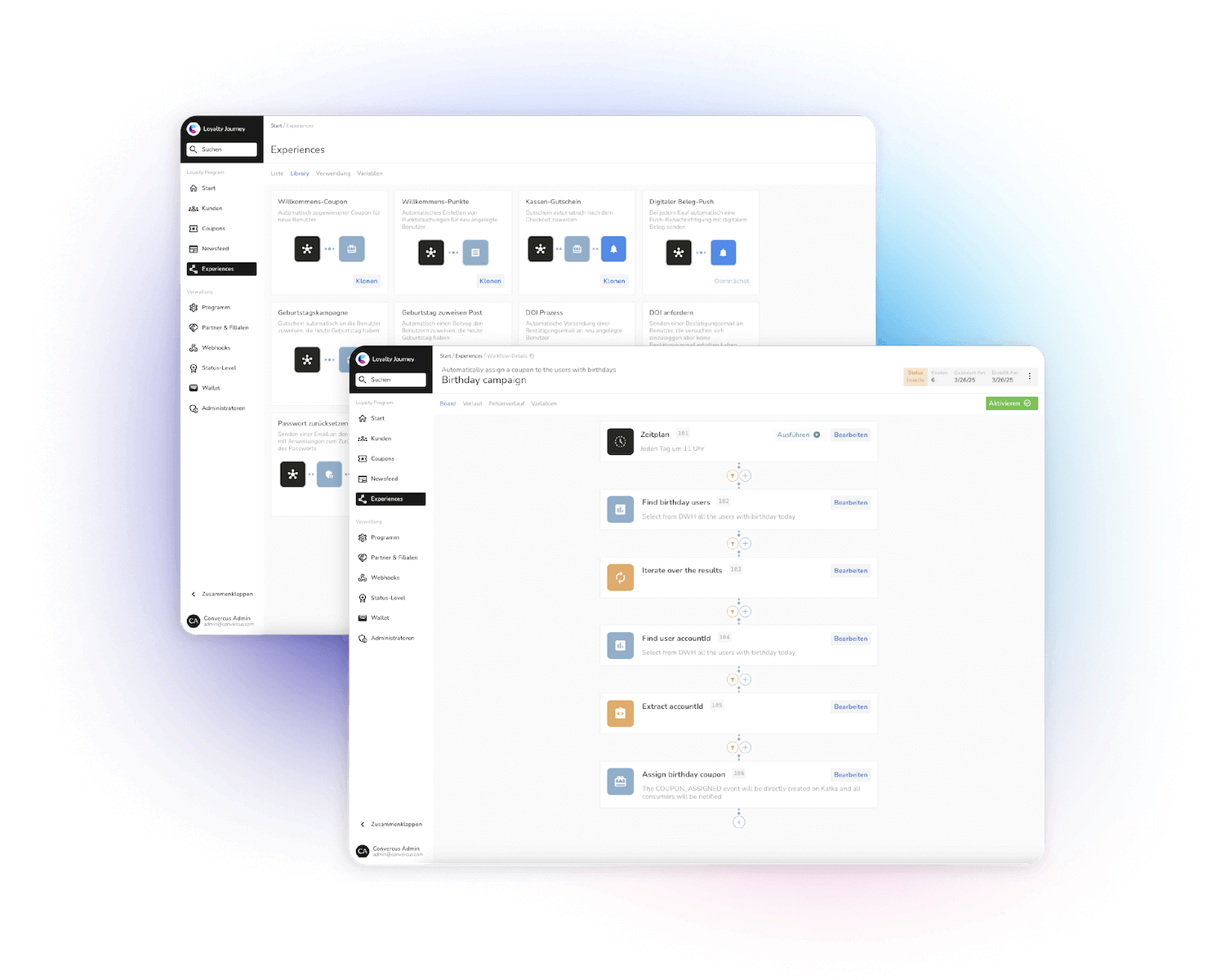
- A good platform must be able to map points, status levels, benefits, and rules in such a way that business departments can further develop programs without permanent IT dependency.
- Couponing should function across all channels so that offers are consistently delivered at the POS, in the online shop, in the app, or via wallet passes.
- Segmentation and personalization must be possible based on behavior, purchase history, and preferences, instead of treating all members identically.
- Reporting should make repurchase rates, redemption rates, active member share, and revenue contributions visible without manual Excel workarounds.
- Gamification, challenges, and status-related benefits are important where programs aim to build emotional loyalty beyond mere discounts.
Relevance in the moment is particularly important here. 80% of surveyed consumers desire immediately redeemable benefits, which has direct implications for reward design, couponing, and real-time capabilities. A program whose benefits only become visible days later quickly loses its impact in everyday use.
Technical Requirements for Product Owners and IT
Technically, companies should primarily focus on API-first, cloud-native architecture, and robust POS integration . Loyalty typically touches the shop, POS, app, CRM, ERP, data platform, and marketing systems. The more rigid the architecture, the more expensive future adaptations will be. Especially with high transaction volumes, low latency, fault tolerance, and offline capability are crucial.
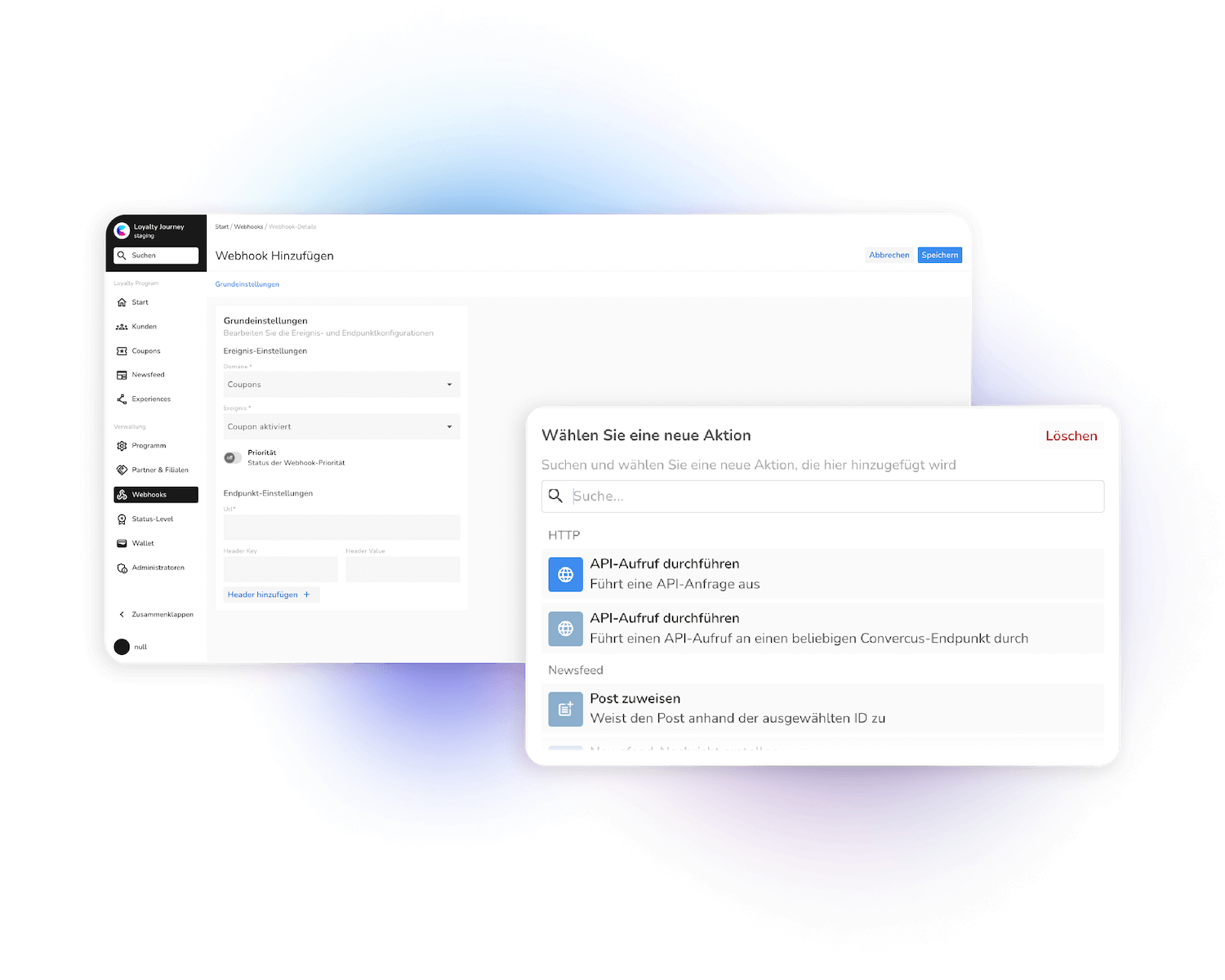
- Open APIs and webhooks are important so that loyalty logic does not remain in an isolated system.
- The system should remain stable even during peak loads, for example, during promotional campaigns, nationwide campaigns, or seasonal peaks.
- Role-based access control, audit trails, and documented processes facilitate governance in larger organizations.
- Multilingualism, international rollouts, and flexible rule sets are mandatory when brands scale across countries, stores, or concepts.
In practice, a Proof of Concept is particularly worthwhile when complex touchpoints need to interact. Those who promise omnichannel should genuinely connect the online shop, POS, and app in testing and not just demonstrate it in slides.
The Most Important Evaluation Criteria: Features Are Not Enough
Many selection processes fail because providers are only compared based on feature lists. That is rarely sufficient. Total Cost of Ownership, data portability, and team acceptance are often more important in a real project than the tenth gamification feature. Especially with contract terms of three years or more, the focus should extend beyond just the license.
TCO Instead of Mere License Consideration
With Loyalty Software Online, costs arise not only from the contract but throughout the entire lifecycle. Usage-based models can increase significantly with a growing number of members, API load, or store count. Therefore, every shortlist should include a 3- to 5-year perspective, including growth scenarios.
Vendor Fit, Success Management, and Data Portability
Especially in the enterprise segment, the following applies: The partner is almost as important as the platform itself. Therefore, don't just ask about features, but also about the implementation process, role model, response times, roadmap transparency, and industry-specific experience. A very powerful system is of little help if business departments can barely operate it in daily use.
- Specifically ask how customer profiles, point balances, and transaction histories can be exported should a vendor change become necessary.
- Ask to be shown how business teams manage rules, coupons, and segments in the backend, instead of just seeing the administrator view.
- Check whether success management is part of the model or if strategic support is only available as an additional service.
- Evaluate references based on industry fit and complexity, not just brand recognition.
A good evaluation process therefore does not end with a demo. What's crucial is how effectively a provider can map your target vision of strategy, operations, and technology.
Loyalty Software Online Comparison: Relevant Providers for the DACH Market
The following overview does not replace an RFP but helps with initial classification. The best loyalty software is not the one with the most features, but the one that best fits your business model. For DACH companies, omnichannel capability, POS expertise, data protection, rollout competence, and local project experience are particularly important.
How to create a robust shortlist from a longlist
For a robust shortlist, it's usually enough to weigh five criteria: functional fit, technical fit, operations & support, TCO, and industry references. After three to five demos at the latest, the differences should clearly align with your target vision,not on general product promises. Anyone who still evaluates ten providers in parallel after that usually hasn't defined the requirements sharply enough.
It's also advisable to differentiate between must-have and nice-to-have criteria. For example, POS integration, real-time redemption, GDPR compliance, and data exports can be must-have criteria, while gamification depth or certain frontend options are considered nice-to-have criteria. This accelerates decisions and makes RFPs significantly more precise.
ROI and Business Case: How Online Loyalty Software Pays Off
The investment in online loyalty software should always be viewed as a business case, not just a software purchase. The key levers are repurchase rate, average basket size, and churn reduction. In addition, there are indirect effects such as better consent rates, more first-party data, and reduced communication wastage.
The three most important revenue drivers
Especially in retail and omnichannel models, loyalty effects can usually be modeled well. A program doesn't work simply because points exist, but because it steers behavior: higher purchase incentives, increased frequency, better reactivation, and higher redemption of personalized coupons. Even conservative improvements can generate a noticeable impact on results.
How quickly a loyalty program can pay for itself
A loyalty program rarely pays off immediately, but it doesn't take years either. Realistic payback periods are often around 6 to 18 months, depending on the industry, frequency, initial situation, and rollout quality. Programs in grocery retail or fashion often show results faster than models with infrequent purchase frequency, for example, in the DIY sector.
It's important to define baselines before launch: active customers, repurchase rate, churn, AOV, coupon redemption, app usage, and revenue per member. Only then can you accurately assess the program's actual impact later on. If you want to read more about how to operationally increase retention, you'll find relevant insights in the articles on enhancing customer retention and customer re-engagement.
From Selection to Implementation: How a Loyalty Project Works in Practice
In practice, loyalty projects usually start for one of three reasons: new implementation, replacement of a legacy system, or expansion of an existing program to include an app, couponing, or automation. The biggest risk is rarely in the concept, but in integration, migration, and operational handover. That's precisely why companies shouldn't separate selection and implementation, but view them as a cohesive process.
A Practical Evaluation and Implementation Process
- First, define the program's goals, such as repurchase rate, member revenue share, data acquisition, or reactivation.
- Then create a target vision for the system landscape, including POS, shop, app, CRM, ERP, and consent processes.
- Consolidate requirements into must-have and nice-to-have criteria to make demos and RFPs comparable.
- In the Proof of Concept, test real omnichannel scenarios, i.e., collecting, redeeming, and status changes across multiple touchpoints.
- Plan migration and testing phases early, especially for point balances, coupon histories, and member communication.
- Agree on clear KPI reviews after go-live so that the program can be further developed based on data.
The quality of a platform and the project team is particularly evident during migration. The transfer of customer profiles, points, and transaction histories is usually the most critical sub-project. In addition, there are trainings for specialist departments, clear approval processes, and robust monitoring routines after launch.

Properly Implement GDPR, Consent, and POS Integration
Anyone processing loyalty data must consider data protection in a structured way from the outset. Particularly relevant are Art. 5 GDPR, Art. 6 GDPR, Art. 7 GDPR, Art. 25 GDPR, Art. 28 GDPR, and Art. 32 GDPR. This concerns data minimization, legal bases, demonstrable consents, Privacy by Design, data processing agreements, and technical and organizational measures. For tracking in web and app, § 25 TTDSG is also often relevant in Germany when information is stored or accessed on end devices.
Operationally, this means: consent status must be available across all systems, data flows must be documented, and personalized communication may only run on a sound legal basis. At the same time, data protection and a good experience should not be contradictory. Wallet passes and mobile touchpoints can be particularly efficient here because they make loyalty functions easily accessible. You can find more in-depth perspectives on this in the articles on App-first Loyalty and Technology & Integration.
Conclusion: The Right Online Loyalty Software is a Growth Lever, Not a Secondary System
The most important insights are clear: Online loyalty software is now infrastructure for retention, first-party data, and omnichannel experience. Anyone who wants to be successful in 2026 should not only compare features but jointly evaluate strategic fit, TCO, integration capabilities, data protection, and operational rollout. This is precisely what distinguishes good decisions from expensive platform changes after just a few years.
If you are looking for a solution that brings together loyalty, couponing, engagement, and API-first integration for mid-market and enterprise, Convercus is an obvious option for the DACH market. Through a personal live demo you can check how your target vision can be specifically realized technically and functionally.
FAQ on Online Loyalty Software
The most common questions in selection processes revolve around effort, costs, integration, and data protection. The following answers summarize the key points concisely.
What does Online Loyalty Software cost?
The costs are almost never just the license fee. Also relevant are implementation, integration, migration, support, and potentially usage-based pricing components such as member count, stores, or API volume. Therefore, a TCO analysis over 3 to 5 years should always be performed.
How complex is the implementation of a loyalty program?
The effort primarily depends on the system landscape and rollout goals. A lean setup is ready much faster than an omnichannel project involving POS, app, e-commerce, CRM, and data migration. In any case, clear goals, defined must-have criteria, and a robust POC accelerate the process.
Is loyalty software GDPR-compliant?
GDPR compliance is not a single feature, but the result of architecture, processes, and contracts. Important elements include sound legal bases, documented consents, data processing agreements, role and rights concepts, and technical protective measures according to Art. 32 GDPR. For tracking in web and app, § 25 TTDSG may also be relevant.
Does loyalty software work with our existing POS system?
In many cases, yes, but the quality of the integration determines success. Therefore, don't just check if an interface exists, but whether points, coupons, and status changes are synchronized in real-time or at least robustly. Especially at the POS, offline scenarios and fault tolerance are important.
Can we migrate an existing program?
Yes, but migration is usually the most critical part of the project. Point balances, profiles, consent data, coupon histories, and status logic must be consistently transferred. Companies should develop a migration concept early on, including tests, cut-off dates, and fallback scenarios.
What's the practical first step?
Start with three to five target KPIs and a clear target vision. If repurchase rate, AOV, churn, and data acquisition are clearly defined, requirements, vendor evaluation, and the business case can be derived much more precisely. Only then should the actual tool shortlist be created.


- 5x Return on Investment
- 80% Customer Identification
- 8x Customer Interaction
- +274% Repurchase Rate

.jpg)