Customer loyalty in grocery retail
Anyone competing in grocery retail today knows the problem: high footfall, but little customer insight. Without your own loyalty program, what your customers buy, when they return, and why they switch to a competitor remains invisible. Convercus provides grocery retailers with the platform to turn anonymous transactions into genuine customer relationships.

50+ mid-market and enterprise companies rely on Convercus for loyalty & couponing








Maximum efficiency: Quick ROI and outstanding results
Return on Investment
customer identification
Shopping cart value
customer interaction
Repurchase rate


Increase visit frequency: Rewards & couponing mechanics
Weekly flyers and price promotions drive short-term footfall, but they don't build genuine loyalty. As soon as a competitor offers a better price, the customer switches. Digital loyalty mechanics, by contrast, focus on recurring incentives, individual relevance, and measurable impacts on visit frequency and basket size.

Collect and redeem points: Directly at the checkout in real time, even offline. The POS integration keeps checkout times short and runs without interruption, even during high transaction volumes.
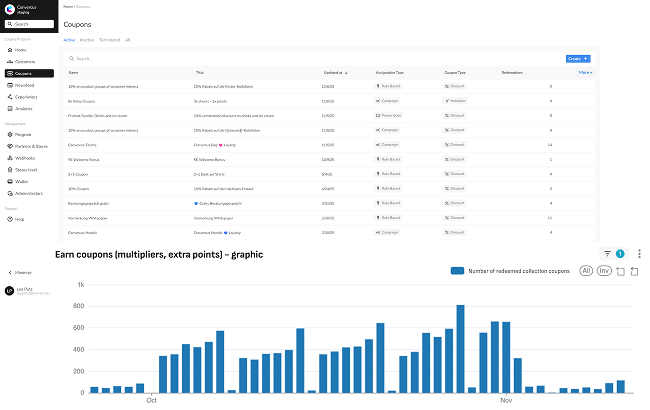
Personalized coupons instead of mass leaflets: The couponing module delivers offers based on individual shopping behavior. This increases redemption rates and reduces the waste associated with traditional flyers.
Bonus campaigns for repeat purchases: Flexible rules and status models reward specific baskets, categories, or frequency thresholds. This creates predictable incentives for the next visit.

.png)

From anonymous receipt to customer profile: building first-party data
In grocery retail, most transactions remain anonymous: receipt printed, customer gone, no knowledge of preferences or frequency. A Loyalty program enables identification at the POS and builds a proprietary, GDPR-compliant database that remains usable independently of third-party platforms.
Purchase behavior as a data foundation: Preferences, frequency, and spending patterns become visible for each customer. This is the foundation for targeted Personalization instead of blanket campaigns.
Dedicated communication channel: Apps and push notifications reach customers directly, without advertising costs on third-party platforms. The Convercus engagement module bundles these touchpoints into one system.
Segmentation and campaign management: AI data insights provide segments based on value, frequency, and category. Campaigns become measurable, with clear ROI transparency for every promotion.
Integration into existing POS systems: Go live quickly without an IT project
Complex POS landscapes are a reality in grocery retail: many locations, high staff turnover, and high transaction frequency. Convercus solves this with an API-first approach, which connects existing POS systems without requiring a months-long IT project.
POS integration, including offline capability: With a 50 ms API response time and 20,000 connected POS systems, checkout times remain short. In the event of network issues, operations continue without interruption thanks to offline capability.
No-code configuration: Marketing and CRM teams configure rules, campaigns, and coupons independently. This eliminates the need for IT tickets and allows new mechanics to go live faster.
White-label app as a touchpoint: A brand-specific app can achieve up to 8 times higher customer engagement compared to programs without an app. Push notifications and coupons are consolidated in a single interface.
.png)
The strengths of Convercus for the grocery retail sector
Instead of blanket flyer campaigns, the platform delivers personalized offers based on purchasing behavior via app or push notification. This increases redemption rates and reduces the waste associated with traditional inserts.

The platform processes over 116 million transactions with an API response time of approximately 50 ms. This ensures that checkout processes remain stable even during peak times, and store networks with high transaction volumes run without noticeable latency.

Data protection is structurally embedded in the platform, not added as an afterthought. GDPR and the highest security standards are our foundation. This allows for legally compliant first-party data without the need for separate compliance workarounds.
What can you achieve with Convercus in grocery retail?
Measurably increase shopping frequency
Increase basket size through targeted coupons and promotions
Identify customers and engage them directly
Let's find out!
In a personal demo, we will show you what kind of impact on footfall and basket size is realistic for your store network.

FAQs
Frequently asked questions about customer loyalty in grocery retail
Ja. Loyalty-Programme steigern Einkaufsfrequenz und Warenkorbwert, was den Deckungsbeitrag stärker hebt als pauschale Preisreduktionen. Wer Kunden mit relevanten Anreizen zur nächsten Transaktion bewegt, muss weniger über den Preis kämpfen. Das erfolgsbasierte Preismodell von Convercus hält die Einstiegshürde niedrig.
Moderne Loyalty-Plattformen binden sich über einen API-First-Ansatz direkt an bestehende POS-Systeme an. Im Lebensmitteleinzelhandel ist Offline-Fähigkeit entscheidend, damit Punkte auch bei Netzstörungen verbucht werden. Convercus betreibt rund 20.000 angebundene POS bei 50 ms API-Response. Ein monatelanges IT-Großprojekt ist dafür nicht nötig.
Zentrale KPIs sind Wiederkaufrate, Warenkorbwert, Kundenidentifikationsrate, Einlöserate, Einkaufsfrequenz und Churn Rate. Diese Kennzahlen sind im Lebensmittelhandel besonders aussagekräftig, weil die Transaktionsfrequenz hoch und der Großteil der Käufe ohne Loyalty-Programm anonym bleibt. Die AI Data Insights von Convercus werten diese KPIs automatisiert aus und liefern Segmente in Echtzeit.
Beide Mechaniken erfüllen unterschiedliche Ziele. Punkteprogramme stärken langfristige Kundenloyalität und Einkaufsfrequenz über kontinuierliche Anreize. Couponing erzeugt kurzfristige Kaufimpulse und erlaubt Personalisierung bis auf Produktebene. Im Lebensmitteleinzelhandel hat sich die Kombination beider Mechaniken als Best Practice etabliert. Convercus bündelt Punktesystem und Couponing in einer Plattform.
Personalisierung basiert auf Kaufhistorie, Frequenz und Produktpräferenzen pro Kunde. Daraus entstehen individuelle Coupons für bevorzugte Kategorien wie Bio oder Tiernahrung, Statusanreize für Vielkäufer und Push-Nachrichten zu passenden Wochenangeboten über die App. Das Convercus Engagement-Modul bündelt dafür Marketing Automation und AI Data Insights in einer Plattform.

