







The topic in brief
- Strategic Instrument: A loyalty program is far more than just a discount system – it combines data, personalization, and long-term customer loyalty to become a true growth driver.
- Five Program Types: Point systems, tiered models, club models, coalition programs, and gamification cover various industries and target groups.
- Measurable Results: Companies with strong customer loyalty significantly reduce acquisition costs and increase customer lifetime value.
- Most Common Mistakes: Over-complexity, irrelevant rewards, and a poor fit for the target audience jeopardize program success.
- Convercus as Your Loyalty Partner: With a modular Loyalty Engine, omnichannel capabilities, and proven success management, Convercus implements customized programs for medium-sized and large companies, scalable from growing retailers to enterprise clients.
Your points program is active, members are diligently collecting, but the impact on repeat purchases and customer retention is stagnating. You're wondering if a tiered model, a club model, or perhaps gamification would better suit your company. This guide addresses precisely that: It shows you what types of loyalty programs exist, where common pitfalls lie, and how to find the right model for your target audience. Convercus supports you as your loyalty partner from question to solution.
What is a Loyalty Program? Definition, How it Works, and Benefits
A loyalty program is a structured customer loyalty system, which rewards customers for repeated interactions and thus builds long-term relationships between brand and customers. The crucial difference from a pure bonus program: While discounts and vouchers focus on short-term incentives, a loyalty program links benefits with data, personalization, and strategic relationship management.
The basic principles are clear: Identify behavior, respond strategically, customize benefits. Payback, as the best-known German example, demonstrates how this works: Far beyond simply collecting points, the system delivers personalized offers based on actual purchasing behavior. But what exactly are the mechanisms behind it?
How Does a Loyalty Program Work?
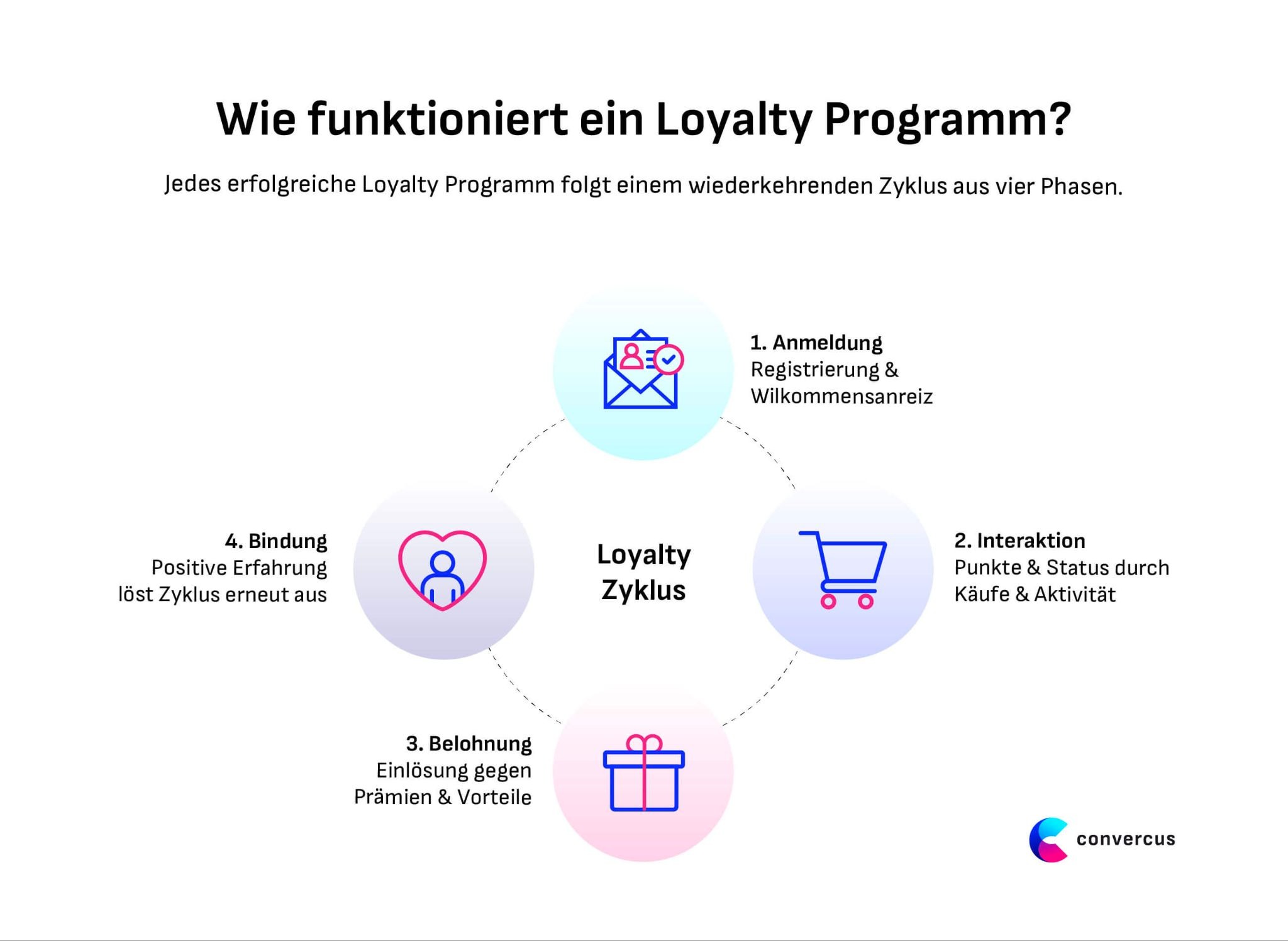
Whether it's a points program, cashback, or a status model: At its core, every loyalty program follows a recurring cycle of four phases:
- Registration: Customers register and receive a welcome incentive such as bonus points or a starting credit.
- Interaction: With every purchase, referral, and activity, points or status grow.
- Reward: Collected points are redeemed for rewards, or status benefits are used.
- Retention and Reactivation: The positive experience triggers the cycle again, starting from Phase 2.
What makes this cycle strategically valuable is the data behind it. Every transaction provides first-party data on preferences, purchasing patterns, and touchpoints. These form the basis for personalization and Marketing Automation. Crucial here is omnichannel capability: The program must be consistently experienced across all channels, whether at the POS, in the app, in the online shop, or via email.
Why Loyalty Programs Truly Retain Customers
Behind a successful customer retention strategy Underlying this are psychological and economic mechanisms that reinforce each other. Those who understand why customers stay can build loyalty strategically, rather than hoping for chance.
Mechanisms that retain customers include, for example:
- Endowment Effect: Collected points feel like ownership. Customers are reluctant to give up what they already 'have'.
- Status Motivation: Advancing to higher tiers creates ambition and loss aversion.
- Reciprocity: Rewards create a desire for reciprocation, for example, through the next purchase.
- Emotional Connection: Customers with an emotional connection to the brand have a significantly higher Customer Lifetime Value.
This has positive results:
- Acquisition Costs: Acquiring new customers costs 5 to 7 times more than a retention measure.
- Retention Lever: Even a 5% higher retention rate can increase profitability by 25–95%, as confirmed by the Harvard Business Review.
Points System, Club Model, or Gamification: Which Type of Loyalty Program Suits You?
Not every loyalty program suits every company. The decision for the right model depends on industry, purchase frequency, target audience, and strategic goals. The following comparison table provides an initial orientation before we examine each type in detail.
Points-Based Loyalty Programs
The principle is remarkably simple: Customers collect points per purchase or interaction and redeem them for rewards, discounts, or experiences. It is precisely this simplicity that makes points-based programs the most popular type of loyalty programs. They are easy to understand, enjoy high acceptance, and can be easily scaled.
Typical industries include retail, fashion, food, and drugstores. Well-known examples like Payback, IKEA Family, or Lidl Plus demonstrate how broadly applicable this model is. It is particularly suitable if your company has a high purchase frequency, a broad target audience, and aims to increase repeat purchase rates.
The Convercus Loyalty Engine enables flexible points rules, which are based on actual customer behavior: from simple collection mechanics to behavior-based bonus points.
Tiered Models and Status Programs
Tiered models leverage a strong psychological lever: status motivation and loss aversion. Customers advance to higher tiers through activity and receive increasingly exclusive benefits. Once Gold status is achieved, members are reluctant to fall back. Well-known examples include Miles & More or Sephora Beauty Insider with its Insider, VIB, and Rouge tiers.
Typical status benefits include:
- Priority service and preferential treatment
- Exclusive offers and early access
- Lounge access or premium experiences
- Higher point multipliers per purchase
This model is particularly suitable for airlines, hotels, e-commerce, and premium retail, where varying customer values require differentiation. The goal: Create incentives for higher spending and visibly reward valuable customers. The Convercus Status Management enables precisely that with flexible tier rules and automated ascent and descent mechanisms.
Club Models and Membership Programs
In club models, customers become members, whether free or paid, and receive exclusive benefits that are unavailable to non-members: free shipping, early access to new products, or exclusive content. Amazon Prime, with over 200 million members is the best-known example.
The benefits for companies lie in strong community building, higher emotional engagement, and predictable customer value. Consumers are sometimes more likely to renew if they perceive the offer as a 'membership' instead of perceiving it as a 'subscription'. The right framing can make a difference depending on the target audience.
Club models suit brands with a strong identity that want to build long-term relationships and a loyal community. Convercus supports membership models with flexible benefit structures, a white-label app, and seamless omnichannel integration across all channels.
Coalition Programs and Partner Loyalty
Coalition programs bring multiple brands or retailers together under a common loyalty system. Customers collect and redeem across brands, which significantly increases the program's appeal. Payback, as Europe's largest multi-partner program, and DeutschlandCard are the best-known examples in German retail.
The advantages are clear: greater reach, shared costs, and more redemption options for customers. A clear trend shows that loyalty is increasingly organized at the retail group level. Programs spanning multiple brands and channels are gaining importance.
This model is suitable if you manage multiple brands under one roof and aim for reach and cross-selling. Convercus Partner Programs enable the integration of external partners with their own point logic and cross-channel redemption, as successfully implemented by EURONICS with multi-POS connectivity. The integration of individual benefits from partner companies is also possible.
Gamification-based Programs
Gamification introduces playful elements into customer loyalty: challenges, badges, progress bars, and rewards for non-transactional actions such as reviews, social shares, or quiz participation.
Typical industries include app-based business models, lifestyle, and sports. Fitness apps with streak rewards or retail apps with weekly challenges demonstrate how interaction beyond mere purchasing is encouraged. This model is suitable if your goal is to increase engagement and interaction frequency
Convercus Gamification & Challenges offer configurable game mechanics that seamlessly integrate into existing loyalty programs. This allows you to playfully increase customer engagement without having to build an entirely new program.
Why do loyalty programs often fail? Common mistakes in loyalty programs
Many loyalty programs don't fail because of the idea, but because of the execution.. The good news is: the most common mistakes can be avoided if you know them. Three challenges consistently emerge:
- Over-complexity: Too many rules, tiers, and exceptions cause customers to lose track and ignore the program. The solution: simplicity in the customer experience, complexity only in the backend. Your customers should understand how to collect and redeem points in seconds.
- Lack of relevance: Rewards and offers that don't match actual purchasing behavior are simply ignored. The solution: data-driven personalization of rewards based on real customer data and interactions.
- Poor data quality: Incomplete or duplicate customer data undermines any personalization from the outset. The solution: a clean data foundation, combined with continuous maintenance and clear processes for data collection.
Good loyalty program, wrong target audience – Leverage what truly fits
A frequently overlooked mistake: The program functions perfectly from a technical standpoint, but doesn't suit the target audience.. A gamification approach for an older customer base with low app affinity misses its mark just as much as a complex tiered model for a business with low purchase frequency, while for B2B Loyalty yet other conditions apply.
The decision for a program type must stem from the behavior and expectations of your customers, not from trends. That's precisely why Convercus starts every project with a situation analysis and goal definition before recommending a model. This way, the program fits the company, not the other way around. But even the best concept needs the right technical foundation.
What criteria should you use to select loyalty program software?
79% of companies with existing loyalty programs plan to overhaul their systems in the next three years. The decision for the right software is therefore business-critical and deserves a structured evaluation. These six criteria will help you find the right solution:
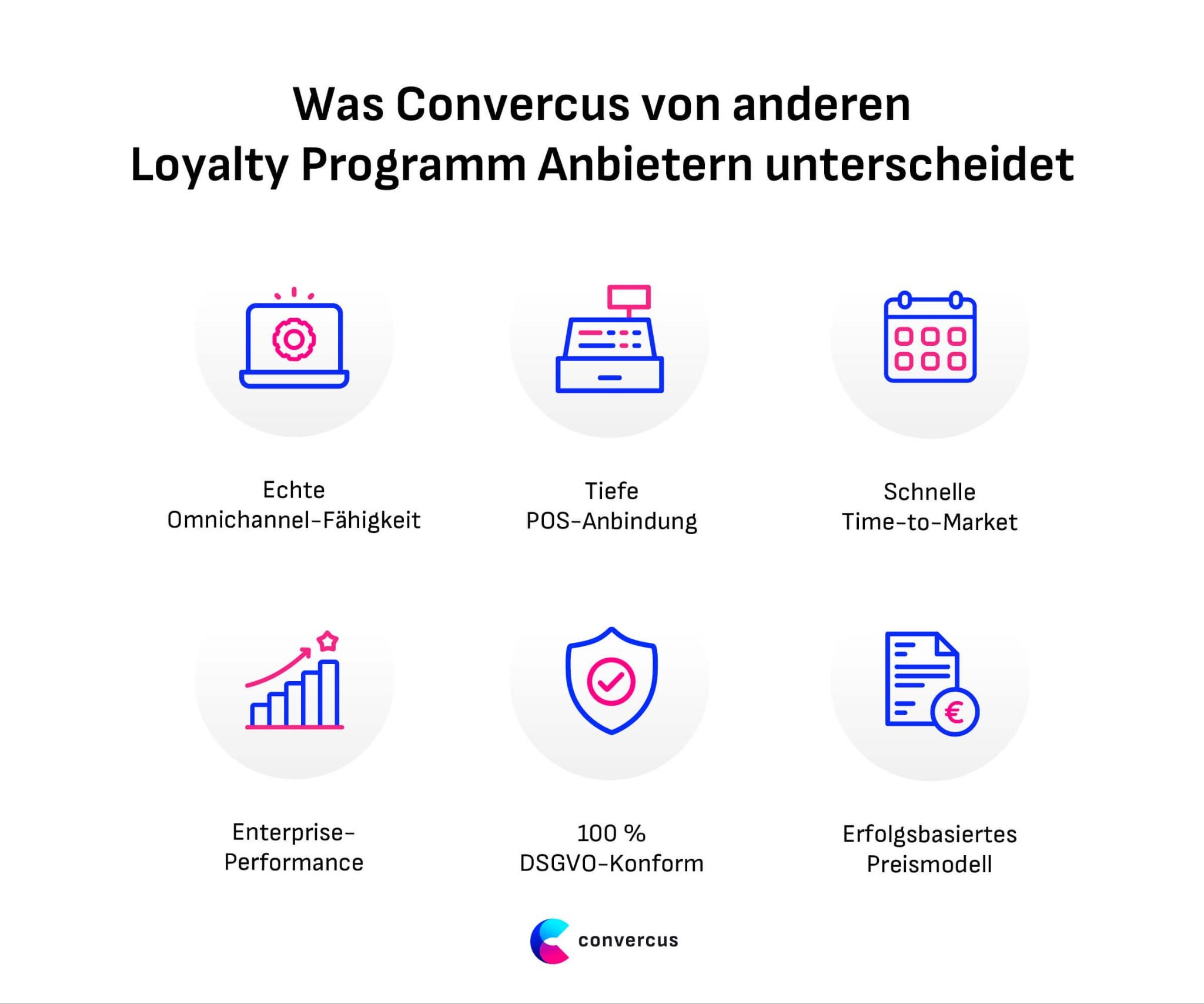
- System Landscape & Integration: How well can the software be integrated into existing CRM, POS, and e-commerce systems? An API-first approach is key for minimal IT effort and flexible connectivity.
- Program Type Flexibility: Does the platform support various models such as points, status, and gamification, even in combination?
- Omnichannel Capability: Does the program work seamlessly across all channels, whether POS, app, online shop, or email?
- Data Protection & GDPR: Is the solution 100% GDPR compliant? How are consents and first-party data managed?
- Scalability & Performance: Can the platform handle millions of transactions and international rollout?
- Support & Success Management: Is there strategic guidance after go-live, not just technical service?
Convercus meets these criteria with an API-first architecture, modular design, and 50 ms API response time. The platform is 100% GDPR compliant and is complemented by a proven success management model. Book a Demo, to experience the platform live.
Conclusion: The best loyalty program is the one that fits you
There isn't one perfect loyalty program. But there is the right one for your company. Three factors are crucial: a clear target group fit, simplicity in the customer experience, and a data-driven reward structure. The choice of the right model and technology determines whether your program creates genuine customer loyalty or ends in loyalty fatigue. In the coming years, AI-powered personalization, seamless omnichannel integration, and consistent simplicity will shape the programs that succeed in the competitive landscape.
FAQ
What types of loyalty programs are there?
The most common types are points-based programs, tiered models with status levels, club models with membership, coalition programs across multiple brands, and gamification-based programs with playful elements. Which model fits depends on the industry, purchase frequency, and target audience. When introducing a loyalty program this should be taken into account.
Which loyalty programs are successful?
Points-based programs achieve the highest activation rates for purchase frequencies of 6 transactions or more per year. Tiered models are particularly suitable for the premium segment: according to industry benchmarks, customers in the highest tier generate 3–4x more revenue than basic members. Membership programs like Amazon Prime demonstrate that perceived long-term value reduces churn rates more effectively than transactional incentives.
What is the difference between a loyalty program and a customer retention program?
In general usage, both terms are used synonymously. A loyalty program emphasizes customer loyalty, while a customer retention program focuses on the strategic aspect of retention. Crucially, both describe structured systems that reward customers for repeated interactions and build long-term relationships.
At what company size does professional loyalty program software become worthwhile?
Professional loyalty software becomes worthwhile as soon as manual processes reach their limits and data-driven personalization is to become a real competitive advantage; the timing for this varies depending on the industry and business model. Convercus supports companies of various sizes with scalable solutions that grow with their requirements.
How do you know if a loyalty program truly works and isn't just active?
Key indicators include KPIs such as repurchase rate, Customer Lifetime Value, redemption rate, and active member ratio — not just the number of registered participants. A program is effective when it changes measurable behavior: more frequent purchases, higher average order values, and stronger customer loyalty.
Discover how Convercus customizes your customer loyalty program – with personal consultation and proven technology.
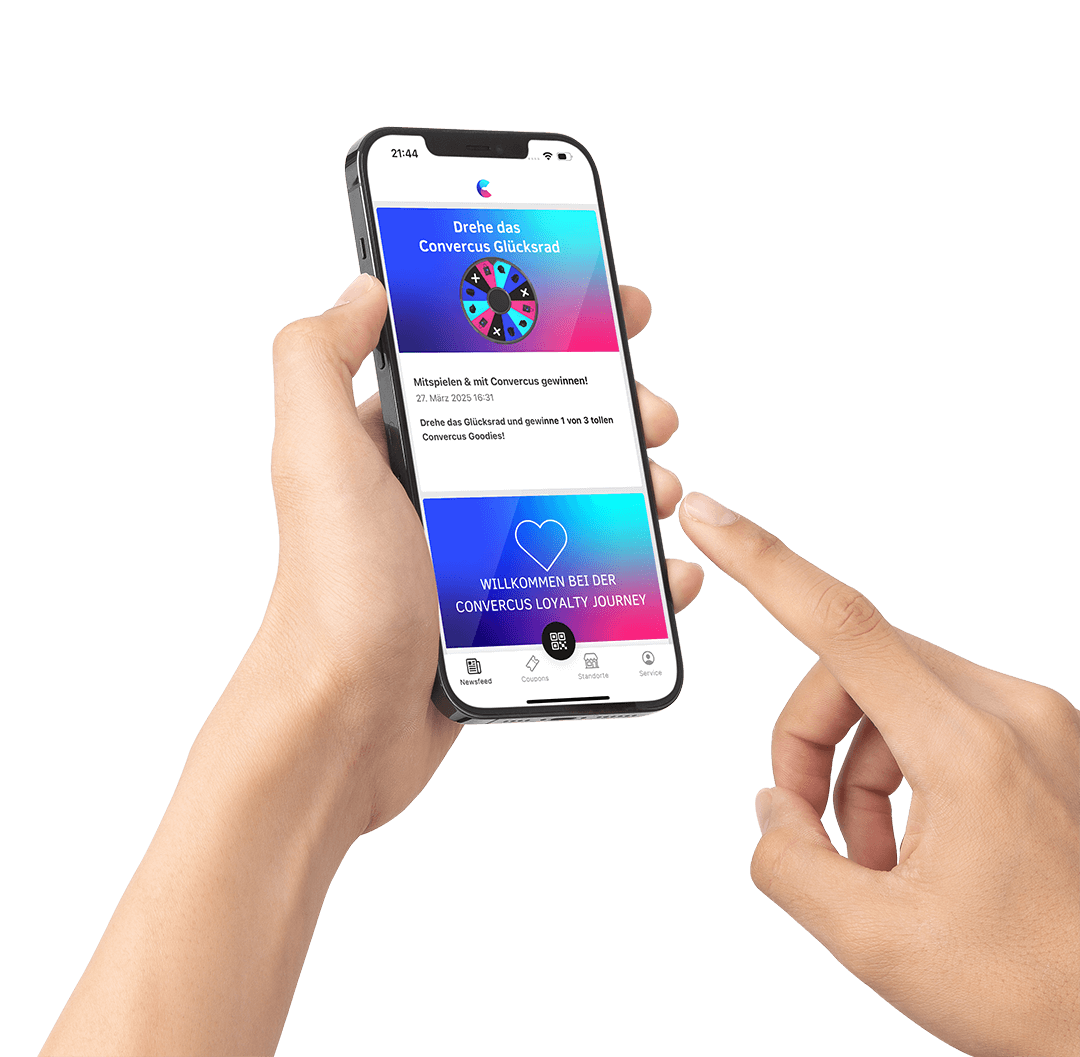

Many companies underestimate the powerful interplay between emotional connection and economic incentives. A loyalty program that only awards points quickly becomes a commodity. What truly binds customers is the feeling of being understood – and that can only be achieved with a reward structure that is based on real behavior.
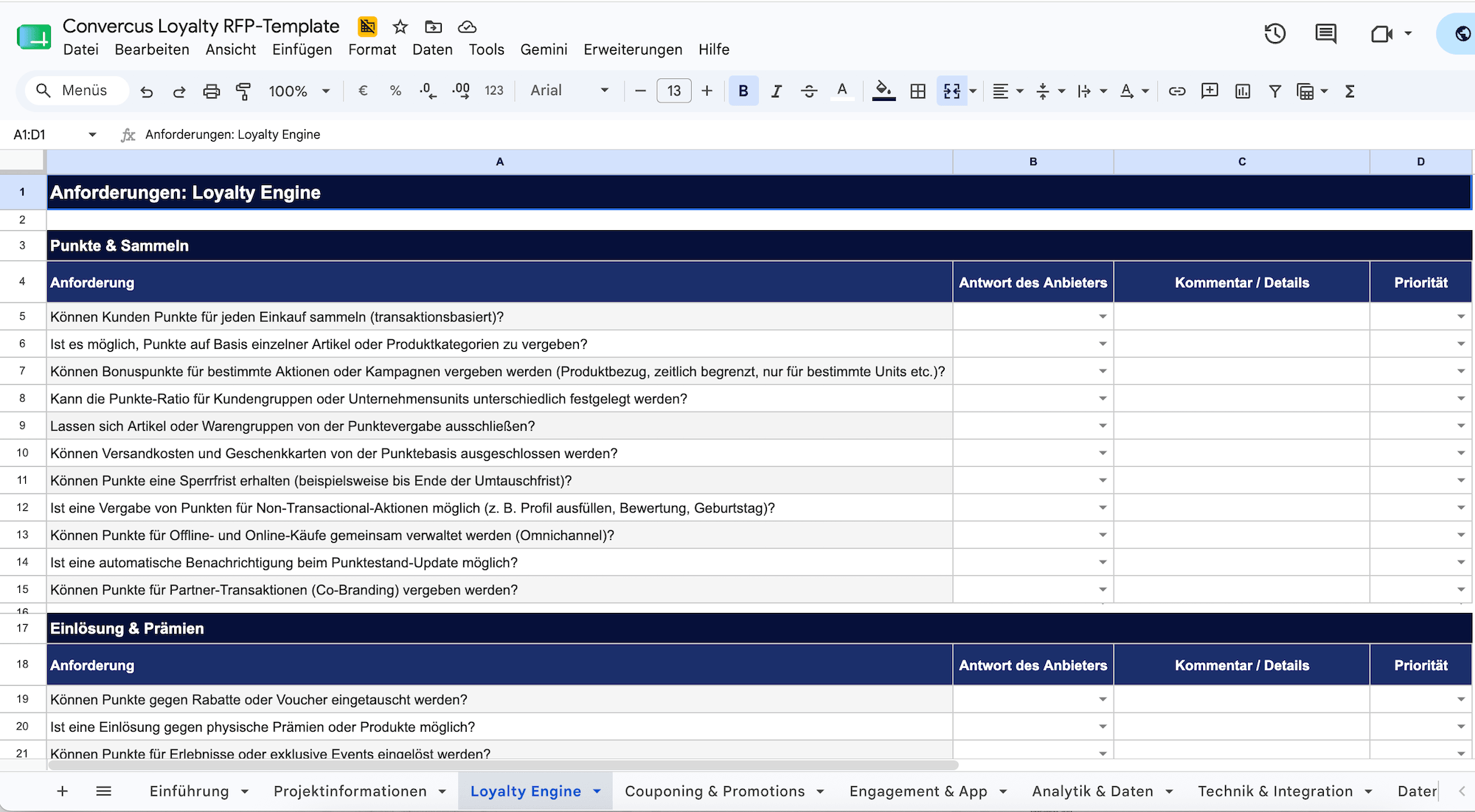
- The right model for your industry and target audience
- Fast implementation with proven onboarding
- Measurably more repeat purchases and higher basket values