







The topic briefly and concisely
- Loyalty is becoming a key differentiator in the mobile sector. As network quality and tariffs become increasingly interchangeable, perks, status benefits, and relevant rewards are measurably gaining importance.
- Telco loyalty follows different rules than retail loyalty. Key factors are non-transactional triggers such as app usage, contract anniversaries, add-on options, and cancellation windows, rather than just purchase frequency.
- Integration and compliance are critical for success. Loyalty software for mobile providers must seamlessly integrate BSS/OSS, billing, CRM, app, and GDPR requirements to genuinely reduce churn.
- Convercus is a software for loyalty, couponing, and engagement. For companies with an API-first approach and app-centric B2C or B2B2C journeys, it's a powerful option for systematically implementing modern customer loyalty.
Loyalty Software for Mobile Operators: Why 2026 is a Strategic Turning Point
For mobile operators, loyalty is no longer a side project, but a direct lever against churn, price pressure, and decreasing differentiation. The Deloitte TMT Predictions 2026 describe a clear paradigm shift: rewards, perks, and exclusive benefits can become at least as relevant for many customers as pure network performance. This is particularly critical in the German market, as tariffs are becoming more comparable, eSIM simplifies switching, and regulatory hurdles for changing providers have decreased.
Why Network Quality Alone Is No Longer Enough
The data is clear: Up to 77% of consumers feel no loyalty to their telecommunications provider, and only 47% stay with their primary provider for more than five years. When product and price are perceived as interchangeable, loyalty becomes visible value creation at the customer interface: through partner offers, status benefits, contract anniversaries, data bonuses, or exclusive access.
What This Specifically Means for German Providers
With the TKG amendment, contracts are significantly easier to terminate after the minimum term, according to §56 TKG; at the same time, it strengthens §59 TKG the provider change and number portability. For MNOs, MVNOs, and regional telcos, this increases the pressure to actively retain customers not just at the point of cancellation, but throughout the entire contract period. Those who want to delve deeper into the fundamentals of modern platforms will find the relevant overview in the article on customer retention software .
What Differentiates Loyalty Software in Mobile Communications from Classic Retail Loyalty
In mobile communications, a different logic applies than in retail: The core product is a subscription, not a frequent single transaction. This is precisely why loyalty software for mobile operators must support different triggers, data sources, and journeys than classic retail systems with a POS focus.
Subscription Instead of Transaction
In retail, many purchasing moments arise, whereas in mobile communications, there are often only a few active touchpoints per month. Good telco loyalty therefore rewards not just revenue, but also behavior: app usage, contract renewal, activation of additional options, roaming usage, referrals, or participation in challenges. Those who only award points for invoice revenue miss out on the real lever for engagement.
The App as a Loyalty Hub
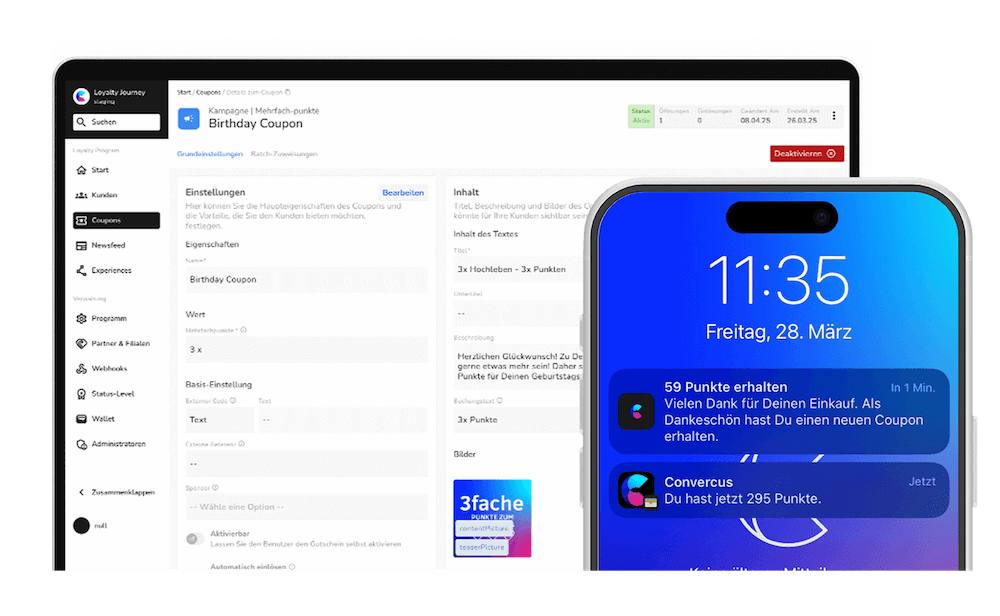
For mobile operators, the customer app becomes the most important contact point. Perks, wallet passes, coupons, self-service, and personalized communication can be brought together there. App-first loyalty is usually more effective in the telco environment than purely passive bonus logic, because interaction can be actively triggered. This is precisely why it's worth looking at modern app-first loyalty approaches, which transform a service frontend into a true engagement channel.

Which Loyalty Models Work in Practice for Mobile Operators
The best loyalty software for mobile operators doesn't just support a single model. In the telco market, perks programs, status logic, and hybrid models work particularly well, which combine partner offers, gamification, and personalized benefits. The German market already clearly demonstrates this.
Perks, Tiers, and Gamification Compared
Programs like Magenta Moments or O2 Priority strongly follow the perks principle: exclusive benefits without complex point logic. Internationally, hybrids of status management, partner rewards, and gamified mechanics. Especially for providers with few natural purchasing moments, challenges, milestones, and time-limited activations are particularly valuable because they generate additional app visits.
Partner Bundles and Streaming as a Loyalty Instrument
Streaming bundles, event access, coffee vouchers, or extra data often have a stronger impact in mobile communications than abstract discounts. Relevance Trumps Complexity: A clearly understandable benefit usually performs better than an overloaded program. Deutsche Telekom reached an average of 1.7 million active Magenta Moments users per month in Germany in 2024, demonstrating the significant leverage a well-curated benefits ecosystem can provide.
What Features Modern Loyalty Software for Mobile Operators Absolutely Must Have
What's crucial isn't the length of the feature list, but whether the platform reflects the telco reality. The focus is on the rule engine, personalization, automation, and omnichannel delivery. Only then can usage data truly be transformed into relevant customer interactions.
Loyalty Engine, Marketing Automation, and Couponing
A good platform must be able to flexibly combine benefits, status rules, coupons, tenure milestones, and trigger campaigns. For mobile operators, this specifically means: Events from billing, CRM, and the app must be translated into actions in real time, for example, when a contract is nearing its end, during international usage, or with recurring inactivity. Those who want to systematically expand customer engagement should therefore look for a combination of Loyalty Engine, Engagement and Couponing .
- The platform should be able to consolidate tenure, segment, tariff, additional options, and behavioral data within a rule set.
- It should be able to deliver benefits across channels in the app, web, service, and wallet pass.
- It should support automated campaigns for churn risks, renewals, and reactivation.
Why Modular SaaS Platforms Are Interesting
For B2C and B2B2C brands with complex customer interfaces, an API-first platform is often a better approach than a rigid legacy extension. Convercus combines loyalty, couponing, and engagement in a modular architecture and is particularly relevant when teams need fast iteration, low IT friction, and app-centric journeys. According to Convercus, programs with a white-label app achieve in some setups up to 8x higher customer interaction than programs without app integration.

Integration, Scaling, and Compliance: What IT and Product Teams Need to Consider
In mobile communications, loyalty rarely fails due to the idea, but rather due to the system landscape. BSS/OSS, billing, CRM, app, and service channels must work together seamlessly. Therefore, architecture in the telco environment is not a secondary issue, but a central selection criterion.
API-first in the Telco Stack
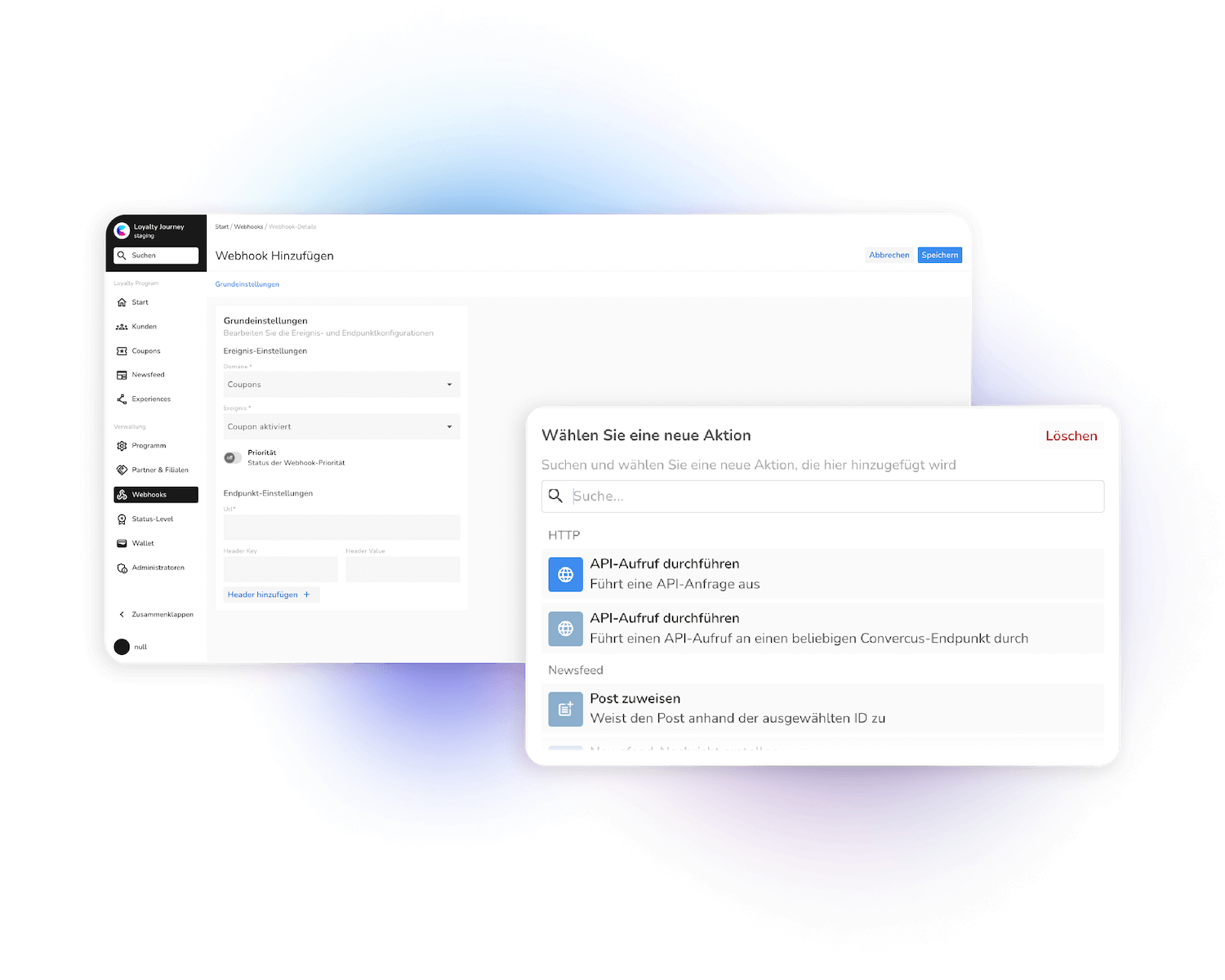
Mobile operators need low-latency event processing, clean APIs, and a robust connection to billing and CRM processes. Rewards like data bonuses, invoice credits, or partner coupons only arise through integration, not through the loyalty interface alone. Therefore, webhooks, event-based processing, SDKs for the app, and multi-tenancy are relevant if multiple brands or flanker brands are to be managed on one platform. More on this can be found on the page about Tech and Integration.
GDPR and TKG in Loyalty Operations
For telcos, data is sensitive. For personalized loyalty, particularly Art. 5 GDPR for purpose limitation and data minimization, Art. 6 GDPR for the legal basis as well as Art. 25 and 32 GDPR for Privacy by Design and security. In practice, this means: clear consent logic, separate purposes for service and marketing, comprehensible deletion concepts, and clean role models. Those who base loyalty on usage data must consider governance from the outset, not just during rollout.
- Before selection, check which data sources actually need to be connected in real time and which only require batch-based processing.
- Define early on whether multiple brands, tariff families, or countries should be mapped on one platform.
- Evaluate not only features, but also response times, reliability, and authorization concepts for departments.
The Business Case: How Loyalty Software Reduces Churn and Increases CLTV
For budget approvals, it's not enough to generally invoke loyalty. The telco business case must be calculated in terms of churn, CLTV, ARPU, and saved acquisition costs. This is precisely where the starting position is attractive: According to Simon-Kucher, 95% of CLTV comes from customers with a retention period of at least three years, and existing customers are significantly more profitable than newly acquired users.
Example Calculation for a Mid-sized MVNO
Assume a provider serves 2 million customers with an ARPU of €18 per month and an annual churn rate of 22%. This corresponds to 440,000 lost customers per year. If a loyalty program conservatively reduces churn by 3 percentage points, an additional 60,000 customers are retained. This secures approximately €12.96 million in annual revenue; with assumed acquisition costs of €120 per new customer, an additional €7.2 million in avoided acquisition costs are added. The value contribution thus amounts to approximately €20 million per year.
The Right KPIs for Telco Loyalty
In 2026, 59% of loyalty managers prioritize CLV, 44% churn reduction, and 35% ROI. The KPI set must therefore combine professional and financial impact.
How Mobile Network Operators Choose the Right Loyalty Software
The most common mistake in selection projects is discussing features too early and operating model, integration, and ownership too late. A good software decision starts with a clear objective: Should the program reduce churn, increase ARPU, expand first-party data, or boost app usage? Only then do the architecture, program model, and vendor shortlist emerge.
Realistically Evaluate Build vs. Buy
Many telcos wonder if they should develop loyalty solutions themselves. This is understandable, as internal IT stacks are extensive. Nevertheless, it is only sensible to build if product, operational, and development resources are permanently available. Those who want to build gamification, couponing, status logic, analytics, and omnichannel journeys simultaneously often underestimate time-to-value and maintenance effort.
Loyalty Software for Mobile Network Operators: Checklist for Selection and Go-Live
- Start with two to three prioritized use cases, such as contract anniversaries, churn prevention, and partner perks, instead of immediately implementing the complete target vision.
- In the selection process, demand a concrete integration plan for billing, CRM, app, and service processes instead of just a product demo.
- Check how well existing programs, status levels, and customer data can be migrated without interrupting the customer experience.
- Measure the pilot not only by enrollments but also by churn, activity, redemption, and additional app usage.
- Plan governance, data protection, and departmental responsibility in parallel with technical implementation.
Those who also want to sharpen the strategic side of retention will find customer win-back and in the guide on increasing customer loyalty practical starting points.
Conclusion: Loyalty Software Becomes Growth Infrastructure in Mobile Communications
By 2026, mobile network operators will no longer be able to differentiate themselves solely through network quality and price. Those who want to reduce churn, increase CLTV, and turn their app into an active customer interface need a loyalty platform that masters telco-specific triggers, clean integration, and robust automation. Programs that intelligently combine perks, status, partner offers, and data-driven personalization are particularly effective.
If you are evaluating a modern, API-first loyalty architecture for B2C or B2B2C journeys, then Convercus is a relevant partner for loyalty, couponing, and engagement. The most sensible next step is an individual assessment of your system landscape and use cases. Schedule a personal demo and see how a loyalty program can be implemented economically and technically within your mobile network setup.
FAQ
Mobile network operators frequently ask these questions during software evaluations.
How do you practically get started with loyalty software in mobile communications?
Start with a clearly defined retention use case, such as contract anniversaries, churn prevention, or partner perks in the app. This allows the business case, integration, and KPI logic to be validated more quickly than with a full-scale rollout from the start.
How complex is the implementation of a loyalty program?
The effort heavily depends on integrations with billing, CRM, app, and consent management . With a modular SaaS platform and clearly prioritized use cases, a significantly faster rollout is possible than with in-house development or deep legacy adaptations.
Can loyalty software for mobile network operators be used in compliance with GDPR?
Yes, if legal bases, purpose limitation, role models, and technical safeguards are properly implemented. Articles 5, 6, 25, and 32 of the GDPR are particularly relevant, as is a clear separation between service data and marketing processing.
Does this work with existing billing and CRM systems?
Today, this is a must-have. API-first, webhooks, and event-based processing are the crucial prerequisites for tariff data, contract status, rewards, and communication to interact reliably.
What does loyalty software for mobile network operators cost?
There is no reliable flat rate, because number of users, channels, integration scope, and program model significantly influence the costs. Economically, therefore, the license price alone is less important than the expected effect on churn, CLTV, and acquisition costs.
Can we migrate an existing bonus program?
Yes, in most cases. It is important to status logics, reward rules, existing data, and customer expectations transfer them in a structured way, so that neither data loss nor friction in the customer experience occurs during the transition.


- 5x Return on Investment
- 80% Customer identification
- 8x Customer Interaction
- +274% Repurchase Rate

.png)