










The topic at a glance
- Loyalty software is a results driver in car dealerships, because it systematically promotes recurring service contacts, higher basket values, and stronger repurchase signals.
- After-sales is the best starting point, as this is where most touchpoints occur across maintenance, tire changes, inspections (HU/AU), repairs, and accessories.
- API-first and GDPR compliance are mandatory, ensuring seamless integration of DMS, CRM, POS, and marketing processes, and legally compliant processing of customer data.
- Convercus is the right loyalty software for car dealerships, if you want to bundle loyalty engine, couponing, engagement, and omnichannel communication into one scalable platform.
Why passive workshop habits at dealerships will no longer be enough for stable customer loyalty in 2026
Profitability Pressure, E-Mobility, and Declining Service Business
Dealerships will face significant transformation pressure in 2026. Bain expects that traditional retail operations will only maintain their profitability if they modernize processes and strategically enhance the customer experience; an additional return of up to 0.8 percentage points is considered realistic. At the same time, e-mobility will, in the long term, reduce parts of the traditional workshop business, because pure battery electric vehicles have fewer maintenance-intensive wear parts.
Precisely for this reason, loyalty software at dealerships is transforming from a nice-to-have into a strategic instrument. Instead of relying solely on vehicle sales and spontaneous workshop appointments, a digital loyalty logic creates recurring opportunities for interaction, data utilization, and additional revenue. Those who systematically work on customer retention stabilize after-sales revenue, increase customer lifetime value, and become less dependent on short-term promotions.
The Dealership Loyalty Paradox
The DAT Report 2025 shows high workshop loyalty: 89% of customers are considered loyal regular customers. This initially sounds reassuring, but in practice, it's often just passive habit. As soon as appointment availability, value for money, or communication disappoint, a portion of these customers quickly migrates to independent workshops or competitors.
In addition, for brand workshops, customers primarily cited appointment availability (64%) and tone of communication (50%) as areas for improvement. Unattractive or missing customer loyalty measures were also explicitly criticized. Loyalty software addresses precisely this gap by transforming mere habit into an active relationship model: with benefits, personalized services, and clear incentives throughout the entire vehicle lifecycle.
What the Data Means for Decision-Makers
Deloitte describes the dealership as a particularly trustworthy point of contact: Many customers trust the service operation more than the manufacturer itself. For managing directors, CRM managers, and workshop managers, this is a clear message: The customer relationship is not only decided in the showroom, but primarily in after-sales. Those who wish to read more will find further approaches here on how to systematically increase customer loyalty .
What Loyalty Software Specifically Achieves at Dealerships
The Vehicle Lifecycle as a Loyalty Framework
In car dealerships, loyalty works differently than in traditional retail. A vehicle is purchased infrequently, but many touchpoints arise between purchase and repurchase: inspection, tire change, general inspection/emissions test, repair, accessories, warranty extension, or referral. Good loyalty software integrates precisely these touchpoints into a seamless system instead of managing isolated individual campaigns.
The goal is not just point allocation, but a measurable engagement model. Customers receive incentives for desired behavior, while the dealership gains first-party data, consents, and better triggers for communication. Those who want to delve deeper into the fundamental platform concept will find in this article on customer loyalty software the most important building blocks of modern loyalty architectures.
Why is after-sales – workshop, tire change, general inspection/emissions test – the most important loyalty touchpoint in a car dealership?
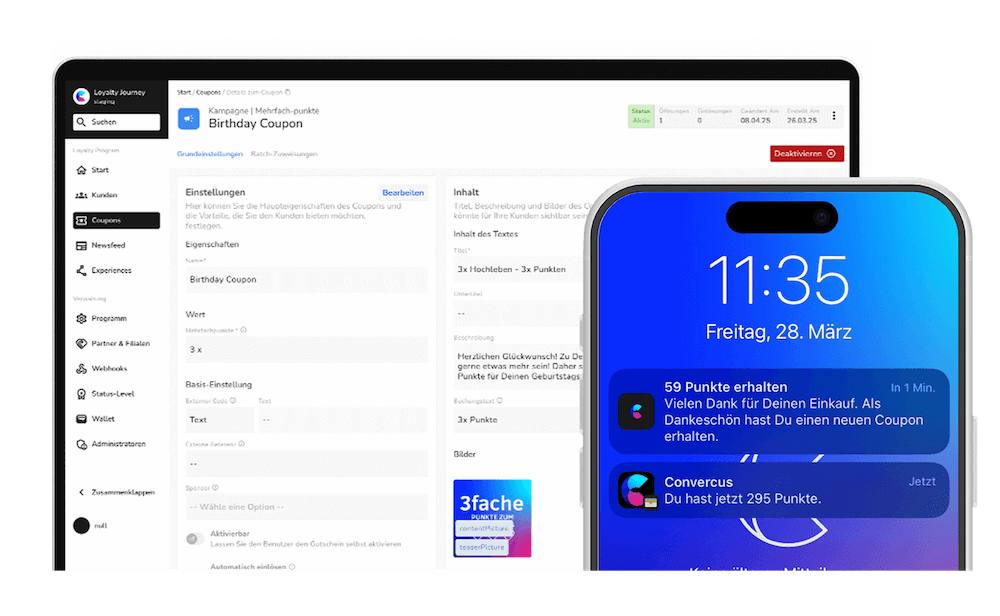
In the automotive sector, after-sales is the area with the highest contact frequency. Workshop, accessories, and service communication are the real loyalty drivers, because this is where regular interaction occurs. For example, loyalty software can award points for maintenance, provide status benefits for recurring service customers, or automate targeted coupons for seasonal services like air conditioning service or tire changes.
Core functions that are truly relevant in car dealerships
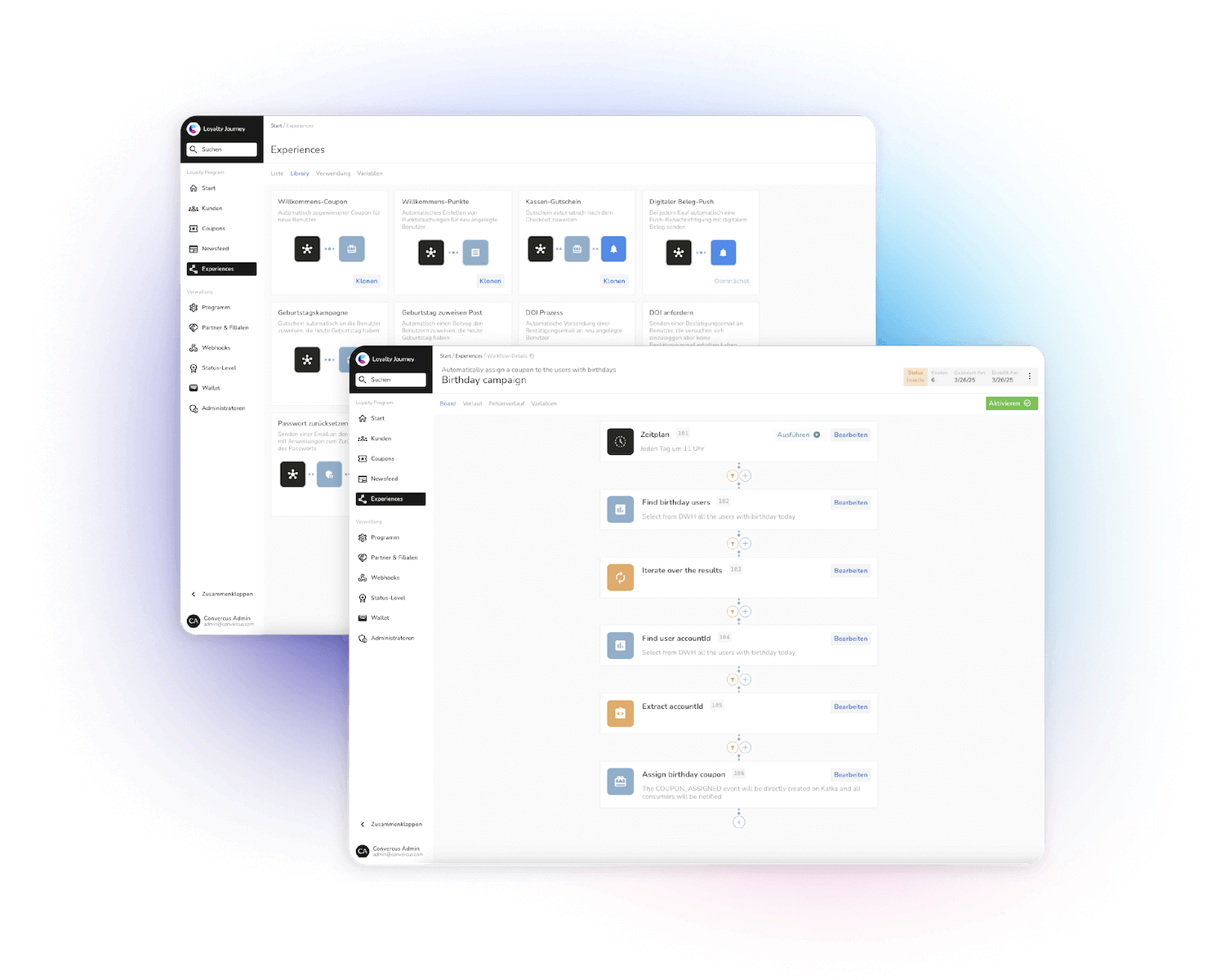
Particularly relevant are flexible point systems, status models, personalized coupons, trigger communication, and reporting at the customer and vehicle level. Equally important is an omnichannel logic: The customer should experience benefits consistently across service operations, online, via wallet pass, or in an app. Crucial is the combination of loyalty engine, couponing, and marketing automation – not an isolated discount module.

How loyalty software pays off in car dealerships
Example calculation for a car dealership group
Let's take a group with 5 locations, 25,000 active customers, an average of 1.5 workshop visits per year, and an average workshop bill of €450. This results in an annual after-sales revenue of €16.875 million. Even small changes in visit frequency and average basket size have a strong impact on total revenue in this model.
Which KPIs measure the success of loyalty programs at car dealerships – workshop frequency, NPS, or CLV?
For the business case, car dealerships shouldn't just focus on registrations. Key metrics include visit frequency, redemption rate, average basket value, repurchase rate, and NPS. A loyalty program is financially robust when it predictably generates additional appointments, higher service utilization, and more cross-selling of accessories or additional services.
Especially in car dealerships, this is more compelling than a pure discount mentality. Priority appointments, pick-up and drop-off services, courtesy car benefits, or exclusive inspections can be more profitable than blanket discounts. Thus, loyalty not only improves revenue but also differentiation from independent workshops and purely transaction-driven offers.
Integration with DMS, CRM, and Dealership IT
Why API-First is Essential for Car Dealerships
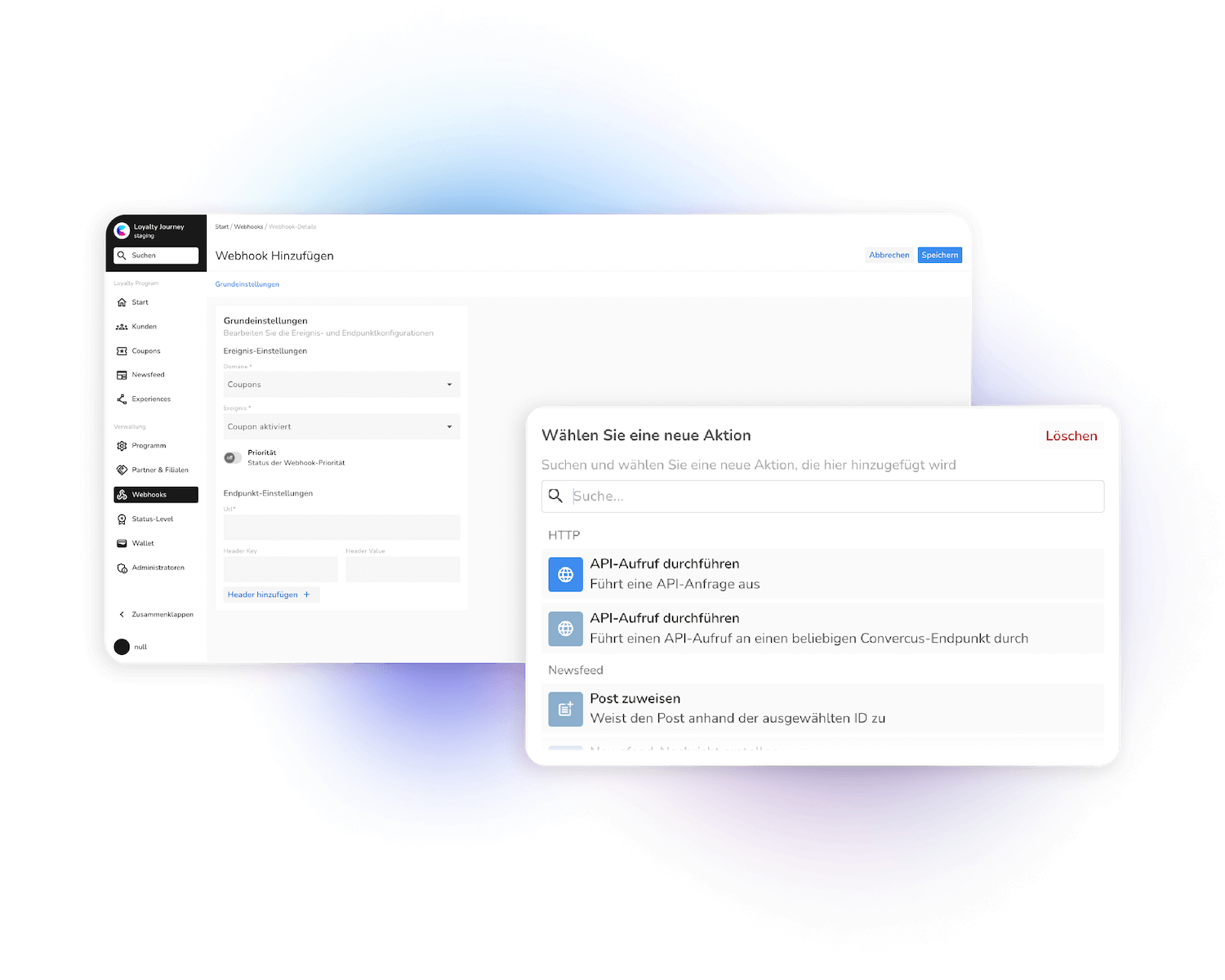
The biggest hurdle is rarely the program idea, but almost always the system landscape. In many operations, DMS, CRM, appointment booking, newsletter tools, POS, and manufacturer applications run independently. A loyalty software must therefore be built API-first, so that data events from various sources can be consolidated effectively and actions triggered in real-time.
In practice, this involves connections to DMS landscapes, such as those found in the market with solutions like alphaplus, VaudisX, or werwiso, as well as CRM and POS processes. Whether a connection is made directly via API, via middleware, or file-based should be evaluated on a project-specific basis. For decision-makers, it's important: the loyalty platform must not create a new data silo. Read more about the technical perspective under Tech & Integration.
GDPR, Consents, and Advertising
In car dealerships, personal data, vehicle information, and communication preferences are processed. Particularly relevant from a legal perspective are Art. 6 Para. 1 (a) GDPR for consents, Art. 6 Para. 1 (b) GDPR for contract-related processes, Article 5(1)(c) GDPR for data minimization, Article 13 GDPR for information obligations and Article 28 GDPR for processor agreements. Additionally, for promotional contact via email or phone, Section 7 UWG is key.
A good platform supports consent management, role-based access, clean logging, and transparent analytics. This is not just about compliance, but also a trust factor for customers and manufacturing partners.
Which loyalty models work best in car dealerships
Digital customer card, Wallet Pass, or app?
Many car dealerships wonder if their own app is immediately necessary. The honest answer is: not always. A Wallet Pass is often the fastest and most accessible entry point, because customers don't have to install an additional app and have their digital customer card directly available on their smartphone. For more complex journeys, an app can be added later. Those who want to delve deeper into this topic can find more about App-first Loyalty.

Status models, coupons, and hybrid programs
In car dealerships, status-based service benefits are often more impactful than mere discounts. Silver, Gold, or Platinum models with genuine privileges such as priority appointments, pick-up and drop-off service, or seasonal free checks, increase perceived relevance. Additionally, personalized coupons for accessories, tire services, or inspections are effective when they are data-driven and tailored to the vehicle's status.
Gamification between service contacts
Since car purchases are infrequent, there's a need for touchpoints between major transactions. Gamification keeps engagement active even outside of service visits, for example, through challenges for seasonal checks, referral programs, or recurring service milestones. This ensures communication isn't limited to repair needs.
How does a car dealership practically launch a loyalty program – Piloting, Rollout, and Measuring Success?
Start where results quickly become visible
For most dealerships, a pilot in after-sales is the most sensible entry point. Service loyalty is usually quicker to implement than a comprehensive vehicle purchase program, because processes, data sources, and touchpoints are clearer. Typical starting points include maintenance, tire changes, seasonal checks, accessories, or referral mechanisms.
These components should be defined as part of the project
- Clear economic objectives should be established upfront, for example, more service appointments, higher accessory sales, or better reactivation of inactive customers.
- Consistent customer and vehicle data are more important than a particularly creative reward system, because only clean data enables reliable triggers and personalization.
- Operational usability must suit service advisors and marketing equally, so that the program doesn't fail due to additional daily tasks.
- A realistic rollout often begins with one location, one brand, or one service category and then scales group-wide.
When a specialized platform makes sense
Once loyalty is intended to be more than just mailings and discount codes, a DMS alone is usually no longer sufficient. This is precisely where a specialized platform is beneficial, one that Loyalty, Couponing and Engagement in a scalable logic. Convercus is particularly suitable for car dealership groups that want to combine omnichannel customer loyalty, marketing automation, and API-first integration..
The practical benefit lies in faster campaign management, better personalization, and clear scalability. With white-label app concepts, up to 8x higher customer interaction is possible; at the same time, loyalty becomes a reliable first-party data basis for recurring, automated communication. Additionally, it's worth looking at strategies for customer re-engagement, as inactive service customers are a particularly valuable segment for car dealerships.
Best Practices and Common Mistakes in Car Dealership Loyalty
What makes FordPass Rewards and successful car dealership loyalty programs so effective?
Internationally, FordPass Rewards demonstrates how to effectively build automotive loyalty: with tiered logic, service relevance, and clear benefits related to parts, accessories, and workshop services. The common denominator of successful programs is not the discount, but everyday relevance.The same applies in the German market: customers respond more strongly to simple, useful benefits than to complicated reward catalogs.
Programs that build service trust and simultaneously improve data quality work particularly well. These include appointment prioritization, personalized workshop offers, seasonal triggers, and partner services. If the program functions uniformly across multiple locations, it becomes a real competitive advantage for car dealership groups.
Which 5 mistakes in implementing loyalty software most negatively impact car dealerships?
- A program without clear objectives generates activity, but no robust management of sales, frequency, or repurchase rate.
- Too much focus on discounts erodes margins, although service privileges often provide better differentiation and fit better with the dealership business model.
- Lack of proper integration leads to data from DMS, CRM, and campaign tools not being consistently integrated.
- Overly complex mechanisms lower adoption among employees and customers, especially in the busy workshop environment.
- Lack of continuous success management prevents segments, rules, and campaigns from being optimized based on real results.
Conclusion: Loyalty Software is a Growth Lever for Car Dealerships, Not Just an Additional Tool
Car dealerships today need more than service reminders and seasonal promotions. Effective loyalty software combines vehicle lifecycle, after-sales, first-party data, and omnichannel communication into a measurable business model. Especially in an industry with long purchase cycles, fragmented IT, and increasing margin pressure, the quality of customer loyalty determines utilization, repurchase, and differentiation.
Those who start strategically usually begin in after-sales, properly integrate DMS and CRM data, and rely on a platform that combines and represents points, status, couponing, and automation. Convercus is a natural choice for thisif you want to implement scalable, API-first loyalty for car dealerships with a clear focus on engagement. We recommend arranging a personal demo and checking how your loyalty program can be set up economically and technically soundly.
FAQ
How complex is the implementation of loyalty software in car dealerships?
That depends primarily on the data situation, integrations, and program scope. A pilot in after-sales is usually much faster to implement than a group-wide program for sales, service, and partner services. A phased approach is more advisable than a big-bang rollout.
Can loyalty software be implemented in a GDPR-compliant manner in car dealerships?
Yes, if consents, information obligations, data processing agreements, and advertising rules are properly implemented. Particularly relevant are Art. 6, Art. 13, and Art. 28 GDPR, as well as § 7 UWG for promotional contact. Data minimization, role-based access rights, and documented processes are also important.
Does that work with our existing DMS or POS system?
In many cases, yes, but not always in the same way. The decisive factor is whether data can be provided directly via API, via middleware, or via defined exports. This is precisely why an API-first architecture is so important in car dealerships.
What does loyalty software cost for a car dealership?
The costs depend on the number of users, transaction volume, feature set, and integration effort. For larger groups, professional platforms typically range from five to low six figures per year. Therefore, the decisive factor is not the list price, but the achievable ROI.
How do you start a loyalty program in practice?
It's best to start with a clearly defined use case in after-sales, for example, maintenance, tire changes, or reactivation of inactive customers. Then, target KPIs, incentives, data sources, and communication rules are defined. Scaling group-wide should only occur once this core functionality is established.
Can we migrate an existing customer loyalty program?
Yes, that is exactly the case in many projects. Point balances, customer segments, coupon logic, or status levels can generally be adopted, provided that data quality and the rule set are properly documented. Before migration, it should always be checked which legacy mechanisms should actually be retained.


- 5x Return on Investment
- 80% Customer Identification
- 8x Customer Interaction
- +274% Repurchase Rate

.png)
.png)