











The topic, short and concise
- Loyalty in sports is a growth driver. In the competition between specialized retailers, D2C brands, and online pure players, it's not just about discounts, but about CLV, repurchase rate, and robust first-party data.
- Sports require different loyalty mechanics than standard retail. Replenishment triggers, activity-based earning, community, events, and omnichannel services are often more effective than a pure points system.
- The right software must be technically and legally robust. Crucial factors include POS integration, API-first architecture, personalization, automation, wallet or app functionality, and GDPR-compliant processes.
- Convercus is particularly relevant as loyalty software when sports retailers want to build a modern omnichannel program. The platform combines loyalty engine, couponing, engagement, and integrations for data-driven customer loyalty in retail.
Anyone looking for Sports Loyalty Software usually means more than just a classic bonus program. In sports retail, for sports brands, and within club environments, it's about omnichannel customer loyalty, first-party data, replenishment campaigns, gamification, and how to create a relevant dialogue between seasonal purchases. Especially in the DACH market, this topic is strategic: While German sports retail has been operating in a market of around €7 to 8 billion for years, the DTC pressure from major brands and competitive pressure from vertical players like Decathlon are continuously growing. Anyone who views customer loyalty merely as a discount mechanism here misses out on potential for repeat purchases, data quality, and customer lifetime value.
Why Loyalty Software is Essential for Sports Today
In sports, customer loyalty has long been a growth driver and not just a CRM side issue. 81% of consumers participate in at least one loyalty program, yet an individual has an average of 19 memberships, only 9 of which are active. This creates pressure: a program must not only exist but also be relevant in everyday life. For sports retailers, this means connecting purchases, services, events, and digital touchpoints in such a way that anonymous traffic transforms into identifiable, activatable customer relationships. You can also find a broader overview of the strategic role of modern platforms in the article on Customer Loyalty Software.
The Sports Market Faces Dual Pressure
In 2024/25, Intersport reached €3.46 billion in external sales, while Decathlon recently achieved around €1.2 billion in sales in Germany and continues to expand. At the same time, brands like Nike and adidas are massively expanding their direct customer relationships. This is critical for sports retailers because purchasing occasions are often seasonal: running in spring, team sports during the European Championship, winter sports from autumn. Anyone who fails to maintain relevant contact during the interim periods loses buyers to brand stores, online pure players, or price-aggressive competitors.
Loyalty is the Strategic Response to CLV and Churn Pressure
According to industry statistics, the best loyalty programs increase the revenue of active members by 15–25% annually. At the same time, 59% of loyalty managers prioritize improving Customer Lifetime Value in 2026, while 44% focus on reducing churn. This makes sense for sports retailers and D2C brands: many products have replacement cycles, accessory potential, and high relevance for advice. Those who accurately attribute purchases and address customers personally not only increase repeat purchase rates but also improve margins, attribution quality, and media efficiency.
Best Practices: How Successful Sports Loyalty Programs Stand Out
The strongest programs in sports show that loyalty is more than points and discounts It must be. Particularly successful are models that combine training, community, content, exclusivity, and commerce. This applies to global brands as well as specialist retailers and clubs. The common denominator: the program creates a recurring relationship between purchases and provides reliable first-party data for personalization.
Nike, adidas, and Rapha Demonstrate Three Distinct Success Models
Nike Membership is primarily an ecosystem, not just a points system. The brand links multiple apps, content, product access, and training experiences into a cohesive experience. adidas, with adiClub, focuses more on points, status, and activities; according to industry sources, adiClub members purchase 50% more frequently and achieve twice the lifetime value of non-members. Rapha, in turn, demonstrates how community functions in the premium segment: the program feels more like a club than a discount model.
The Key Takeaway for Sports Retailers in the DACH Market
For retailers such as Intersport, Sport 2000, Globetrotter, or regional chains, the key insight is: There's no need to copy Nike, but its principles should be adapted. Relevant elements include digital identification at the POS, an app or a wallet pass, personalized recommendations, services like event invitations, and triggers for replacement purchases. Anyone who introduces only a digital customer card without automation and a data strategy merely modernizes the interface, not customer loyalty itself.
Major Challenges in Sports Loyalty – and Software Solutions
Sports loyalty programs rarely fail because of the concept, but rather in their execution. Five common problems emerge in nearly every project: seasonality, low purchase frequency, fragmented data, loyalty fatigue, and omnichannel disconnects between physical stores, online shops, and apps. This is precisely where it's decided whether a bonus program becomes a real revenue and data driver.
Overcoming Seasonality and Low Purchase Frequency
In sports, many purchases are situational: back-to-school, marathon preparation, ski holidays, or major events. A modern platform therefore needs replenishment and reactivation logic. Running shoes often have a lifespan of 500–800 km, and wear parts in the bike sector or training apparel also have discernible replacement cycles. With personalized triggers, segmented journeys, and targeted couponing , these specific time windows can be utilized instead of communicating generically to the entire database.
Fragmented Data and Loyalty Fatigue Hinder ROI
Many sports retailers are familiar with the problem: store revenues are sometimes not attributable to individuals, online and POS data are separate, and marketing operates with overly broad segments. At the same time, their own program competes with many other memberships. An average of 19 programs per person means that rewards alone are no longer a differentiator. Software must therefore centrally consolidate transactions, profiles, consents, and behavioral data to enable personalization, attribution, and churn prevention. Anyone who wants to know more about measures for activating existing customers can find additional insights in the article Boosting Customer Loyalty.
Omnichannel Disconnects Are Particularly Costly in Sports
Sports products often require extensive consultation: running shoe analysis, ski fitting, teamwear, or bike accessories thrive on in-store experience, service, and subsequent online repurchases. According to industry figures, omnichannel customers purchase 1.7 times more frequently than single-channel customers. If points are recorded differently at the POS than in the online shop, coupons don't work across channels, or an app doesn't integrate in-store services, the experience suffers. Loyalty software must therefore technically connect POS, e-commerce, app, CRM, and marketing automation seamlessly.
What Sports Loyalty Software Needs to Deliver: Features and Evaluation Criteria
The crucial question isn't whether a platform can manage points. What's important is whether it can operationally implement sports-specific customer loyalty : replacement purchase triggers, activity-based earning, cross-channel redemption, status logic, wallet passes, and robust analytics. Especially in sports retail, the software should not only support marketing but also improve store processes, POS identification, and data quality.

Points, Status, App, and Gamification are the Foundation – But Not the End Goal
At 42.1%, gamification is the most important loyalty trend for 2026. In sports, this is particularly obvious: challenges, check-ins, milestones, leaderboards, or rewards for event participation create touchpoints between purchases. This is complemented by classic mechanics like points, tiers, and benefits. A good solution combines both: transactional incentives for revenue and non-transactional mechanics for engagement. Anyone looking to switch from a card-based to a mobile model should also check how strongly app and wallet experiences are supported; this also ties into looking at App-first Loyalty.

Personalization, Automation, and Replenishment Drive True Business Impact
Only 16% of companies have achieved true hyper-personalization so far. Especially in sports, this is wasted potential because product replacement, seasonality, and target groups are often highly predictable. For example, addressing running shoe buyers, team sport parents, seasonal outdoor shoppers, and bike accessory customers differently leads to significantly more relevant communication. This requires segmentation, trigger logic, and journeys that react to purchase history, channel usage, and activity. This is precisely where engagement and marketing automation become crucial: not as an add-on, but as the core of loyalty implementation.
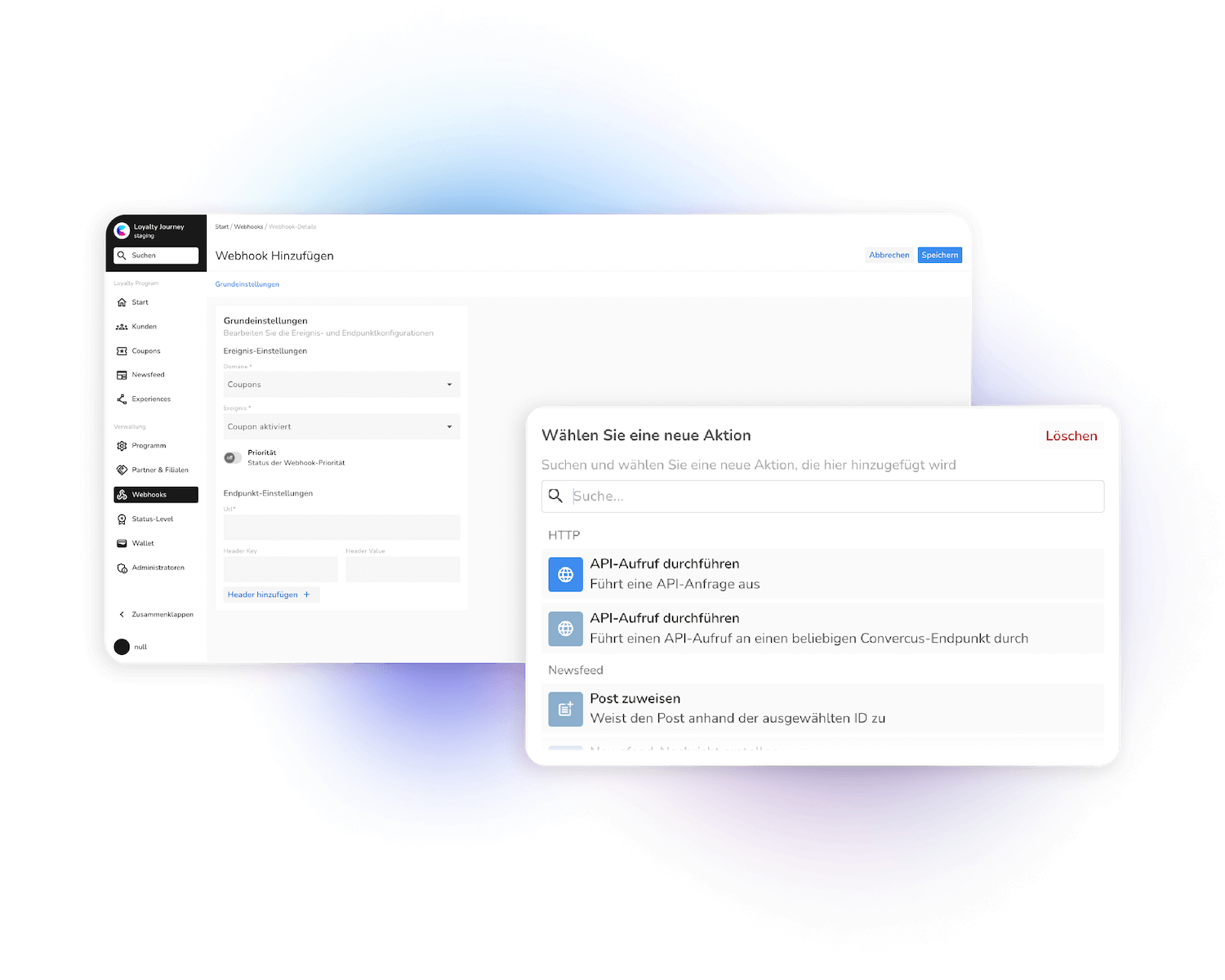
API-First, POS Integration, Offline Capability, and Data Privacy are Essential
For IT and product decision-makers, API-first architecture in sports retail is usually the safer choice than a rigid suite model. Store networks, e-commerce, apps, POS, and CRM must operate decoupled but synchronously. Legal and process security are equally important: personalized communication in Germany often relies on Art. 6 Para. 1 lit. a GDPR, contract processing on Art. 6 Para. 1 lit. b GDPR. Data minimization and purpose limitation are governed by Art. 5 GDPR, information obligations by Art. 13 GDPR, data processing agreements by Art. 28 GDPR, and Privacy by Design by Art. 25 GDPR. Anyone using email marketing must also strictly adhere to § 7 Para. 2 No. 3 UWG. Technically relevant aspects also include offline scenarios, fast response times, and robust integration into existing system landscapes.
- First, assess omnichannel capability, because in sports, linking physical stores, online shops, and mobile experiences is business-critical.
- Evaluate activity-based earning separately, because sports loyalty, in particular, must create value beyond purchases.
- Demand robust POS identification, so that in-store revenue can be attributed to members and activated personally.
- Require flexible rule sets, when status thresholds, seasonal campaigns, and brand or assortment logics vary.
- Focus on automation and analytics, so that replenishment, churn prevention, and CLV management don't run manually.
- Review governance and GDPR processes, so that consents, profiles, and communication channels are managed in an auditable manner.
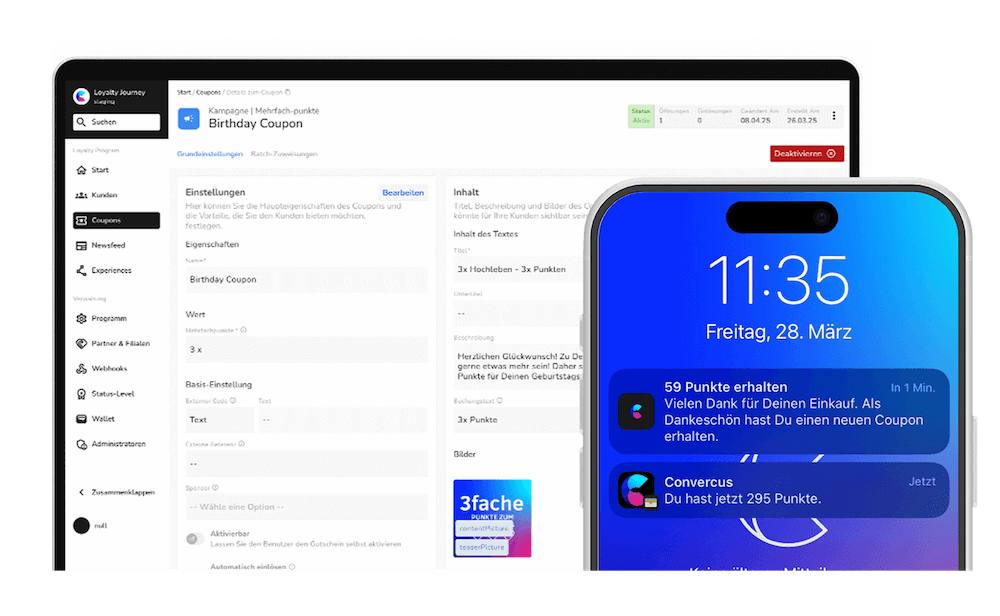
For sports retailers looking to replace an existing program or switch from a plastic card to a digital model, Convercus as Loyalty Software is particularly relevant when a Loyalty Engine, Loyalty, Couponing, Engagement and API-first integration are intended to work together in one platform. White-label app and wallet pass scenarios are particularly useful in sports, as mobile programs can enable up to 8x higher customer interaction, according to Convercus projects.
The Business Case: The ROI of Loyalty Software in Sports Retail
The economic impact is generated when loyalty is assessed not by enrollments, but by CLV, repeat purchase rate, and measurable revenue attribution. This is particularly relevant in sports, as many companies still struggle to attribute in-store revenue to individuals, thus hindering effective reactivation, up-selling, and cross-selling.
Example Calculation for a Sports Retailer
A realistic scenario involves 50 branches with 200,000 members and an average annual revenue of €400 per customer. This equates to €80 million in annual revenue. If the repurchase rate increases by 10% through personalized loyalty journeys, this would mathematically result in approximately €8 million in additional annual revenue. With a 5% margin, that would be €400,000 in additional profit. This also leads to better data quality, higher campaign relevance, and more efficient media spending. Market benchmarks show that this effect is realistic: AdiClub members purchase 50% more frequently, and a 5% improvement in customer retention correlates industry-wide with approximately 25% higher profitability.
You should define these KPIs before making a software decision
A robust business case requires clear target metrics instead of general activity values. What's crucial is not just registrations, but the active member rate, identified revenue share, repurchase rate, redemption rate, CLV development, and churn. Additionally, it's worth looking at reactivation campaigns; this also ties into the professional context of customer win-back.
Trends 2026: Where Loyalty Software in Sports is Heading
The direction is clear: Experience programs are replacing pure discount logic. In a saturated loyalty market, it won't be the next points scheme that wins, but the most relevant experience. Especially in sports, the conditions are ideal because brands and retailers can create more touchpoints with training, community, events, and service offerings than many other industries.
Gamification, Automation, and AI are becoming standard
In 2026, gamification ranks with 42.1% at the top of trend priorities, automation rises to 44.4% as an investment focus, and omnichannel experience to 32.2%. For sports companies, this means: challenges, personalized triggers, dynamic journeys, and intelligent segmentation will no longer be nice-to-haves. Those who still work with manual lists, rigid coupons, and siloed data will lose speed, relevance, and margin.
Connected Loyalty and Community are becoming a differentiator
The next stage of development is connected loyalty between brands, retailers, and partners. Examples like linking brand memberships with retail partners show where the market is heading. In sports retail, this can mean: exclusive brand access for members, event benefits, local running or outdoor communities, service slots in-store, or sponsorship offers within club environments. This creates loyalty that won't collapse with a competitor's next discount campaign.
Conclusion: The Right Loyalty Software in Sports Connects Commerce, Community, and Data
Sports loyalty software must do more than just manage points. It should map seasonal purchasing patterns, centralize first-party data, reliably connect omnichannel processes, and enable automated personalization. For sports retailers, D2C brands, and related sports organizations, this is precisely the leverage against churn, price pressure, and fragmented customer experiences. If you are looking for a platform that practically combines loyalty engine, couponing, engagement, and API-first integration, then Convercus is an obvious next step. Schedule a personal live demo with a loyalty expert and see how a modern sports loyalty program can look within your system landscape.
FAQ
Decision-makers in the sports sector frequently ask these questionswhen evaluating a loyalty platform or looking to modernize an existing customer card system.
Which loyalty software is suitable for sports retail?
A solution that primarily seamlessly connects POS, e-commerce, app, and CRMis suitable. In sports, pure point systems are rarely sufficient; replenishment triggers, omnichannel couponing, segmentation, mobile identification, and activity-based earning are also important.
How complex is the implementation of a loyalty program?
The effort depends on the branch network, data quality, and integration level. Companies start fastest with a clearly defined MVP: membership, POS identification, basic benefits, and initial automated journeys. More complex topics like partner logic, gamification, or white-label apps can then be gradually expanded.
Does loyalty software work with our existing POS system?
Yes, if the platform is built API-first and can connect POS processes in a structured way. Real-time or near-real-time synchronization, stable identification at the checkout, and sensible fallbacks for branches with unstable connectivity are important.
Is loyalty software GDPR compliant?
It can be operated in compliance with GDPR if legal bases, consents, information obligations, and deletion processes are properly implemented. In practice, Articles 5, 6, 13, 25, and 28 of the GDPR, as well as Section 7 of the UWG (German Act Against Unfair Competition) for advertising, should be considered in the concept, contracts, and system logic.
What does loyalty software cost in sports?
Costs vary depending on the number of users, channels, depth of automation, app scope, and integration effort. The license price alone is not the deciding factor, but whether the platform measurably improves identified revenue, repurchases, and campaign efficiency.
Can we migrate an existing customer card or loyalty program?
Yes, in many cases, this makes more sense than a complete restart. Member data, point balances, status levels, and consent histories can usually be transferred, provided that data quality, mapping, and migration logic are carefully planned early on.


- 5x Return on Investment
- 80% Customer Identification
- 8x Customer Interaction
- +274% Repurchase Rate

.png)