








The topic, brief and concise
- Loyalty software is a growth driver for catering businesses. It helps caterers increase repeat orders, build first-party data, and reduce their reliance on pure new customer acquisition amidst margin pressure.
- Catering loyalty is not the same as restaurant loyalty. High order values, multiple stakeholders, and the B2B2C dynamic require different models than a simple digital punch card.
- The best program logic depends on the business model. Point programs are suitable for frequent orders, tier models for corporate clients with high volume, and referral mechanisms are especially effective for event catering.
- Convercus is a suitable software for catering loyalty. When omnichannel loyalty, couponing, engagement, and API-first integration need to converge, Convercus is an obvious solution for professional customer retention.
Loyalty Software for Catering: Why it's now becoming strategic
By 2026, catering will no longer be a niche business, but a central growth driver for many providers. The German catering market generates around €4.5 billion in revenue, while personnel costs, material costs, and expectations for digital services are rising. Anyone who only focuses on new customer acquisition in this environment is working against their own margin. This is precisely why modern customer loyalty software is strategically relevant in catering: It makes repeat orders more predictable, increases share of wallet, and generates reliable first-party data.
Market Dynamics 2026: Growth Meets Margin Pressure
The market is growing, but the environment remains challenging. IBISWorld estimates the industry at 6,741 companies, while many caterers report rising costs and staff shortages. 86% of catering companies are considered understaffed, while 53% of corporate buyers intended to increase their catering spending. Loyalty is therefore not just a marketing topic, but a question of efficiency: automated retention instead of manual follow-ups.
Why Catering Loyalty Works Differently Than Restaurant Loyalty
In restaurants, it's often about individual guests and spontaneous return visits. In catering, however, office managers, procurement, event managers, and end guests collectively determine success. High order values, longer sales cycles, and multiple stakeholders make the topic more complex. Therefore, loyalty software for catering must not only manage points but also orchestrate relationships on multiple levels.
The three segments, each with its own requirements
Event catering thrives on references, recommendations, and the multiplier effect of every guest. Contract catering requires recurring usage, stable processes, and often B2B2C logic. Restaurant catering, in turn, combines individual customers, corporate orders, and branch business. A one-size-fits-all approach for all three models rarely works – the software must support segmentation, differentiated rewards, and cross-channel activation.
What Loyalty Software Must Deliver in Catering
The requirements in catering go far beyond a digital punch card. A powerful solution must consolidate orders, preferences, touchpoints, and campaign responses. A unified customer view is crucial: Only when order history, order type, frequency, and redemption behavior converge in one place can meaningful automations and personalized offers be set up.
Managing B2B and B2C Simultaneously
Many caterers simultaneously serve companies as clients and employees or guests as end-users. This dual-audience structure is the key difference from traditional restaurant programs. Therefore, the software should be able to manage company accounts, contacts, locations, and end-user profiles in parallel – including different reward logics, budgets, and communication channels.
- Good loyalty software for catering connects order history, contact roles, and preferences in a consistent profile.
- It allows for separate rules for corporate clients, event planners, and end consumers, without building multiple siloed solutions.
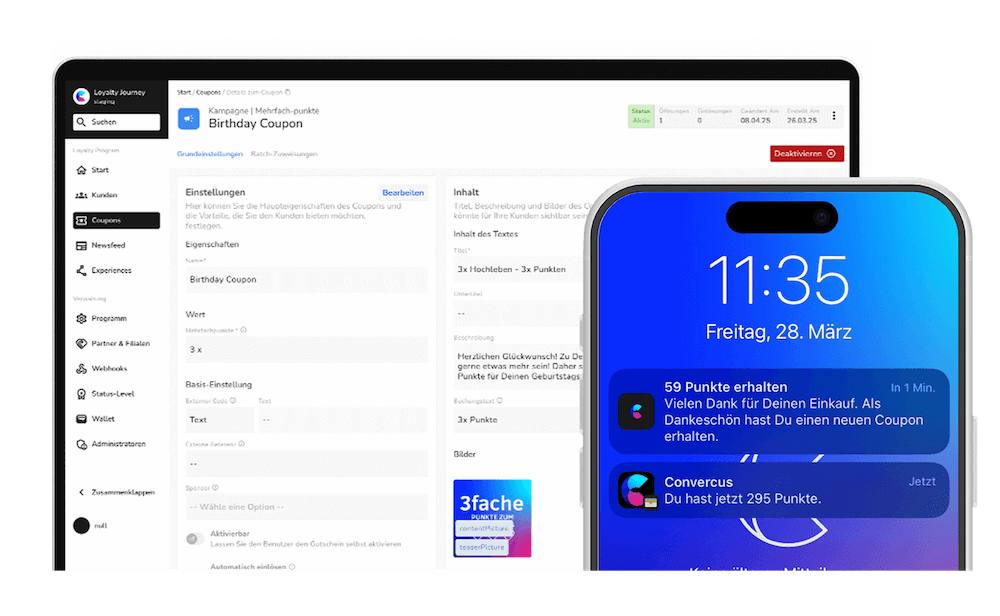
- It supports omnichannel delivery via order portal, app, Wallet Pass, email, and on-site communication.
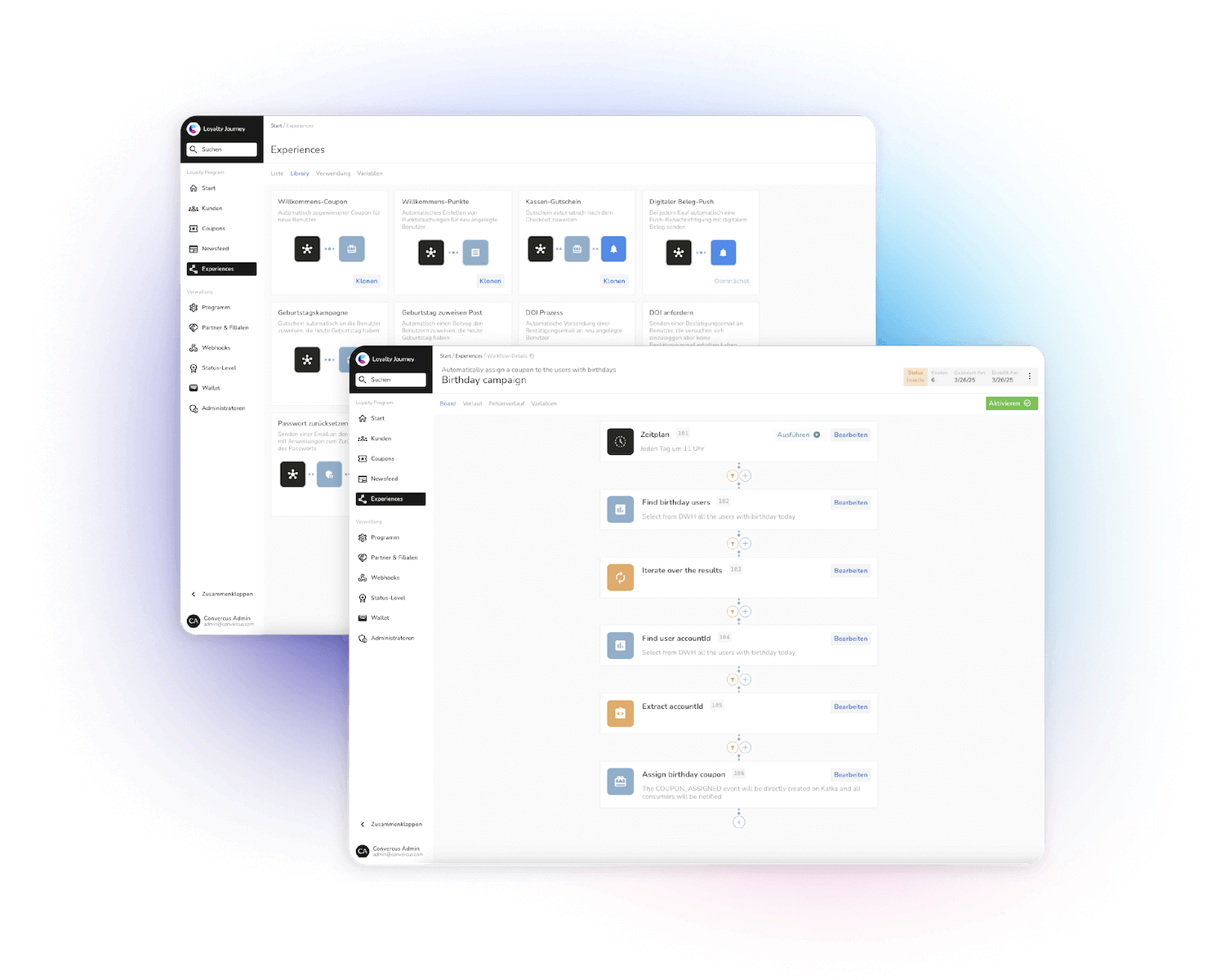
- It automates reactivation, birthday or anniversary occasions, event follow-ups, and couponing based on real behavioral data.
Integration is More Important Than Feature Abundance
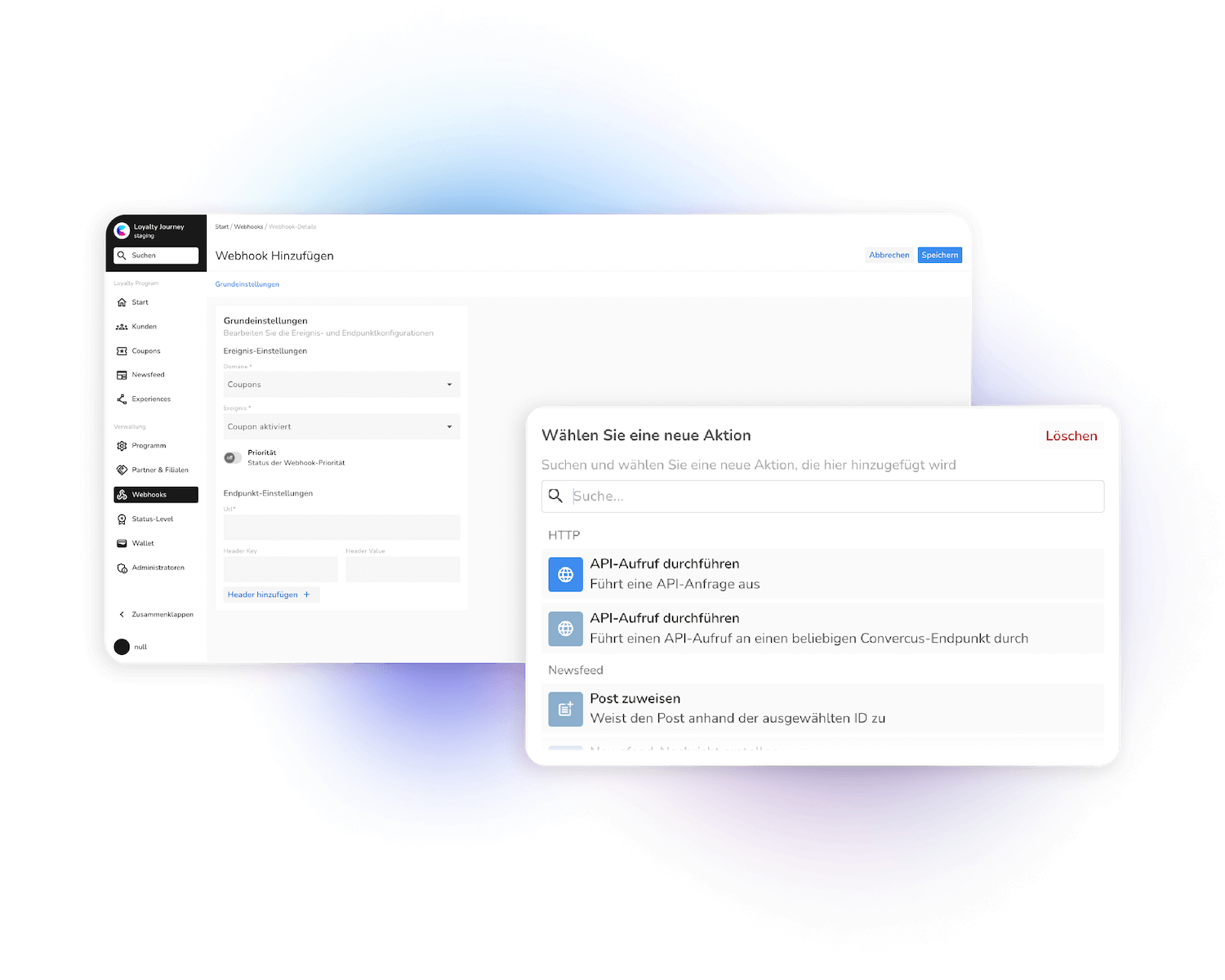
In catering, friction usually arises not in the frontend, but between the ordering platform, POS, ERP, CRM, and service process. That's why an API-first approach to integration is so important. Loyalty logic must be available where orders originate – for example, in the online ordering process, at the checkout, in the app, or in the self-service portal. Especially for larger group orders and recurring business accounts, this technical consistency determines scalability.
GDPR-compliant data usage is mandatory, not optional
Anyone who uses profile data, order patterns, and consents needs clean processes. In Germany, typically Article 6(1) GDPR for the legal basis, Art. 5 GDPR for purpose limitation and data minimization, Art. 13 GDPR for transparency obligations, and Art. 28 GDPR for data processing agreements are relevant. For promotional emails, regularly Section 7(2)(3) UWG must also be observed. In practice, this means: clear consent texts, documented opt-ins, clearly defined purposes, and a role-based model that cleanly separates operational use and marketing.

Which Loyalty Model Suits Which Catering Type?
The best loyalty software in catering is not the one with the most features, but the one with the right program logic. Catering requires different mechanics than traditional restaurant operations. Those who serve meetings, corporate lunches, trade fairs, and events should tie rewards to frequency, volume, and relationship depth – not just individual transactions. Often, a combination of points, status tiers, referrals, and targeted couponing is more sensible than a simple earn-and-burn model.
Points Programs for Recurring Orders
Points work particularly well for regular office orders, team lunches, or branch pickups. They create transparency and an immediately understandable value. It's important to have a rule base that accurately reflects high ticket sizes: for example, points per order value, bonus points for pre-orders, or bonuses for recurring slots at the same location.
Tier Programs as the Gold Standard for B2B Catering
For corporate clients, status models are often more effective than pure discounts. Bronze, Silver, or Gold status can be linked to annual revenue, order frequency, or number of locations. The added value lies in exclusive services: prioritized ordering windows, preferential consulting, exclusive menus, or early access to seasonal offers. This builds loyalty without permanently lowering prices.
Referral and Subscription Leverage the Catering Multiplier
In event catering, every guest is a potential new customer. QR codes on menu displays, digital registrations at the buffet, or a follow-up link in event communications transform individual occasions into recurring contacts. In contract catering, subscription-like models for weekly lunches or meeting packages can also be beneficial. The model becomes particularly powerful when combined with an app-based loyalty strategy , which enablesseamless registration, Wallet Pass integration, and redemption.
ROI of Loyalty in Catering: Convincing Figures
Many catering companies no longer ask if loyalty makes sense, but when the investment pays off. The answer is usually clear when the program, data foundation, and activation align. Industry data shows that loyalty members, on average, order more frequently and spend more. At the same time, customer retention is significantly cheaper than constant new customer acquisition – especially in a market with high product similarity and rising sales costs.
Key Benchmarks for Decision-Makers
In the gastronomy sector, the average retention rate is only around 55%, while across industries, 75% is often considered a benchmark. 81% of consumers would participate in a loyalty program if one were offered. 90% of companies report a positive ROI, with the average often cited as 4.8x. These figures are not a guarantee, but they show that structured customer loyalty is no longer a nice-to-have.
Calculation Example for a Mid-Sized Caterer
Assume a caterer has 500 active corporate clients with an average order value of €2,000 and an order frequency of 4 orders per year. This corresponds to €4,000,000 in annual revenue. If only 50% of these customers actively use a loyalty program, and this group orders 20% more frequently and spends 20% more, this results in incremental revenue of approximately €880,000. With full program participation, annual revenue would be €5,760,000, which is €1,760,000 above the initial value. Additionally, it is an industry consensus that even a 5% increase in retention can boost profits by 25% to 95%.
5 Steps to Software-Supported Loyalty Implementation
The most common mistake in practice is starting with rewards too early, before goals, target groups, and data flows are defined. Successful programs, however, follow a clear logic: first segmentation, then mechanics, then technology, then activation. The more complex the catering business, the more important a smooth rollout becomes. This is especially true when multiple locations, sales channels, or B2B contacts are involved.
1. Segment Target Groups Accurately
First, differentiate between recurring corporate clients, one-time event customers, internal orderers like office managers, and end-users. Without segmentation, any loyalty program becomes too broad. Crucial factors are order type, frequency, basket size, seasonality, and role in the purchasing process – not just total revenue.
2. Link Program Logic to Margin
Not every reward has to be a price discount. Especially in catering, convenience benefits, preferred slots, faster reordering, exclusive menus, or event add-ons often work better than blanket discounts. Good loyalty rewards desired behavior, for example, earlier planning, higher frequency, or cross-selling into higher-margin packages.
3. Select Software That Truly Supports Omnichannel
Check if the solution can be integrated into the order portal, POS, CRM, app, and reporting. Important features include rule sets, role-based models, triggers, couponing, and robust APIs. If loyalty, couponing, and engagement are to be orchestrated from a single source, a scalable platform has an advantage. Convercus combines precisely these building blocks with an API-first architecture for mid-market and enterprise setups; over 40 million+ loyalty accounts, 116 million+ transactions, and 22 million+ redeemed coupons demonstrate that such programs run reliably even at high volumes.
4. Activate Rollout via Real Touchpoints
The best logic is useless if no one joins. In catering, activation doesn't start only after the purchase, but already with the offer, order confirmation, and event execution. QR codes on menu displays, Wallet Passes, follow-up emails, and triggers for customer win-back are particularly effective here. Every event contact should be converted into a measurable next step.
5. Measure the right KPIs and continuously optimize them
Many programs fail not due to the idea, but due to poor management. More relevant than mere registrations are active usage, redemption, and incremental revenue. Measurement should always be against a business problem: too few repeat orders, declining share of wallet, or high dependence on individual contacts.
- The active program rate shows how many members actually order or redeem within a defined period.
- The repeat order rate per segment reveals whether corporate clients, event clients, and end-users react differently.
- The incremental revenue per member demonstrates whether the program creates real added value or merely discounts existing demand.
- Redemption rate, churn rate, and NPS help to specifically fine-tune the reward structure, communication, and service quality.

Common Mistakes in Catering Loyalty – and How to Avoid Them
Most weak programs fail not due to a lack of budget, but due to incorrect assumptions. Those who treat catering loyalty like a simple discount campaign miss out on potential. This applies to small event caterers as well as larger groups with multiple locations. Three mistakes are particularly common in projects.
Mistake 1: 'A punch card is enough'
Analog or semi-digital models may be quick to implement, but they provide little reliable data. They don't capture order types or contact roles, nor can triggers or reactivation be clearly mapped. Without a data foundation, there is no scalable personalization.
Mistake 2: Only thinking of end customers
Those who only address guests or individual orderers often overlook the actual decision-makers: purchasing, assistants, event planning, or site managers. In B2B catering, it's not just about who consumes, but also who places the order. Successful programs connect the client and user levels instead of limiting themselves to one.
Mistake 3: Confusing loyalty with discounts
Price reductions can be useful, but they should never be the only lever. In catering, trust, reliability, convenience, and personal relevance are often more powerful than another discount. The best customer loyalty arises when economic and emotional ties come together – for example, through preferential service, smart reorder processes, exclusive benefits, and relevant communication.
Conclusion: Loyalty Software in Catering Needs Strategy, Data, and Integration
Loyalty software for catering is effective when it combines B2B and B2C logic , generates genuine first-party data, and is deeply integrated into ordering and service processes. Those who only award points fall short of their potential. However, those who combine segmentation, automation, couponing, and omnichannel activation can systematically increase repeat orders and make customer relationships less dependent on individual sales representatives.
If you want to modernize an existing program or set up catering loyalty professionally for the first time, then Convercus is an obvious partner for scalable loyalty, couponing, and engagement setups. The next logical step is a personal live demo, to jointly evaluate goals, system landscape, and the appropriate rollout.
FAQ: Frequently Asked Questions about Loyalty Software in Catering
Is loyalty software in catering also worthwhile for B2B customers?
Yes, especially there, the leverage is often particularly significant. High order values and recurring ordering patterns make B2B catering ideal for tier programs, reactivation, and share-of-wallet strategies.
How complex is the implementation of a loyalty program?
That primarily depends on your system landscape. With clear processes and an integrable SaaS solution, an initial rollout is significantly faster than a custom build; data model and interfaces are usually critical, not the reward idea itself.
Can loyalty software be used in catering in compliance with GDPR?
Yes, if consents, information obligations, and processing purposes are properly implemented. Particularly relevant are Art. 5, Art. 6, Art. 13, and Art. 28 GDPR as well as § 7 UWG for promotional emails.
Does this work with our existing POS or ordering system?
In many cases, yes, provided APIs, webhooks, or other interfaces are available. API-first solutions have an advantage here because they embed loyalty logic into existing processes instead of building another silo.
Can we migrate an existing bonus or punch card program?
Yes, typically members, point or status balances, and parts of the history can be transferred. It's important to define in advance which legacy logic should be retained and which will be deliberately replaced, so that the migration doesn't perpetuate old weaknesses.
How do we practically start in the first 30 days?
Start with a clearly defined segment, for example, recurring corporate customers at one location. Then define a goal, a reward model, and three measurable KPIs – such as repeat order rate, active members, and redemption rate – before broadening the rollout.


- 5x Return on Investment
- 80% Customer Identification
- 8x Customer Interaction
- +274% Repurchase Rate