







The topic, short and sweet
- Emotional Connection: Discounts alone don't create sustainable customer loyalty. Only emotional incentives like status, exclusivity, and experiences make customers resilient to competitor offers.
- Personalization: Individualized communication measurably increases purchase frequency. Reaching customers with the right offer at the right time builds true loyalty.
- Omnichannel Consistency: Channel breaks between POS, app, and online shop are the biggest loyalty killers. Seamless experiences across all touchpoints are crucial for long-term customer loyalty.
- Measurability: Key figures such as Customer Lifetime Value, Net Promoter Score, and Churn Rate make the success of customer retention strategies manageable and transparent.
- Convercus as a partner: provides the technological foundation for scalable loyalty programs with demonstrable results.
Why do customers churn even if products and service are good? The answer rarely lies in the offering itself, but rather in a lack of emotional connection. The economic leverage is enormous: acquiring new customers costs significantly more than retaining existing ones – and those who systematically invest in retention strengthen their profitability long-term. Therefore, true growth comes from investing in the right customer loyalty strategies: from Loyalty Software to personalized communication and targeted couponing. This article shows which methods work and how Convercus helps brands and retailers implement them measurably.
Transactional vs. emotional: What types of customer loyalty are there?
Not all customer loyalty is created equal. A customer who habitually chooses the nearest store behaves fundamentally differently from one who consciously identifies with a brand. To develop effective customer loyalty strategies, it's worth looking at the four basic types of loyalty. The key insight: emotional connection is the most sustainable form and therefore particularly important.
The most effective customer loyalty strategies combine several of these loyalty types, but always address the emotional level. Because contracts expire, bonus points can be outbid by a competitor, and convenience is interchangeable. True loyalty only emerges when customers build a relationship with the brand.
The 5 most important customer loyalty strategies
The following five strategies form a proven framework for sustainable customer loyalty. Each strategy operates on a different time horizon and is suitable for different types of companies. The key is not to implement all measures simultaneously, but rather to find the right combination for your business. The following table provides a quick overview:
1. Introducing Loyalty Programs: Why emotional incentives retain customers longer than discounts
Classic discount systems like stamp cards or cashback models function purely transactionally: customers collect points and redeem them. The problem? Such mechanics create habituation, not true loyalty. A "buy 10, get 1 free" card only keeps buyers until a competitor makes a better offer. Emotional loyalty mechanics, which, for example, are implemented with the help of a [SEG 30] customer loyalty software , on the other hand, focus on status, exclusivity, and experiences . TheseLoyalty Programs create a sense of belonging The Convercus Loyalty Engine
enables precisely this transition : flexible point mechanics combined with status management that addresses different customer segments in a differentiated way. The entire rule set can be configured without tying up your IT team for months. This creates a customer loyalty program that goes beyond mere discount logic. Gamification elements further deepen the emotional connection. Challenges, badges, and milestones transform interaction with your program into an experience that customers actively seek. The result: higher app usage, increased purchase frequency, and stronger customer loyalty. The distinction here is important: gamification complements substantial added values in the program, but does not replace them. Playful elements without real benefit quickly lose their appeal.
2. Scaling Personalization: How personalized communication increases purchase frequency
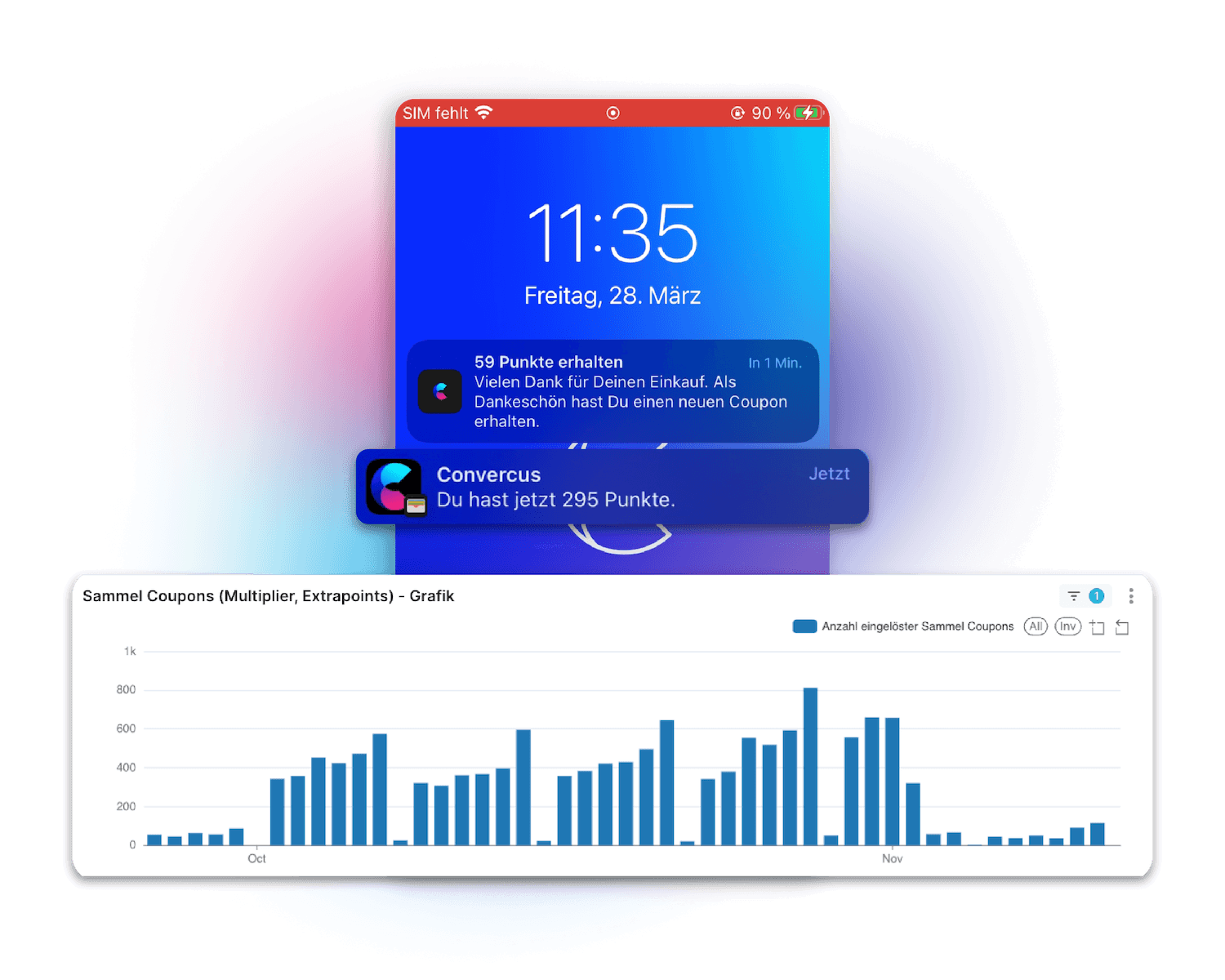
Personalization begins with segmentation and ends with automated trigger campaigns that
deliver the right message at the right time
. Instead of sending the same email to all existing customers, a data-driven system reacts to individual behavior. Specific use cases that show immediate impact: Reactivating inactive customers after 60 days without a purchase Cross-selling based on previous purchase behavior
- Personalized birthday offers with an exclusive bonus
- Trigger-based welcome sequences for new loyalty members
- The numbers confirm the effect:
- According to a
Medallia study (2024) , 61% of consumers are willing to spend more with companies that offer them a personalized experience. For your business, this means: those who don't personalize communication lose revenue to competitors who do. Personalization is no longer a differentiator; it's an expectation of your customers. Convercus makes this personalization operationally implementable. AI-powered insights identify patterns in customer behavior that
Marketing Automation translates into scalable campaigns. This also works for teams without their own data science department, because the platform automates segmentation and delivery. 3. Building Omnichannel Loyalty: How POS, app, and online store seamlessly work together
Channel breaks are the biggest loyalty killer. Imagine this: A customer diligently collects points in your store, but wants to redeem them in the online shop and finds that it's not possible. This leads to frustration and loss of trust, especially in
retail customer loyalty
. Customers today expect a consistent experience across all touchpoints, whether in-store or in e-commerce . Every break in this chain jeopardizes the relationship you've built with your customer loyalty program. Theapp plays a central role in this
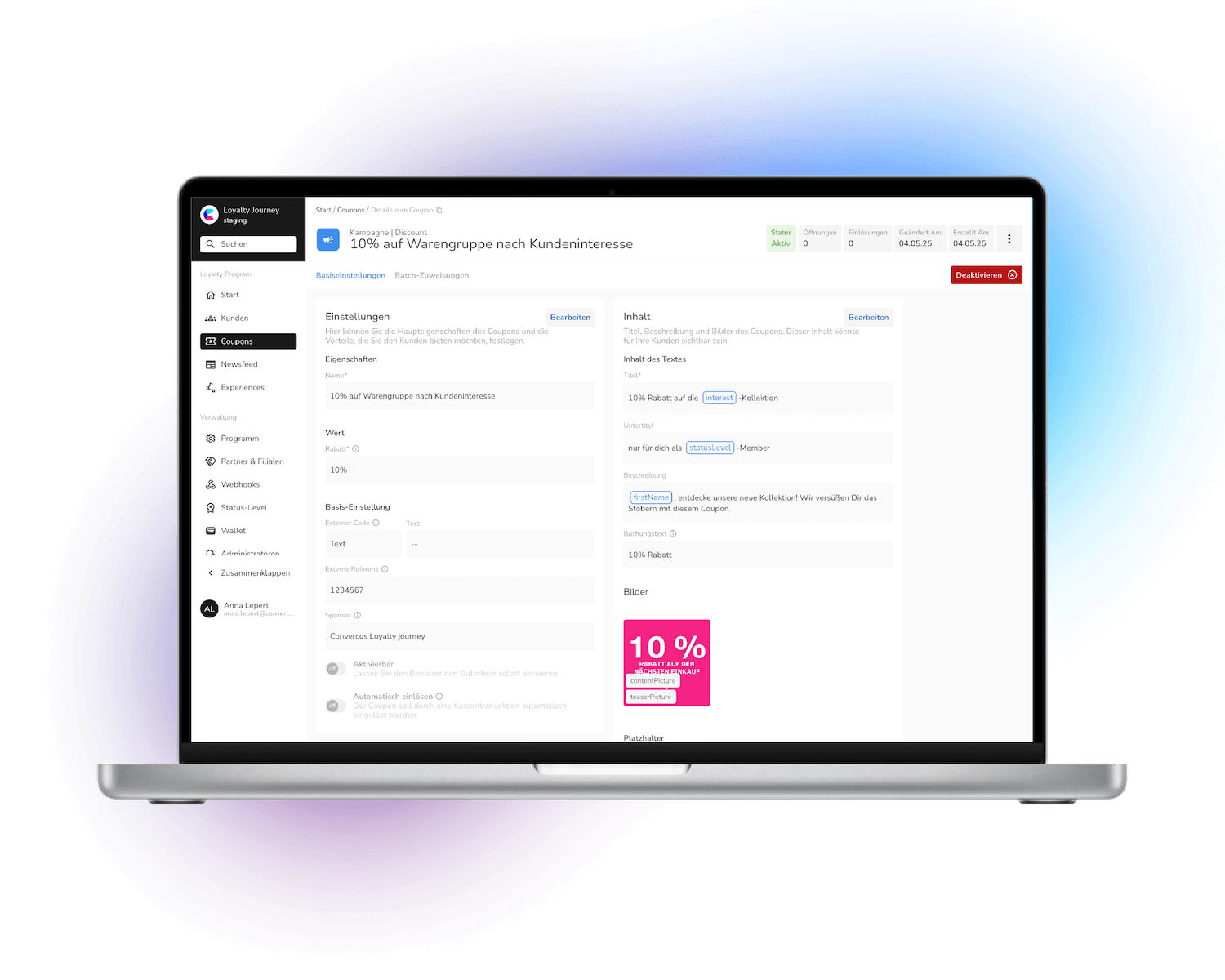
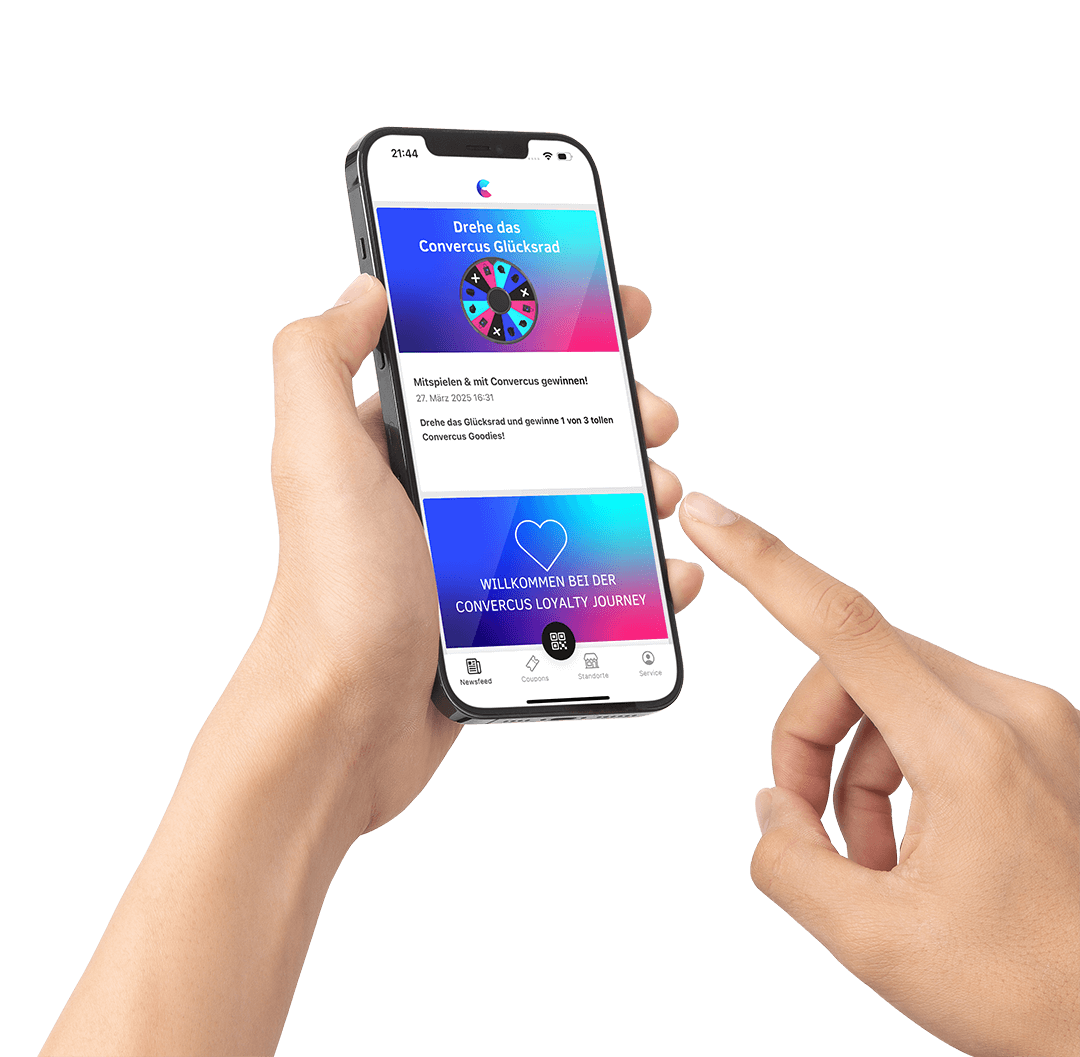
. Convercus data shows: Programs with a dedicated app achieve 8 times higher customer interaction than programs without. The reason: The app bundles push notifications, wallet, point balance, and coupons in one place, thus becoming the central touchpoint for your regular customers. That omnichannel loyalty also works in complex structuresis demonstrated by the example of Intersport:
5 countries, 4 languages, integrated into e-commerce, mobile, and POS. Concrete proof that seamless customer loyalty across all channels doesn't have to remain theoretical. The API-first architecture makes such integrations possible. 4. Targeted Couponing: How segmented offers drive repeat purchases and reactivation
Spray-and-pray couponing devalues your brand and trains customers to only buy when there are discounts. In contrast, targeted
couponing
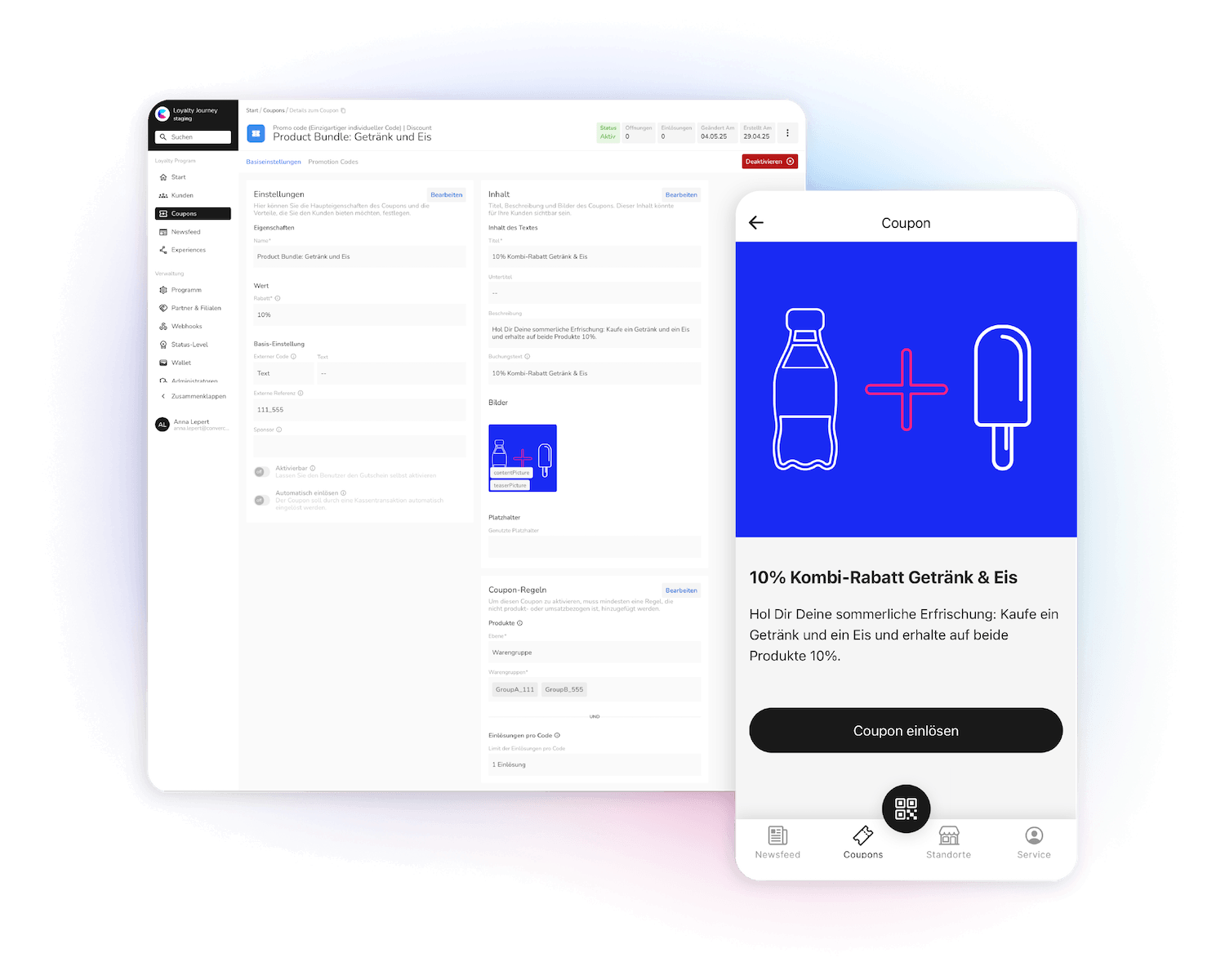
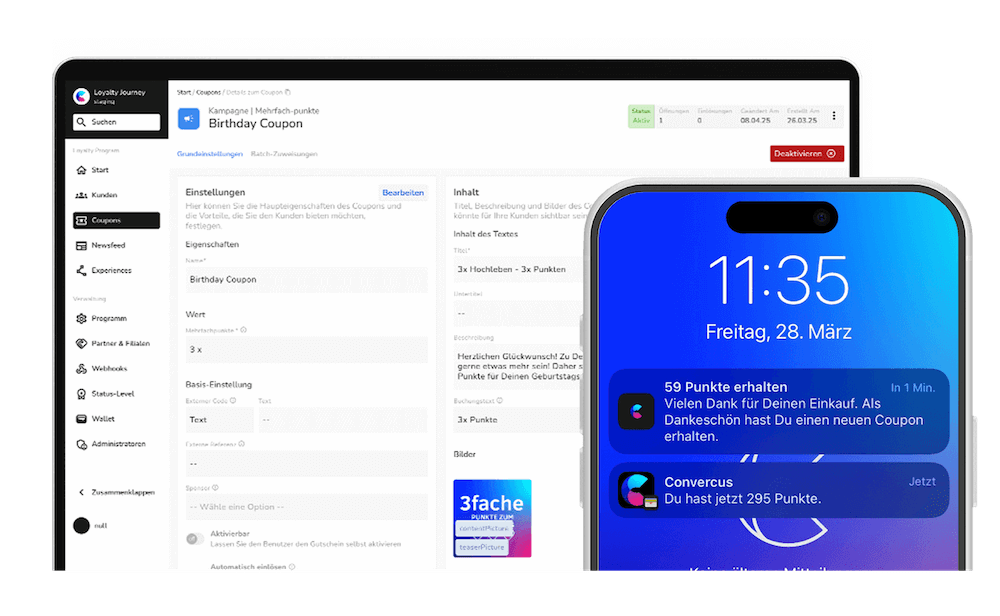
acts as a true customer loyalty strategy: offers are delivered based on data to defined segments and behaviors . The difference lies in precision. A coupon for everyone is a marketing cost. A coupon for the right customer at the right time is revenue. TheConvercus Couponing Module combines omnichannel distribution with event triggers
and target group segmentation. An example: A customer hasn't made a purchase in 30 days. The system automatically triggers a personalized coupon, redeemable both online and at the POS. Every campaign is measurable, every coupon traceable. Thus, couponing becomes a controllable instrument for improving customer loyalty. 5. Actively Leverage Customer Feedback: Why NPS is an Early Warning System for Churn
Customer feedback is one of the
most underestimated customer loyalty measures
. Most companies collect customer opinions, but few close the feedback loop: they visibly react to criticism and communicate improvements. This is precisely where loyalty is created. Those who react quickly and transparently to feedbackbuild trust – and trust is the foundation of all true customer loyalty. TheNet Promoter Score
is far more than a satisfaction metric. It functions as an early warning system: Detractors (score 0–6) indicate churn risks before they become visible in sales figures. Those who proactively address these customers can save the relationship before it ends. If a customer has churned nonetheless, that's not necessarily the end – our guide on how to systematically win back churned customers shows Customer Win-back. Integrated into a loyalty program, the NPS becomes an operational control instrument for sustainable customer loyalty.
Measuring customer loyalty strategies: What results are realistic?
Strategies are only as good as the results they deliver. The best customer loyalty strategy is therefore one that can be proven with concrete figures. A frequently cited study by Bain & Company proves: Even a 5% higher customer retention rate can increase profits by 25–95%.
This shows the significant leverage companies gain when they systematically invest in existing customers instead of focusing solely on new customer acquisition:
- Higher Customer Lifetime Value: Existing customers buy more frequently and spend more per order. With each additional transaction, the value of the customer relationship increases.
- Lower Acquisition Costs: Acquiring new customers costs many times more compared to retaining existing ones. Retention significantly reduces marketing costs.
- Better Customer Data: Loyal customers provide valuable first-party data. This data forms the basis for personalization and data-driven decisions.
- Stronger Brand Identification: Emotional connection makes customers more resilient to competitor offers. Those who identify with a brand won't switch for a few percentage points off.
- Higher Repurchase Rate and Average Order Value: Directly measurable revenue effects that immediately impact the balance sheet.
These effects don't have to remain theoretical; the results from Convercus customers demonstrate this: +274% repurchase rate, +134% average order value, and a 5x return on investment. These figures prove that the described customer loyalty strategies, with the right technology , deliver measurable increases that go far beyond incremental improvements.
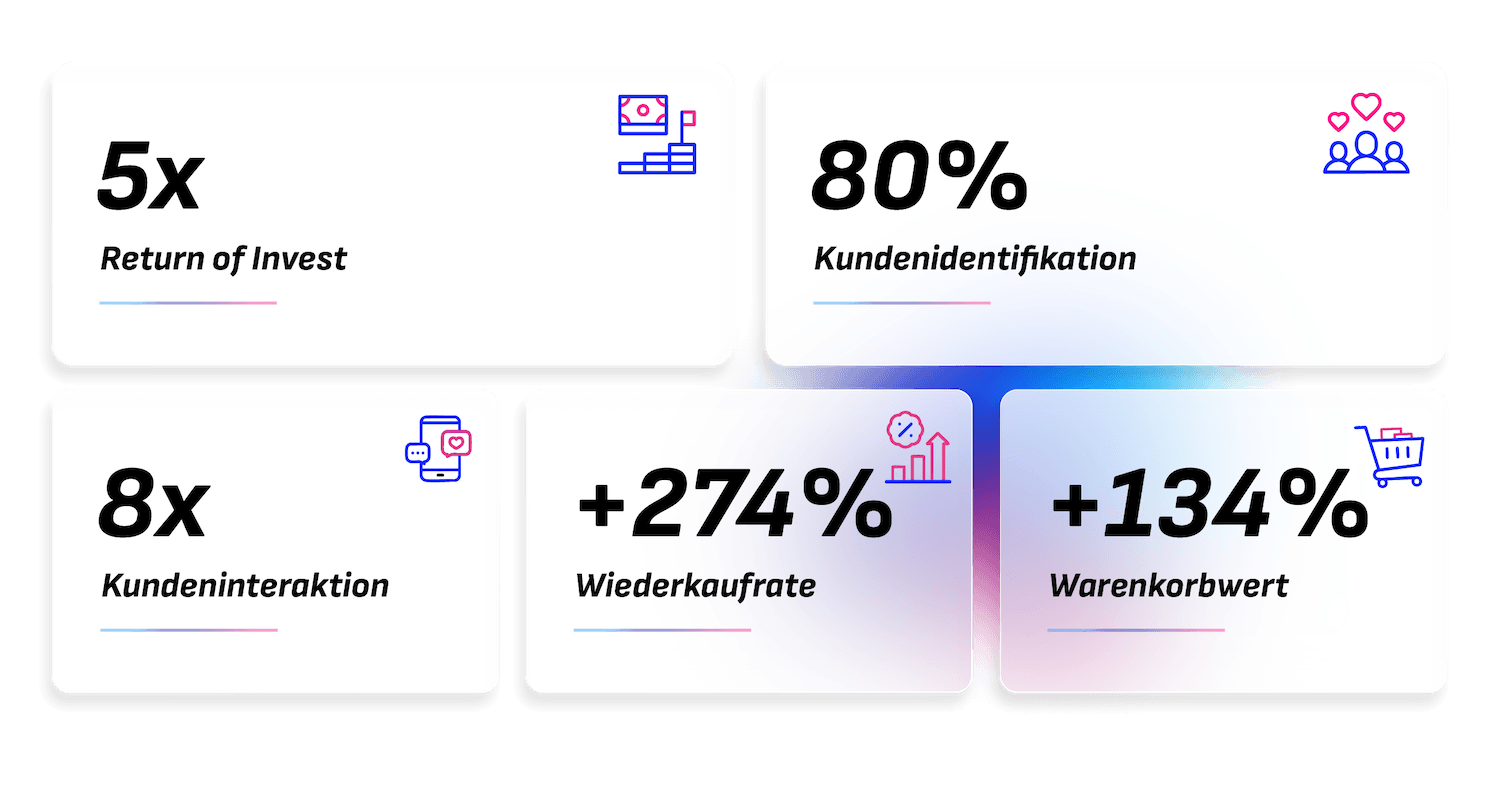
Key Metrics for Customer Loyalty Strategy
What isn't measured cannot be improved. Customer loyalty strategies only unleash their full potential when companies verify the success of individual measures with clear metrics. Three key metrics have proven particularly insightful: Customer Lifetime Value, Net Promoter Score, and supplementary metrics like Churn Rate and Redemption Rate.
Customer Lifetime Value (CLV)
Customer Lifetime Value describes the total revenuethat a customer generates over the duration of their relationship with a brand. It is the central control variable for any customer loyalty strategy, as it directly shows whether investments in retention pay off economically.
The calculation follows a simple formula: Average Order Value × Purchase Frequency × Customer Lifespan. If the CLV increases over time, it's the strongest proof that your customer loyalty measures are working. If it decreases, a closer look at purchase frequency and average order value is worthwhile to identify the cause.
Net Promoter Score (NPS)
The Net Promoter Score measures your customers' willingness to recommend on a scale of 0–10. Responses are divided into three categories:
- Promoters (9–10): Enthusiastic customers who actively recommend your brand.
- Passives (7–8): Satisfied but uncommitted customers who can easily churn.
- Detractors (0–6): Dissatisfied customers with a high risk of churn.
The NPS functions as an early warning system: a rising detractor rate indicates problems before they become visible in revenue. It is crucial to regularly collect NPS data and link it to concrete actions. As a pure reporting metric, it wastes its potential.
Other Relevant Metrics
Two additional metrics complete the picture:
- Churn Rate: The percentage of customers who leave within a specific period. The lower the churn rate, the more stable the customer base. A sudden increase signals an urgent need for action.
- Redemption Rate (Burn Rate): The proportion of collected points that are actually redeemed. A high value indicates that customers actively use the loyalty program and are engaged. Low redemption rates suggest a lack of relevance in the rewards.
The Convercus Loyalty Software provides these key KPIs directly within the platform: Penetration, engagement rate, earn/burn rate, and voucher uplift are available in real-time. Convercus customers achieve up to an 80% redemption rate for collected points. These figures demonstrate the platform's data quality and control capabilities.
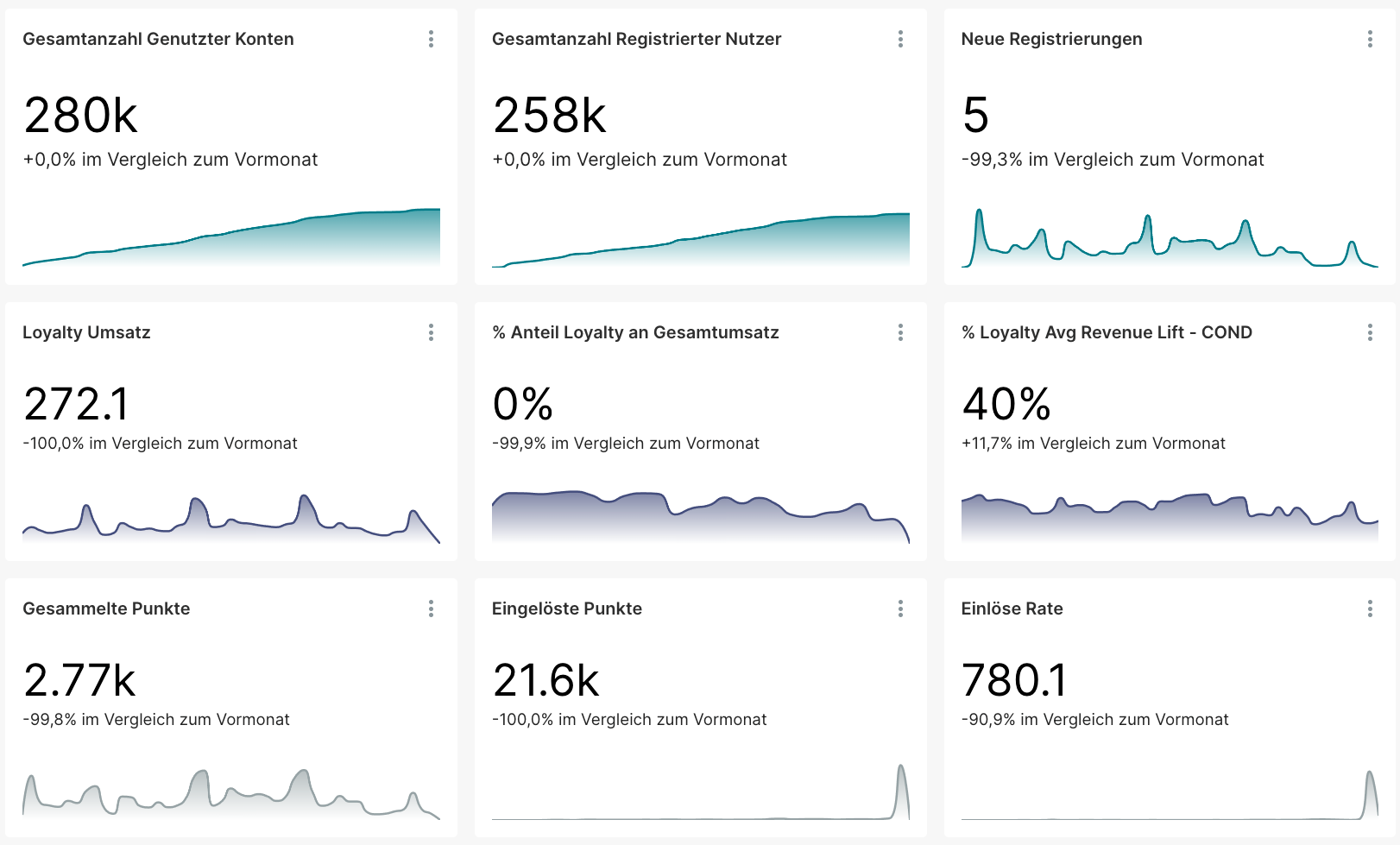
B2B Customer Loyalty Strategies: What's Different?
Customer loyalty in a B2B environment follows different rules than in traditional B2C business. Decision cycles extend over months, multiple stakeholders are involved in each purchasing process, and switching barriers are significantly higher. At the same time, the costs of churn are heavier: A lost B2B customer often means the loss of six-figure annual revenue.
The five customer loyalty strategies from this article also apply to B2B Loyalty, but must be weighted differently and tailored to the specifics of complex customer relationships.
- Personalization: In B2B, account-based engagement replaces mass campaigns. Individual offers are based on order history, contract volume, and the specific requirements of each company. Instead of generic email sequences, tailored communication and personal support are key.
- Omnichannel: Consistency across field sales, online portals, and customer service is crucial. If a key account sees different conditions in the portal than in a personal conversation, trust is immediately undermined.
- Feedback: Regular satisfaction surveys and proactive support from Key Account Management replace anonymous NPS surveys. In B2B, the feedback loop is more direct and personal.
Beyond traditional B2B, more and more companies are adopting loyalty mechanisms. In sectors like mobility, travel, and D2C, the lines between business and end-customer models are increasingly blurring. Loyalty programs that serve both sides become a competitive advantage. Convercus works with clients in B2B2C and D2C environments, and with its flexible platform supports various business models, from classic retail to complex partner structures.
Conclusion: Customer Loyalty as a System, Convercus as a Partner
Customer loyalty strategies are not a one-off project that is set up once and then runs itself. They are a system of emotional connection, scalable personalization, omnichannel consistency, intelligent couponing and active feedback management. The success lies in the combination of these measures and in consistent measurement using metrics like CLV, NPS, and repurchase rate. The central insight remains: emotional loyalty is the most sustainable form of customer retention. However, it doesn't develop on its own; it requires the right technological foundation.
Convercus provides precisely this infrastructure: from the Loyalty Engine with flexible points mechanics and AI-powered marketing automation to seamless omnichannel management. As a partner, Convercus supports brands and retailers not only in planning these strategies but also in implementing them operationally and making them measurable.
FAQ: Frequently Asked Questions about Customer Loyalty Strategy
What are the different customer retention measures?
The most important measures include loyalty programs with points and status levels, personalized communication via trigger campaigns, targeted couponing for defined customer segments, and feedback instruments like NPS. They are most effective when implemented in combination – cross-channel and data-driven.
What is the difference between customer retention and customer loyalty?
Customer retention is the measurable outcome: a customer makes repeat purchases. Loyalty is the emotional foundation behind it: a loyal customer identifies with the brand, recommends it to others, and doesn't switch at the next discount offer from a competitor. The goal of every sustainable strategy is to turn retained customers into true brand ambassadors.
How do customer retention strategies differ for existing and new customers?
Existing customers already know your brand. Here, the focus is on deepening the relationship, personalization, and rewarding customer loyalty. For new customers, the first positive impression is key: fast onboarding, welcome offers, and a seamless initial experience that builds trust.
Which industries benefit most from customer retention strategies?
Industries with high purchase frequency and strong competition have the greatest leverage: Retail & Omnichannel, Hospitality, Travel, as well as E-commerce and D2C. Generally, the more often a customer buys and the more interchangeable the offering appears, the stronger the impact of a well-thought-out customer retention strategy.
How long does it take for a customer retention strategy to deliver measurable results?
Initial effects such as higher redemption rates and increasing program participation often appear within 3–6 months. Sustainable changes in Customer Lifetime Value and repurchase rate require 6–12 months. It is crucial to define KPIs from the outset and measure them regularly.
Discover how leading retail and omnichannel brands build lasting loyalty and achieve measurable results with Convercus.

- Develop the right customer retention strategy
- Engage customers personally and across all channels
- Detect and counteract churn early
- Measure and manage success with clear KPIs