








The topic in brief
- Requires specific mechanisms: B2B loyalty programs differ structurally from B2C. Longer purchase cycles, multiple decision-makers, and higher transaction values require status management, volume-based incentives, and exclusive services instead of blanket discounts.
- Measurable Revenue Driver: Companies with structured B2B loyalty programs demonstrably boost repurchase rates, customer lifetime value, and referral rates.
- Most common mistake: Directly applying B2C logic to business customers wastes budget without impact.
- Data-Driven Infrastructure is Crucial: A scalable loyalty program needs a platform with API-first architecture, point systems, status management, and personalized coupons — exactly what the Convercus Loyalty Engine provides.
- Act now: 65% of B2B companies , according to a study by Forrester Consulting (cited by QIC), plan to introduce or expand a loyalty program. Those who start too late will lose existing customers to faster competitors.
An industrial supplies wholesaler loses its second-largest customer. Not due to poor quality, not due to excessive prices. But because a competitor systematically nurtured the business relationship: with exclusive support, transparent status benefits, and data-driven offers. How much revenue does your company lose annually because existing customers quietly churn? Classic B2C mechanisms like blanket discounts and simple point collection don't work in B2B. Longer buying cycles, multiple decision-makers, and high transaction values require specific strategies. This is precisely why B2B loyalty is rapidly gaining importance as a strategic revenue driver. Convercus, as a loyalty platform provides the scalable infrastructure to implement these strategies measurably.
What differentiates a B2B loyalty program from a B2C one?
Companies that approach business customers with the same mechanisms as end consumers risk disinterest and churn. The differences between B2B and B2C loyalty are not gradual, but structural. The following table shows the most important dimensions in direct comparison:
A frequently underestimated dilemma: Should the company as an organization be rewarded, or the individual buyer? Company-wide benefits like better terms or priority support strengthen the business relationship. Personal incentives for purchasing employees increase engagement. However, data protection regulations (GDPR), internal corporate compliance guidelines, and national anti-corruption laws must also be considered. A hybrid approach that serves both levels has proven effective in practice.
Longer Buying Cycles, Multiple Decision-Makers
In B2B, a single person rarely makes the decision. Purchasing, IT, and management evaluate offers from different perspectives. An effective customer loyalty software must therefore offer unique value for each role: Purchasing benefits from better terms, IT from easy integration, and management from a strategic partnership. Instead of a single purchase impulse, the program accompanies a decision-making process that spans weeks or months.
Relationship Value Instead of Transaction Value
In B2B, it's not about the individual purchase, but the long-term business relationship. The central goal: to increase share of wallet, meaning to increase the proportion of a customer's total budget. Existing customers generally generate higher revenues than new customers and are more profitable because acquisition costs are eliminated. Therefore, B2B loyalty focuses on partnership and sustainable relationship value rather than short-term bargain hunting. By consistently prioritizing Customer Lifetime Value, you build customer relationships that pay off for years.
Which B2B Loyalty Program Types Work
Not every program model fits every company. Whether it's a points program, cashback, or status model: The choice of the right type depends on the business model, partner structure, and strategic goals. The following overview shows three proven approachesthat have established themselves in practice:
Status Models with Volume-Based Incentives
Tiered status levels like Silver, Gold, or Platinum create clear incentives: The higher the order volume, the better the benefits. Typical benefits include priority support, exclusive terms, and co-marketing budgets. This approach motivates partners to consolidate their purchases with one provider instead of distributing orders among multiple suppliers.
A proven example is the Cisco Partner Program. Partners progress through tiers from Select to Premier, Gold, and Integrator. With each tier, available resources, discounts, and co-marketing opportunities increase. The result: long-term partner loyalty through transparent, volume-based benefits.
Knowledge and Certification Programs
Learn-and-earn models reward partners not for orders, but for completed training and certifications. This approach increases product expertise across the entire sales channel and simultaneously strengthens team loyalty to the provider. Those who invest in knowledge are less likely to switch.
The Salesforce Partner Program relies precisely on this mechanism. Partners earn points and achieve higher status levels through proven expertise and certifications. The reward: access to better leads, exclusive resources, and prioritized sales opportunities. Thus, further education becomes a strategic tool for collaboration.
Performance-Based Partner Programs
In this model, incentives are directly tied to measurable business results: sales targets, new customer acquisition, or market penetration. The program rewards not activity, but demonstrable results. This creates a clear link between performance and reward.
BMW uses this approach with its Inside Edge program . Dealers and sales staff are rewarded for achieving sales targets and customer satisfaction scores. Rewards are tiered, so higher performance leads to significantly more attractive benefits. This creates transparency and promotes results-oriented action across the entire partner network.
Strategies to Increase B2B Loyalty
A loyalty program alone doesn't create loyal customers. What's crucial is how it's integrated into the overall customer relationship strategy and what measures support the program.
The following strategies have proven effective in practice:
- Account-level personalization: Tailor offers and communication to the specific needs of individual business customers, not to mass segments. A large proportion of B2B buyers today expect personalized offers and communication.
- Build switching barriers through added value: Exclusive services, dedicated support, and deep system integration make switching providers unattractive. The more intertwined the processes, the stronger the loyalty.
- Implement structured loyalty programs : Status management and volume-based incentives create transparent incentives for increasing order volumes.
- Utilize data-driven insights: Purchase history and behavioral data enable targeted upsell and cross-sell campaigns that systematically increase Customer Lifetime Value .
- Maintain transparent communication: Regular performance reviews and transparent terms strengthen trust between teams on both sides.
- Actively involve the sales team: The program will only achieve its full effect if the sales team understands it and actively promotes it to customers.
ROI and KPIs: How to Measure the Success of B2B Loyalty
Without measurable KPIs, every loyalty program remains a cost factor instead of a revenue driver. Only systematic evaluation shows whether your measures are effective or if you're burning through your budget.
These six KPIs provide the crucial overview:
- Retention Rate: The percentage of customers who remain active over a defined period. The basis of all success measurement.
- Customer Lifetime Value (CLV): The total revenue generated by a customer over the duration of the business relationship. Shows whether the program creates long-term value.
- Net Promoter Score (NPS): Willingness to recommend on a scale of 0–10. Functions as an early warning system for churn.
- Churn Rate: Percentage of lost customers per period. The counterpart to the retention rate.
- Redemption Rate: The percentage of redeemed points or rewards. A direct indicator of program engagement.
- Upsell/Cross-Sell Rate: The percentage of existing customers who purchase additional products or services. Shows whether the program increases share of wallet.
According to a study by Bain & Company an increase in customer loyalty can significantly boost profits, depending on the industry, by 25% to 95%. Structured loyalty programs can also significantly increase upsell and cross-sell potential. These figures make it clear: anyone who consistently monitors their key figures and optimizes them in a data-driven way transforms a loyalty program from a cost factor into a measurable revenue driver.
In this example, a medium-sized B2B company achieves over €1 million in additional annual revenuesolely through a moderate increase in retention and targeted upselling:
5 Mistakes That Cause B2B Loyalty Programs to Fail
Most B2B loyalty programs fail not because of the idea, but because of the implementation. These five mistakes cost budget and customer trust.
- Directly applying B2C mechanics: Collecting points and blanket discounts don't work for business customers with complex decision-making structures. What motivates end consumers bores purchasing managers. B2B requires its own processes tailored to longer buying cycles and multiple stakeholders.
- Unclear Value Proposition: If customers don't understand what the program offers them within 30 seconds, they won't sign up. Without clear communication of the value, even the best system remains invisible.
- Overly complex program structure: Too many rules, tiers, and exceptions cause customers to lose track and ignore the program. While backend management can be complex, the customer experience must remain simple.
- Lack of program promotion: A loyalty program that sales teams don't know about or actively promote remains ineffective. Without training and tools for customer-facing teams, the crucial interface to the customer is missing.
- Artificial price increases to fund the program: Anyone who raises prices to fund the loyalty program destroys the very trust they aim to build. Transparency in terms and conditions is the foundation of any long-term business relationship.
An overarching problem behind all these mistakes: insufficient data utilization. Without systematic analysis of purchasing behavior, redemption rates, and engagement data , the basis for ongoing optimization is missing. Those who don't measure cannot manage and lose customers who could have been retained with targeted customer re-engagement measures.
Implement B2B Loyalty Scalably with the Convercus Loyalty Engine
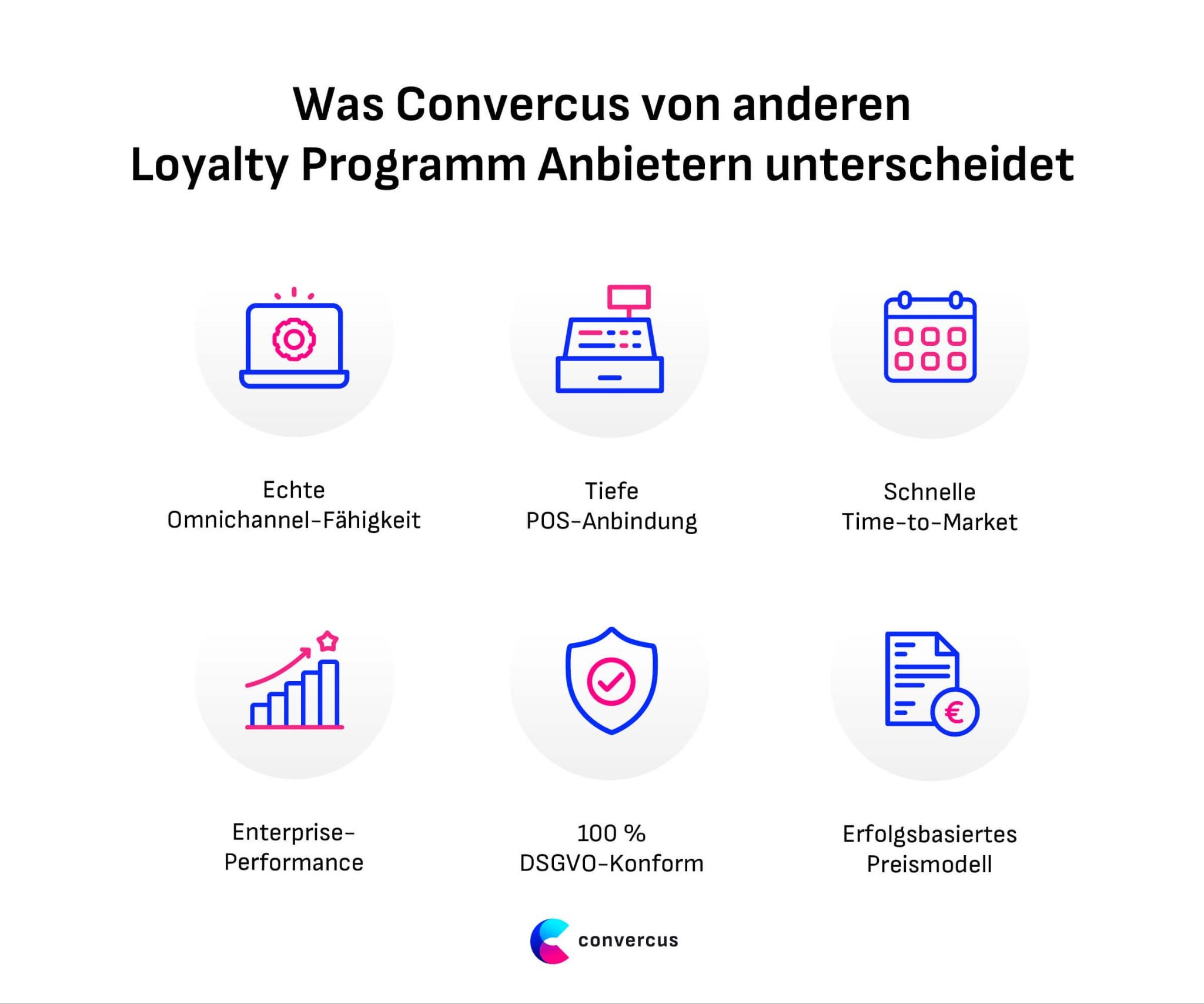
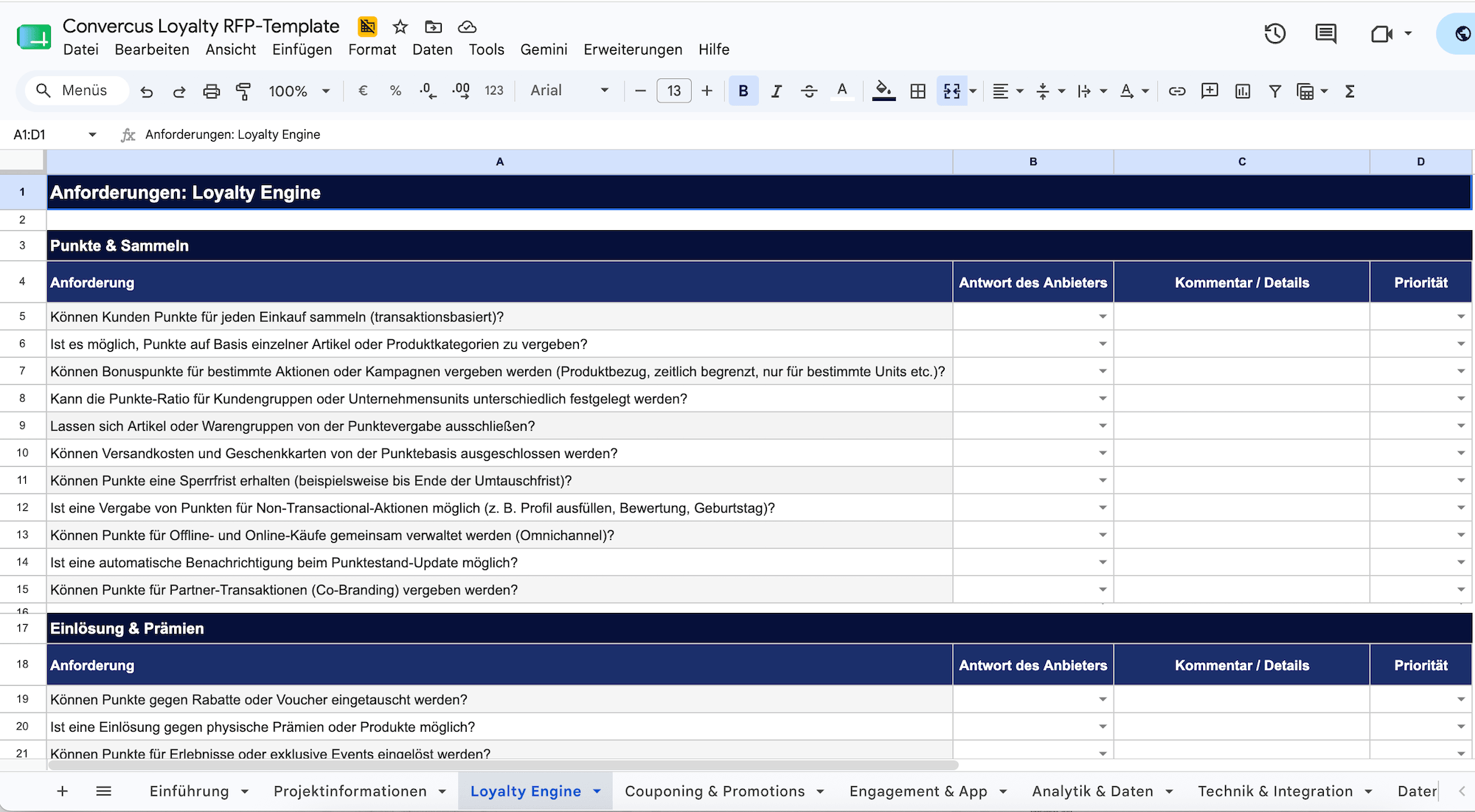
The B2B loyalty requirements described in the article show: Without the right technical infrastructure , any program remains piecemeal. The Convercus Loyalty Engine precisely meets these requirements and can be flexibly adapted to different business models.
Convercus Features at a Glance:
- API-first architecture: Integration into existing CRM and ERP systems with minimal IT effort. No complex custom programming, but open interfaces for quick connection.
- Modular design: Point systems, status management, personalized coupons, and marketing automation can be flexibly combined, depending on the program type and objectives.
- 100% GDPR compliant: Hosting on European servers with full data protection compliance. Especially for B2B programs with sensitive business data, this is a crucial factor.
- Usage-based pricing model: Low entry costs that scale with program success. This keeps investment risk low.
- Proven Success Management: Personal support from loyalty experts who work with your team to achieve measurable results.
B2B Loyalty: Start with API-first Architecture and Fast ROI
B2B loyalty is not a sales topic, but a strategic revenue driver. But only if the mechanics are tailored to B2B decision-making structures . Unique program types, measurable KPIs, and data-driven optimization form the foundation in the business customer environment to increase customer loyalty.
Review your existing measures based on the described program types and key figures. Identify gaps in your management and rely on a scalable platform like Convercus to systematically build and measure your B2B loyalty program.
FAQ
What ROI can a B2B loyalty program achieve?
According to Bain & Company, even a 5% increase in retention can boost profits by 25–95%. Alvarez & Marsal estimates the annual revenue increase at 10–20%. Many B2B loyalty programs achieve a positive ROI, especially when managed in a data-driven way.
Should a B2B loyalty program reward the company or the buyer?
Ideally, both. A hybrid approach combines company-wide benefits such as better terms and priority support with individual incentives like training or events. Important: For personal incentives for buyers, GDPR regulations, as well as compliance and anti-corruption guidelines, must be checked in advance.
Which KPIs measure the success of a B2B loyalty program?
The most important metrics are Retention Rate, Customer Lifetime Value, Net Promoter Score, Churn Rate, Redemption Rate, and Enrollment Rate. Initial results appear after 3–6 months, with sustainable CLV increases after 6–12 months.
How can a B2B loyalty program be integrated into CRM and ERP?
Through an API-first approach. Modern loyalty platforms like Convercus offer open interfaces, which can be connected to existing systems like SAP, Salesforce, or Microsoft Dynamics with minimal IT effort. Complex custom programming is not necessary.
What legal aspects apply to B2B loyalty in the EU?
The GDPR requires a legal basis for data processing (e.g., legitimate interest or consent) and transparent communication about data usage. For personal incentives for buyers in client companies, compliance and anti-corruption regulations must also be considered to avoid conflicts of interest or undue advantage.
Transform your transaction data into loyal partnerships. Experience the Convercus Loyalty Engine in a short live demo.

Leverage Convercus for data-driven status models and full ERP integration to achieve measurable growth, not B2C logic.