








- It not only manages points and discounts but also supports first-party data, personalization, omnichannel communication, and the targeted increase of frequency and basket size.
- High transaction volumes, low margins, and diverse store landscapes make API-first architecture, offline capability, and low latency essential.
- Multi-partner models provide reach, but a proprietary loyalty program offers more data control, greater differentiation, and more command over couponing and the customer experience.
- Convercus is suitable software for supermarket loyalty when omnichannel, couponing, and enterprise performance need to converge. The platform combines a Loyalty Engine, engagement, and API-first integration, making it particularly interesting for retailers who want to measurably grow customer loyalty.
Why Loyalty Software Will Become Strategic Infrastructure in Supermarkets by 2026
The German market has fundamentally shifted in a short time: REWE has left PAYBACK, Edeka has switched to PAYBACK, Lidl Plus is growing strongly, and more and more retailers are examining whether a proprietary loyalty program offers more long-term control than a multi-partner model. For supermarkets, it's no longer just about points or discounts, but about first-party data, personalization, and the ability to strategically manage demand.
Grocery Retail is the Most Important Loyalty Sector in Germany
47.3% of German adults are members of a supermarket loyalty program, and 82% of loyalty app users utilize programs from food retailers. At the same time, many retailers invest in loyalty, but only some achieve the expected impact: According to grocery studies, 73% have invested in rewards, but only 49% consider their programs effective. This very gap makes software selection so relevant.
Why the Time is Right
With the end of third-party cookies, loyalty in supermarkets becomes the most important lever for first-party data, consents, and personalized offer logic. Those who choose the right platform today lay the foundation for omnichannel communication, better basket analyses, and increased relevance at the POS, in the app, and in e-commerce. Conversely, those who continue to rely on rigid or fragmented systems lose data sovereignty, reaction speed, and room for differentiation.
What Differentiates Loyalty Software in Supermarkets from Other Industries
Supermarkets have different requirements than fashion, hospitality, or D2C. Purchase frequency is significantly higher, margins are lower, and the number of daily transactions is massive. Therefore, loyalty software must be supermarket-ready : high-performing, fault-tolerant, and close to the operational reality of the store.
High Frequency, Low Margin, High Complexity
In grocery retail, customers often shop weekly or even several times a week. Therefore, even small improvements in frequency, basket size, or coupon redemption have a significant impact on sales. At the same time, the net margin in the industry is often only 1% to 3%, which is why inefficient discount logic has a particularly rapid negative effect. Software must therefore precisely control which target group receives which incentive.
POS Integration Trumps Creativity
The best program fails if points are not properly recorded at checkout, coupons are not validated in real-time, or cashiers cannot identify what is redeemable. Therefore, in supermarkets, POS integration is the most critical success factor. Additionally, there are heterogeneous POS systems, store networks, self-checkout, click & collect, and sometimes delivery models. This is precisely why generic customer loyalty software from other industries is often insufficient for grocery retail.
Own Program or Multi-Partner? The Central Fundamental Decision
Many supermarkets begin by asking whether a multi-partner program like PAYBACK is sufficient or if their own system is strategically more sensible. The answer primarily depends on brand strength, customer numbers, store network, data strategy, and the desired depth of control. Multi-partner programs provide reach, while proprietary programs provide data sovereignty.
When a Multi-Partner Model Makes Sense
A multi-partner approach can be attractive if a retailer wants to quickly build reach, does not pursue its own app strategy, or has limited internal resources for operation and development. The disadvantage: customer data, program rules, and communication usually cannot be controlled with the same depth as in a proprietary program. Differentiation then arises more through promotions than through experience.
When a Proprietary Program is Superior
A proprietary program is particularly strong when retailers want to personalize across channels, analyze SKU-level data, and use couponing specifically for frequency or basket control. Especially in the supermarket context, the combination of data sovereignty, omnichannel control, and an app-first experience is a significant competitive advantage.
Essential Features for Supermarket Loyalty Software
When evaluating providers, one should not stop at "collecting points." Good loyalty software in grocery retail combines a loyalty engine, couponing, engagement, and analytics into a system that functions across stores, apps, and digital channels. What's crucial is not the quantity of features, but their operational relevance.
Point Systems, Couponing, and Immediate Benefits
Classic earn-and-burn mechanics still work, but they are rarely sufficient on their own. In supermarkets, customers primarily expect concrete, directly usable benefits. Therefore, the software needs flexible rules for threshold coupons, product recommendations, product category bonuses, and time-sensitive promotions. Offers based on past purchases, replenishment cycles, or preferred brands are particularly effective.
App, Wallet Pass, and Digital Customer Card
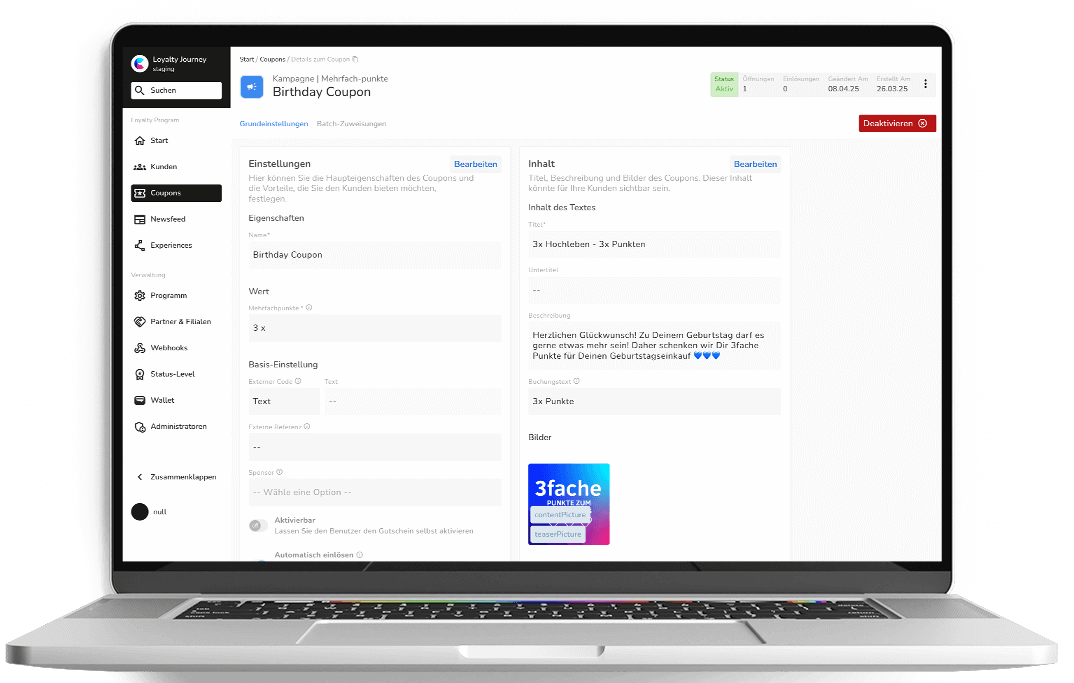
Since many customers use programs on mobile devices, a modern solution should support digital customer cards, wallet passes, and ideally strong app integration. This is not only convenient but also reduces media discontinuities at the POS. Those who want to delve deeper into mobile strategies will find further practical approaches in the article on App-First Loyalty . In grocery retail, the rule is: The simpler the identification and redemption, the higher the usage rate.

Personalization, Gamification, and Engagement
Standard offers for everyone are barely sufficient in a crowded loyalty market. 62% of consumers expect personalized offers. Therefore, loyalty software should support target group logic, trigger communication, challenges, and status mechanics. Gamification not only increases interaction but also provides additional behavioral signals, which can then be incorporated into future campaigns.
- A good platform must make purchase data usable at the SKU or product category level so that offers become truly relevant instead of generic.
- It should operate across channels so that coupons function consistently in-store, in the app, in e-commerce, and with Click & Collect.
- It needs analytics for redemption rates, active members, frequency, basket size, and retention, rather than just simple point balances.
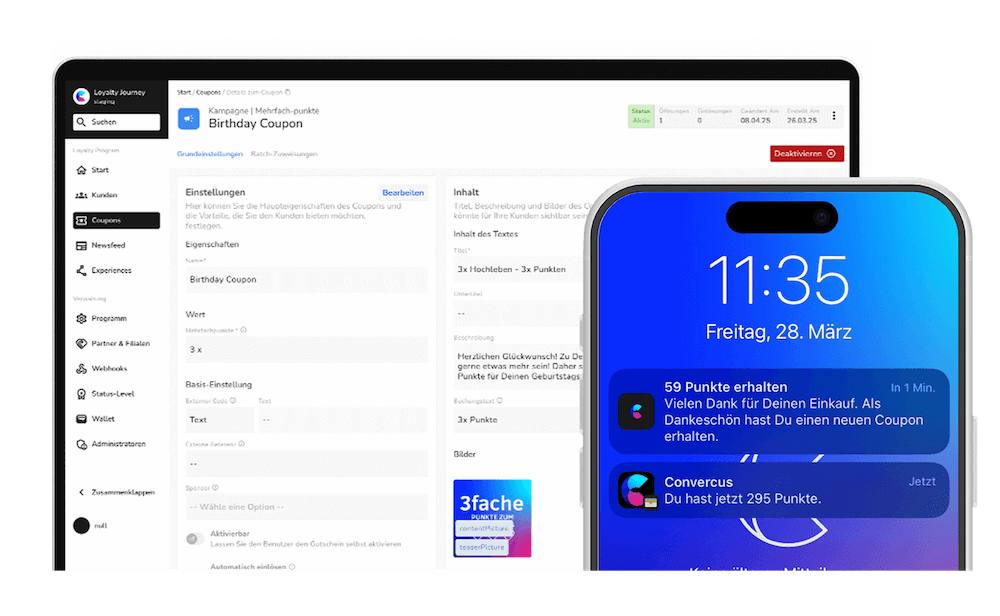
If you are looking for precisely these building blocks, it's worth taking a look at modern loyalty solutions, couponing and engagement. Convercus combines these areas in a SaaS platform designed for omnichannel retail, which can enable up to 8x higher customer interaction in programs with a white-label app.

Technical Requirements: API-First, POS Integration, and Offline Capability
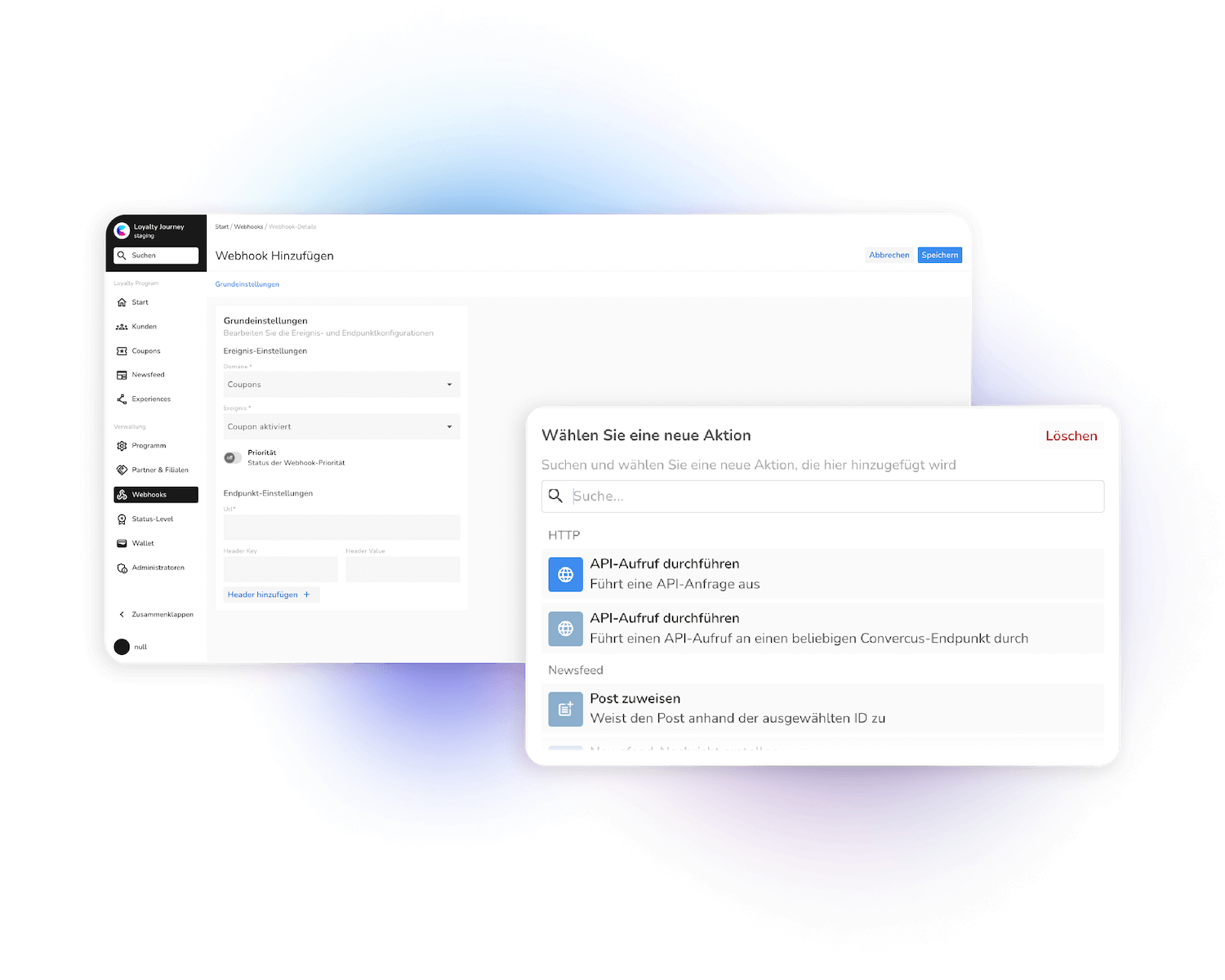
In supermarkets, architecture determines future success. Good loyalty software must integrate into existing POS systems, apps, webshops, and data landscapes without creating a fragile, custom solution. API-First is not a buzzword in grocery retail, but an integration principle.
Heterogeneous Store Landscapes Require Flexible Connectivity
Many retail groups operate with historically grown POS systems, different store formats, and multiple touchpoints. Therefore, the platform should offer clearly documented APIs, event-based processing, and robust fallbacks. It is particularly important that point recording, coupon validation, and customer identification in real-time or with very low latency are possible.
Offline Capability is a Must in Store Operations
If the internet connection fails, the loyalty program must not fail. Store processes require offline fallbacks, defined synchronization logic, and clear prioritization for later posting. Those evaluating modern architecture should specifically ask about response times, load tests, availabilities, and retry mechanisms. More on this can also be found on the page about Technology and Integration. For large retailers, the rule is: Scalability for millions of transactions is a must, not an extra.
GDPR, TDDDG, and Data Protection: What Supermarkets Specifically Need to Consider
Data protection is not a secondary issue in German grocery retail, but a central acceptance factor. Many non-users would generally be open to customer programs if concerns about data misuse and traceability decreased. Therefore, data protection should already be embedded in the architecture and program design. Legal compliance doesn't start with the banner, but with the data model.
Which Legal Bases are Relevant in Practice
For personalized offers, consent is often required under Art. 6 para. 1 lit. a GDPR required, which, according to Art. 7 GDPR must be demonstrable, voluntary, and revocable. Customers must be informed transparently, according to Art. 13 GDPR about which data is processed for what purpose. For requests for information and deletion, processes are necessary under Art. 15 and Art. 17 GDPR necessary. Furthermore, Art. 25 GDPR requires Privacy by Design and Art. 32 GDPR appropriate technical and organizational measures.
Why the TDDDG can also be relevant
If app or web components store or retrieve information on end devices, then additionally § 25 TDDDG must be checked. This applies, for example, to certain tracking or analysis mechanisms. In practice, for supermarkets, this means: consent management, data minimization according to Art. 5 Abs. 1 lit. c DSGVO, documented deletion concepts, and clear roles between retailers, app operators, and software providers are mandatory.
Calculating the Business Case: Where the ROI truly originates in supermarkets
The economic evaluation of loyalty software should not be based solely on discount costs. In the retail sector, several levers work in parallel: higher purchase frequency, larger basket size, reduced churn, better coupon efficiency, and additional manufacturer budgets through supplier-funded promotions. The best loyalty software reduces wastage and improves contribution margins.
Illustrative Calculation Example for a Regional Retailer
Let's take an operator with 100 stores and 500,000 active members, an average basket size of €35, and two purchases per week. This corresponds to approximately €1.82 billion in annual revenue. If purchase frequency increases by 5% due to targeted loyalty measures, this translates purely mathematically to around €91 million in additional revenue. An increase in the average basket size by 3% represents a further €54.6 million in revenue potential. Even if not all effects are fully additive, it becomes clear how significant the leverage is.
What is often underestimated
The real added value often arises where retailers currently still use a "shotgun approach": with unnecessary discounts, weak re-engagement strategies, and a lack of prioritization by customer segments. Additionally, supplier-funded promotions and retail media-like models can create new revenue streams if manufacturer budgets are cleanly integrated into the platform logic. More fundamental ideas on this can also be found in the overview of customer loyalty software.
Best Practices from Retail: What Successful Programs Have in Common
The German market shows that not every program automatically becomes a success story. This is precisely why it's worth looking at recurring patterns. Successful supermarket programs combine ease of use with clear, immediately recognizable benefits.
Lidl Plus, REWE Bonus, and Tesco Clubcard
Lidl Plus has gained attention primarily through low barriers to entry, strong coupon logic, and gamified elements. REWE Bonus represents the trend of strategically prioritizing proprietary data sovereignty and a unique app experience. Tesco Clubcard is an international benchmark for how data-driven personalization and assortment management can be scaled over years. What these programs have in common is that they are not just a marketing add-on, but an integral part of commercial steering.
What these programs do right
- They provide customers with clear, immediate benefits instead of just long-term points systems without tangible everyday advantages.
- They make loyalty as easy as possible at checkout and in the app, so that identification and redemption don't create additional hurdles.
- They use purchase history and segmentation to increase relevance and deploy discount budgets more effectively.
This is precisely where it's decided whether a program merely incurs costs or becomes a demand engine for frequency, basket size, and retention .
The Most Common Mistakes When Introducing Loyalty Software in Supermarkets
Many programs fail not due to their concept, but due to their implementation. Typical problems arise when strategy, technology, and store reality are not considered together. The biggest danger is a program that exists formally but is operationally weak.
Mistakes 1 to 3: Incorrectly Prioritizing Technology, Relevance, and Benefit
Firstly, POS integration is often addressed too late. Secondly, retailers rely on one-size-fits-all offers, even though customers expect personalized benefits. Thirdly, programs are launched with points collection without quickly redeemable benefits becoming visible. Especially in supermarkets, immediate benefits are usually more effective than abstract long-term rewards.
Mistakes 4 and 5: False Assumptions and Lack of Optimization
Marketers often overestimate emotional attachment and underestimate practical factors such as price perception, convenience, and checkout friction. Furthermore, after launch, there is often a lack of a clear optimization process for coupon performance, re-engagement, segment logic, and churn prevention. Therefore, anyone who systematically wants to increase customer loyalty or customer win-back needs not just an introduction, but a permanent operating model with KPI management.
How to Choose the Right Loyalty Software for Your Supermarket
When selecting a provider, supermarkets should not just compare demo impressions, but establish a clear evaluation framework. Particularly important are integration capabilities, performance, depth of control, data protection, omnichannel capabilities, and how quickly new campaigns can be implemented without major IT projects. The best solution is the one your team can truly operate scalably in everyday use.
The Most Important Questions for Every Provider
- How does POS integration work in a heterogeneous store landscape, and which specific API endpoints are available?
- What offline fallbacks are available if stores or individual systems temporarily lack a stable connection?
- How are coupon rules, segmentation, and redemption checks processed in real-time?
- What evidence is available regarding GDPR concept, role model, deletion processes, and authorization systems?
- How quickly can new mechanics like threshold coupons, challenges, or re-engagement flows be launched live?
- Which KPIs are available by default, and how are active members, retention, and redemption rate measured?
What to Look for in an Enterprise Fit
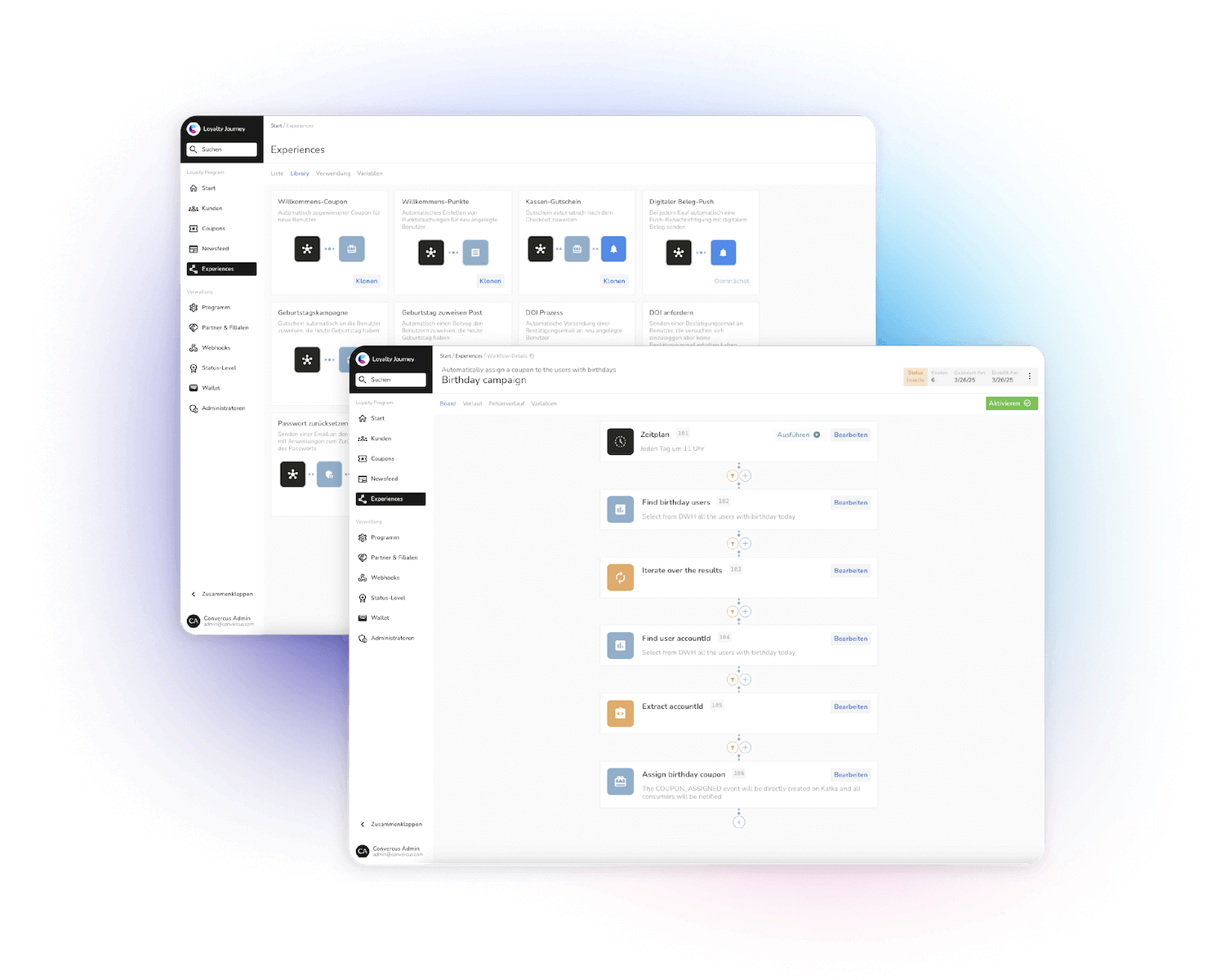
Besides functionality and price, it's important whether a provider truly understands your business model. Convercus is relevant here if you are looking for API-first integration, omnichannel couponing, and loyalty management with enterprise performance . The platform manages 40M+ loyalty accounts, 116M+ transactions, and 22M+ redeemed coupons, making it particularly interesting for retailers who not only want to launch a program but also operate it long-term as a central engagement infrastructure.
Conclusion: Loyalty Software in Supermarkets Must Do More Than Just Manage Discounts
The crucial question is not whether supermarkets need loyalty, but which platform enables the step from discount mechanics to data-driven management. Good loyalty software combines POS-proximate execution, personalized couponing, GDPR-compliant data processing, and scalable omnichannel processes. This is precisely the difference between a program that merely runs and one that delivers measurable impact.
If you want to replace an existing system, build your own program, or get more out of your existing customer base, Convercus is a valuable next point of contact. The combination of Loyalty Engine, Couponing, Engagement, and an API-first approach is particularly suitable for retail companies that need fast time-to-value and long-term scalability. Schedule a personal live demo with a loyalty expert and see what you can achieve for your supermarket with modern loyalty software.
FAQ
How complex is the implementation of loyalty software in a supermarket?
The effort primarily depends on the POS landscape, data sources, and desired omnichannel scope. Technically, the most critical aspects are POS integration, identification logic, and coupon validation. However, with an API-first platform, the rollout can be implemented much more structured and usually faster than with highly customized middleware.
Does loyalty software also work with our existing POS system?
In many cases, yes, provided the software offers clean interfaces, flexible integration patterns, and clear real-time or fallback logic. What's important is less the individual POS system and more the provider's ability to stably connect heterogeneous store landscapes. This is precisely why POS integration and offline scenarios should be evaluated early.
Can loyalty software for supermarkets be implemented in compliance with GDPR?
Yes, if consents are properly documented, information obligations are met, and data is processed only for specific purposes. Articles 6, 7, 13, 15, 17, 25, and 32 of the GDPR are particularly relevant, as is Section 25 of the TDDDG depending on the tracking setup. It is crucial that data protection is integrated into the architecture, processes, and operations.
How much does loyalty software for a supermarket cost?
This depends on the number of stores, user base, transaction volume, app scope, and integration complexity. In enterprise scenarios, you should consider not only licensing costs but also savings from more precise couponing, reduced wastage, and more first-party data. Ultimately, the overall benefit is what matters, not just the initial price.
How long does implementation take?
There is no fixed duration, as data situations, POS systems, and decision-making processes vary greatly. Typically, scoping, integration, testing, and rollout take several weeks to a few months. It becomes faster if processes, responsibilities, and the target architecture are clearly defined early on. [SEG 7] Can we migrate an existing loyalty program?
Yes, this is often even the most common reason for seeking a new provider. Crucial factors are data quality, migration logic for accounts and balances, consent status, and how existing rules are transferred to a more modern platform. A good migration minimizes friction for customers and ensures that the new program doesn't start from scratch.
Supermarkets need loyalty software that handles POS integration, real-time couponing, and personalization across millions of transactions. Convercus combines a Loyalty Engine, Engagement, and API-first architecture into a platform designed for omnichannel grocery retail.


- 5x Return on Investment
- 80% Customer Identification
- 8x Customer Interaction
- +274% Repurchase Rate