








The topic briefly and concisely
- Loyalty is a revenue driver for delivery services: With high CAC, low switching costs, and app-centric behavior, retention has a greater impact on profitability than the next discount code.
- The most effective programs combine multiple mechanics: Points, instant rewards, paid loyalty, personalized coupons, and gamification usually work better in combination than in isolation for delivery services.
- Technology and data protection must be considered: API-first integration, real-time rules, KPI tracking, and GDPR-compliant data processing are fundamental requirements for scalable loyalty software in the DACH market.
- Convercus is a suitable software for loyalty in the delivery-focused environment: If you want to consolidate customer loyalty, couponing, and engagement into a scalable platform, this is a sensible next evaluation step.
Why Loyalty Software is Indispensable for Delivery Services Today
The German delivery market in 2026 is characterized by consolidation, price pressure, and extremely low switching costs. Those who don't actively retain customers often lose them to the next provider after just one poor experience. Especially in the food delivery and quick commerce sectors, it's no longer enough to simply acquire reach through platforms. What's crucial is whether first-time orderers become repeat customers.
For delivery services, this isn't just a marketing question, but an economic one. Studies show that even a 5% increase in retention can boost profits by 25% to 95%. If you'd like to delve deeper into the strategic fundamentals, you'll find further insights in the article on Customer Loyalty.
The German Delivery Market in 2026: Consolidation Instead of Growth at Any Cost
Lieferando dominates the German market, while quick commerce and grocery delivery have undergone significant consolidation. The exit of Getir and Gorillas, along with Flink's increased focus, demonstrates that sustainable growth has become more important than simply chasing new customers. For restaurant chains, D2C food brands, and regional delivery services, this means that their own customer relationships are becoming a strategic asset.
At the same time, competitors are focusing on paid loyalty, exclusive partnerships, and better app experiences. Wolt+ or Lieferando-Plus models are good examples of this. In this environment, those who only work with generic discount codes remain interchangeable.
Why Discounts Alone Don't Create Loyalty
Many delivery services try to combat churn with a constant stream of new vouchers. This temporarily increases conversion but often doesn't permanently reduce churn. On the contrary: customers learn to wait for the next discount instead of developing a genuine preference for your brand.
Effective customer loyalty in delivery services therefore requires more than just an earn-and-burn system. Instantly redeemable benefits, relevant coupons, challenges, subscriptions, and personalized triggers based on ordering behavior have a more lasting effect. This is precisely where loyalty software comes in: it connects data, rules, communication, and redemption within a controllable system.
How Loyalty Software Works in the Delivery Service Context
Loyalty software for delivery services doesn't just manage points or discounts. It translates ordering behavior into targeted incentives, personalized communication, and measurable retention effects. In the delivery context, this is particularly relevant because orders are frequent, mobile, and context-dependent.
The three-sided market: End customer, restaurant, and platform
In delivery services, loyalty is more complex than in many other industries. Besides the end customer, restaurant partners and platforms also play a central role. A good loyalty setup must therefore clearly define who owns the program, where the data resides, and through which channels value is created.
For restaurant chains or D2C brands, the strategic question often is: How do I build my own relationship with the customer, even though some orders go through aggregators? The answer usually lies in a parallel, proprietary loyalty infrastructure with app, web, or wallet integration.
The 6 most important loyalty mechanics for delivery services
- Point systems work well when customers experience quickly visible progress and rewards are not only attainable after many orders.
- Paid Loyalty and Subscriptions such as free delivery or exclusive deals are particularly suitable for frequent orderers with a high order frequency.
- Instant Rewards increase relevance in the price-sensitive market because the benefit is immediately noticeable with the next order.
- Gamification with Streaks, Badges, and Challenges fits ideally with app-centric models and can reinforce weekly routines.
- Personalized Coupons based on time of day, shopping cart, favorite category, or inactivity make offers significantly more efficient than mass discounts.
- Referral Programs are particularly effective in the delivery market because recommendations among friends quickly translate into first orders.
Subscription, points, or gamification: Which model is right?
Not every approach suits every business model. A regional grocery delivery service needs different incentives than a high-frequency QSR chain or a ghost kitchen without a physical touchpoint.
In practice, hybrid models are usually the strongest: for example, points plus personalized coupons or a subscription model with exclusive benefits and challenges for in-app engagement.
What features a loyalty software for delivery services should have
When delivery companies evaluate a solution, it's not about having as many features as possible, but about operational feasibility. Key factors are integration capability, real-time logic, mobile activation, and clean data management. Especially during peak loads like Friday evenings, TV events, or promotional weeks, the loyalty engine must not be a bottleneck.
API-first architecture and real-time capability
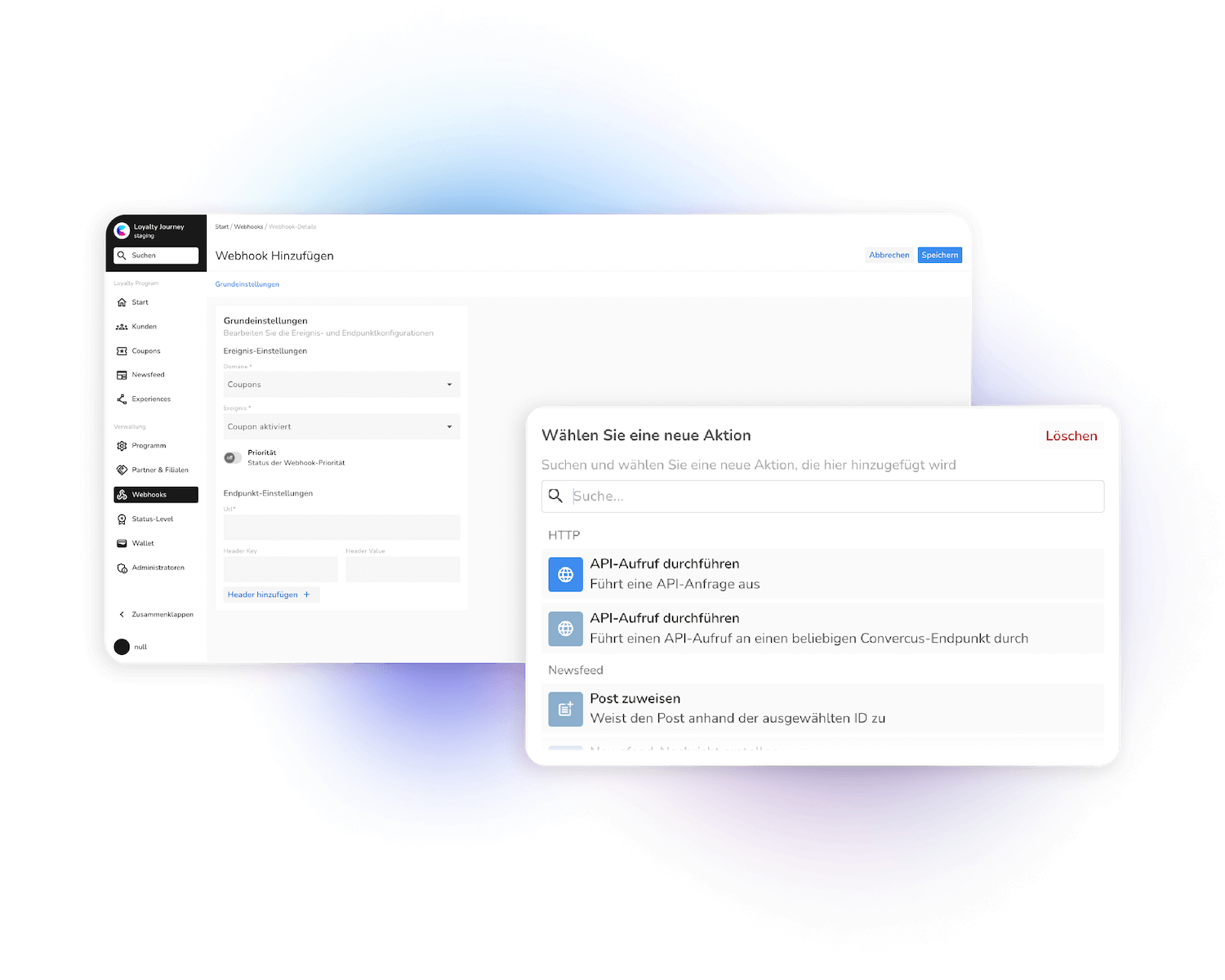
A modern loyalty software must be able to integrate cleanly via API into order apps, webshops, CRM, payment systems, and potentially POS. In delivery services, API-first is not a nice-to-have, but a prerequisite for rapid implementation and clean omnichannel processes. Only this way can points, status, coupons, or challenges become visible directly in the checkout, in the account, or after the order.
Performance is equally important: rules must apply in real-time, even when thousands of transactions are processed simultaneously. What is technically relevant in this context is shown in the section Tech and Integration.
Personalization, Couponing, and Marketing Automation
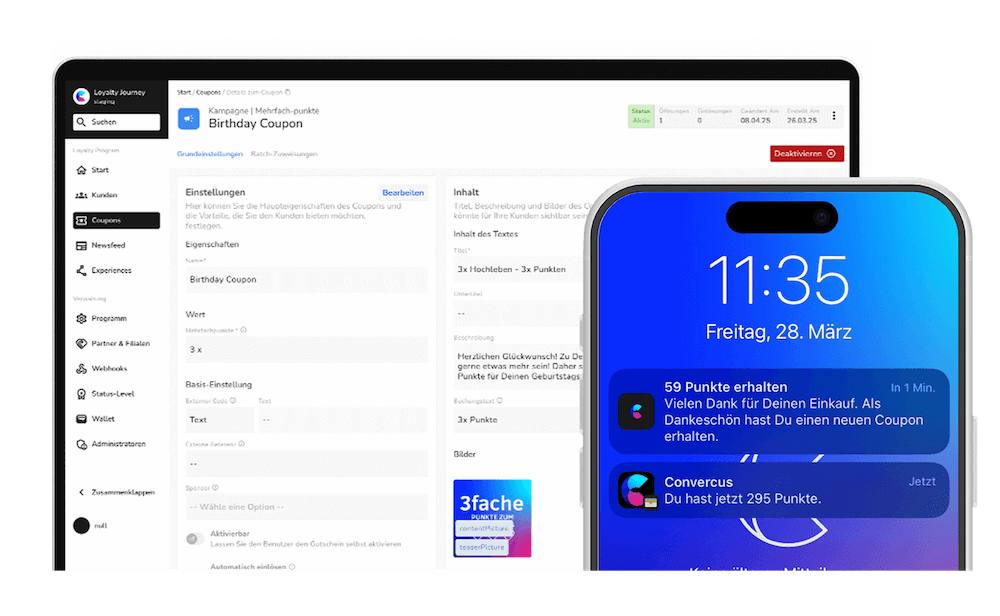
Today, delivery customers expect relevant offers instead of generic ones. The best loyalty software recognizes patterns in ordering behavior and automatically deploys suitable incentives. Examples include reactivation after 21 days of inactivity, a vegetarian coupon for customers with a relevant order history, or a weekend trigger for family households.
Crucially, this involves combining loyalty, couponing and engagement. With Convercus, such logic can be implemented within a single platform instead of laboriously orchestrating multiple individual solutions. This reduces operational friction and accelerates testing, A/B variants, and rollouts.

Mobile Engagement, Wallet, and Gamification
Since delivery services are almost always used mobile-first, loyalty software should support apps, mobile web experiences, and wallet touchpoints. The lower the barrier to a membership account, the higher the activation rate. A wallet pass can serve as an easy entry point if a fully developed app is not yet available.
Gamification is not an end in itself, but it can be highly effective in the delivery context. Studies from the restaurant sector show that playful rewards can significantly increase app usage and reward redemption. Especially for regular consumption occasions, streaks, weekly challenges, or small interim goals are often more effective than distant grand prizes. You can find more about this mobile approach in the article on App-first Loyalty.
Analytics, KPIs, and GDPR-compliant Data Processing
Without accurate measurement, loyalty quickly becomes a matter of gut feeling. A robust solution displays order frequency, churn, redemption rates, AOV, CLV, and campaign effectiveness in real-time. This allows teams to immediately see which rewards are profitable and which segments merely generate discount costs.
For the DACH market, data protection is also mandatory. Relevant foundations include, in particular, Art. 5 GDPR with purpose limitation and data minimization, Art. 6 para. 1 lit. a GDPR for consents, Art. 25 GDPR for Privacy by Design, and Art. 28 GDPR for commissioned processors. For promotional emails, § 7 UWG (German Act Against Unfair Competition) must also be observed. GDPR is therefore not an impediment to personalization, but rather the framework for clean and trustworthy loyalty processes.
ROI of Loyalty Software in Delivery Services: What's Measurably Achievable
Decision-makers don't need a vision for loyalty, but a business case. In the delivery market, order frequency, repurchase rate, and churn are usually more important than purely short-term voucher conversions. This is precisely why the benefits of good loyalty software can be modeled relatively clearly.
The most important KPIs for delivery services
Four key metrics are central: order frequency, Average Order Value, Churn Rate, and Customer Lifetime Value. Order frequency is often the strongest lever in delivery services, because just one additional order per month per customer can generate significant revenue impact. In addition, there are redemption rate, active member percentage, referral rate, and reactivation rate.
If you don't separate these metrics by members and non-members, the program's effect remains unclear. It's also important to directly offset discount costs, free deliveries, and reward costs against incremental revenue and CLV.
Example calculation: Regional delivery service with 100,000 active customers
Even moderate improvements can generate significant additional revenue. The following example is based on frequently cited market benchmarks from restaurant and delivery-related loyalty programs.
This is not a guarantee, but a realistic framework for orientation. In practice, the result depends on product mix, margin, channel share, regional density, and reward logic.
What successful programs typically achieve
Studies from restaurant and loyalty programs show that members visit restaurants 20% more often on average and spend about 20% more per visit. Mature loyalty programs often increase revenue not through a single lever, but through a combination of higher frequency, better reactivation, and relevant personalization. Additionally, companies with AI-powered personalization report significantly higher redemption rates than with purely static segmentation.
This is particularly relevant in the app-centric delivery environment, because mobile commerce often keeps only a small fraction of users active after 30 days. Loyalty software closes this gap by intelligently stimulating recurring usage.
Best Practices for Loyalty in Delivery Services
The strongest programs in the delivery market combine economic benefit with convenience. Customers remain loyal not because they see points, but because the overall experience becomes more convenient, relevant, and rewarding.. This is precisely where the most important best practices can be derived from.
Paid Loyalty as a Growth Driver
Models like Wolt+ or Lieferando Plus demonstrate why paid loyalty works so well in delivery. When a membership regularly saves on delivery costs and offers exclusive benefits, the likelihood of repeat orders significantly increases.. For providers, this simultaneously creates a more predictable revenue stream and stronger commitment from their most engaged customers.
Crucially, paid loyalty shouldn't just promise free delivery. Additional benefits like exclusive time slots, member coupons, early access to promotions, or bonus mechanisms for referrals are valuable.
Cross-Channel Consistency is a Must
Customers don't neatly distinguish between an app, website, QR code on packaging, or a physical touchpoint. They expect their status, rewards, and benefits to work consistently everywhere.. Whether ordering online, scanning in a restaurant, or activating via a wallet pass, customers should experience the same loyalty identity.
This is particularly important for restaurant chains looking to integrate delivery, click & collect, and in-store sales. According to studies, omnichannel customers shop 1.7 times more frequently than single-channel customers. Therefore, delivery loyalty is strongest when it's not tied to a single channel in isolation.
5 Mistakes Delivery Services Should Avoid
- A static welcome voucher without a further journey usually only creates a short conversion peak, but no sustainable repeat purchase behavior.
- Too much discount logic in the medium term reduces margins and trains customers to only order when there's a price advantage.
- Lack of real-time segmentation results in inactive users, frequent buyers, and bargain hunters receiving the same messages.
- Standalone tools for coupons, CRM, and loyalty slow down campaigns and complicate success measurement.
- Lack of a clear KPI set makes it impossible to assess whether the program truly increases CLV or merely generates reward costs.
From Platform Dependency to Building Your Own Customer Loyalty
For many restaurant chains, virtual brands, and regional delivery services, loyalty is primarily a strategic response to platform dependency. Businesses that only reach their most valuable customers through aggregators lack both data ownership and a direct communication relationship. This is precisely where proprietary loyalty infrastructure can become a competitive advantage.
Why First-Party and Zero-Party Data Are So Important
First-party data reveals how often, when, and what customers order. Zero-party data complements this by adding voluntarily provided preferences, such as dietary habits, favorite categories, or communication channels. This data forms the foundation for relevant personalization and, consequently, for more profitable retention.
It's crucial that customers recognize the value exchange. When someone shares their preferences, it should visibly lead to more relevant communication. Otherwise, data collection remains merely a form and fails to build trust.
How to Build Your Own Program Alongside Lieferando and Wolt
The pragmatic approach is rarely a complete platform exit. A parallel strategy is often more successful: strengthen their own app or mobile web presence, use QR codes on packaging, promote wallet or app registration, and gradually transition existing customers into their own loyalty ecosystem.
Technically, this requires a robust loyalty engine that can integrate into existing ordering processes and consolidate data across all channels. This is precisely why Convercus is relevant in the mid-market and enterprise sectors: as an API-first platform for loyalty, couponing, and scalable customer retention, without tying you to a specific suite. Additionally, for winning back churned users, it's also worth considering Customer Win-Back .
Customer Win-Back instead of Constant Discounts
Not every inactive customer needs the same incentive. Reactivation becomes more profitable if you identify churn risks early and deploy segmented triggers. For example: an immediate benefit after 14 days of inactivity, a personalized favorite product coupon after 30 days, or a challenge mechanism for the first two reorders.
This creates a win-back logic that doesn't constantly rely on widespread price reductions. This protects both margins and brand perception.
Loyalty Trends 2026: What Delivery Services Should Be Watching Now
The loyalty market is evolving significantly beyond traditional points-based systems. In 2026, formats that reduce friction and deliver immediate, tangible benefits will gain particular importance. This is particularly relevant for delivery services because purchasing decisions are made on mobile, quickly, and often situationally.
Conversational Loyalty via WhatsApp and Messaging
Enrollment, point inquiries, reward redemption, and reactivation are increasingly moving into messaging channels. Conversational loyalty shortens paths and lowers the barrier to entry for customers who don't seek every interaction within an app. Especially for regional brands or recurring dining occasions, this can be a powerful additional channel.
However, the orchestration in the background remains crucial: Chat is just the interface. The real relevance comes from rules, data, and triggers from the loyalty engine.
Small milestones and instant rewards instead of infrequent major rewards
Many programs reward birthdays or large thresholds. In delivery, the opposite often works better. Small, frequent moments of success, such as the fifth order, the first review, or three orders in two weeks, increase perceived momentum. This fits the high frequency of the channel.
At the same time, many consumers in the DACH market expect immediately usable benefits instead of long-delayed rewards. Instant rewards, easy wallet redemption, and small progress are therefore often more effective than distant collection goals.
AI as an invisible loyalty lever
The most effective AI in loyalty does not present itself as a mere show. It reduces irrelevance. This means: fewer irrelevant coupons, better product recommendations, more suitable delivery times, and earlier churn signals.
For delivery services, this can mean, for example, incorporating weather, time of day, category preferences, or order pauses into the trigger logic. Customers then don't experience 'AI', but simply a better, more personalized program.
How to get started with the right loyalty software for delivery services
The biggest mistake when starting is to immediately discuss point currencies or reward catalogs. The starting point is business goals, data availability, and integration realities. Only then does it become clear which mechanics, which setup, and which operating model truly fit.
Checklist: These questions to answer before choosing
- Which key metric should increase first – order frequency, reactivation, AOV, or app usage?
- Which data sources are already available and how seamlessly can they be integrated with your ordering app, CRM, and potentially POS?
- Through which channels should loyalty operate – app, web, wallet, email, push, or additional messaging?
- Which rewards are economically viablewithout eroding margins through overly aggressive discounts?
- How are consent, data protection, and role permissions organizedto ensure seamless collaboration between marketing and IT?
- How should success be measured– meaning, which control groups, KPI definitions, and reporting structures are established from the outset?
A realistic project roadmap
In practice, a good project starts with scoping, goal definition, and data validation. This is followed by the rule set, integration concept, pilot setup, and a controlled launch. Particularly important is an initial rollout that yields measurable results quickly, rather than waiting months for the perfect program. An existing solution or an old coupon system can often be migrated incrementally.
If you want to compare different software approaches, it's also helpful to look at the overview of Customer Loyalty Software. This highlights the typical requirements that mid-market and enterprise companies have for modern platforms.
Conclusion: Loyalty software is a strategic lever for delivery services
Delivery services today face dual pressure: high acquisition costs and low barriers to switching. Loyalty software is therefore not an add-on, but a tool for retention, first-party data, and more profitable growth. Programs that combine points, coupons, personalization, gamification, and reactivation into a unified logic are particularly effective.
If you are looking for a scalable solution for delivery-focused customer loyalty, Convercus is a logical next step: an API-first loyalty platform for mid-market and enterprise requirements, focusing on performance, omnichannel, and rapid implementation. You can find more about the solution on the Loyalty Enginepage. If you would like to discuss your specific scenario, you can also directly request a personal demo .
FAQ
How complex is it to implement loyalty software for a delivery service?
The effort primarily depends on your existing system landscape. If your app, ordering process, and CRM are already cleanly integrated, a pilot can launch significantly faster than with highly fragmented systems. Many companies therefore start with a clearly defined use case, such as reactivation or a points program for loyal customers.
Does loyalty software work with existing ordering apps and POS systems?
Yes, provided the solution is built API-first. It is crucial that transactions, identities, and reward logic are synchronized in real-time between the app, web, and, if applicable, POS. This integration capability should be part of any technical evaluation.
Is a personalized loyalty program possible while remaining GDPR compliant?
Generally, yes. Crucial factors include a clear legal basis, transparent information, purpose limitation, and data-minimizing processing in accordance with GDPR. For email marketing, the requirements of Section 7 of the German Unfair Competition Act (UWG) must also be met.
What does loyalty software for delivery services cost?
Costs vary depending on the number of users, transaction volume, integration effort, functional scope, and rollout depth. More important than the pure software price is how quickly the program pays for itself through increased frequency, reduced churn, and improved CLV. Therefore, every selection should begin with a business case.
How long does implementation take?
An initial launch can be possible within a few weeks to several months, depending on complexity. It will be faster if you start with a focused scope and don't immediately try to cover every country, channel, and special logic. A phased rollout is usually more sensible for delivery services than a big bang approach.
Can we migrate an existing loyalty or coupon system?
Yes, this is often the standard scenario. It is important to systematically transfer existing points, vouchers, membership statuses, and consent data. In many projects, the old system is initially run in parallel until the new logic and reports are stable.


- 5x Return on Investment
- 80% Customer Identification
- 8x Customer Interaction
- +274% Repurchase Rate
.jpg)