










The topic, short and concise
- The loyalty software marketplace is a selection market, not a feature showcase. Crucial factors are provider type, integration capability, omnichannel expertise, and TCO – not just the length of the feature list.
- API-first, GDPR, and POS integration are key purchasing criteria in the DACH market. Especially in retail, hospitality, and mobility scenarios, data flows, consents, and cross-channel redemption must be meticulously planned from the outset.
- The business case is built on CLV, repurchase rate, and lower churn. Even a 10% higher repurchase rate can generate significant additional revenue for large programs.
- Convercus is a specialized software for Loyalty, Couponing, and Engagement. For mid-market and enterprise companies, Convercus is particularly relevant when omnichannel, API-first integration, and scalable loyalty programs need to come together.
Loyalty Software Market: What it's really about in 2026
Those searching for "Loyalty Software Market" usually aren't looking for a single online marketplace, but rather the software market for loyalty platforms: including the vendor landscape, selection criteria, pricing models, and technological differences. This is precisely where guidance is needed, as search results often consist of product pages, case studies, and individual opinions, but rarely a clear market overview.
The market is growing dynamically. Depending on the analyst firm, the global volume in 2026 is already at approximately USD 16.44 billion, with forecasts exceeding USD 32 billion by 2031. Simultaneously, brands and retailers face increasing pressure to build first-party data, enhance customer lifetime value, and measurably reduce churn. Loyalty software is therefore no longer just a marketing tool, but a core part of the commercial infrastructure.
Why Loyalty Software is Becoming Strategically More Important
For retail, e-commerce, hospitality, mobility, and D2C brands, the following applies: rising acquisition costs and shrinking profit margins make retention more valuable than ever before. In 2026, 59% of loyalty executives prioritize improving CLV, while 44% focus on reducing churn. This shifts the discussion away from mere sign-ups and towards genuine engagement, relevant benefits, and data-driven personalization.
In the DACH market, additional factors come into play. For loyalty programs, data protection and governance are not peripheral issues but strict selection criteria. Particularly relevant are GDPR Art. 5, Art. 6, Art. 7, Art. 25, Art. 28, and Art. 32 as well as supplementary BDSG, for instance, concerning data processing agreements, consents, Privacy by Design, and technical protective measures.
How the Loyalty Software Market is Structured
The market can be broadly divided into four groups: specialized best-of-breed platforms, suite solutions from large CRM or marketing providers, API-first loyalty engines, and full-service providers offering software plus operational management. None of these categories is inherently superior – what's crucial is the actual complexity of your program, your system landscape, and your omnichannel model.
Understanding Best-of-Breed, Suite, and Full-Service
Many procurement processes fail because companies ask about features too early and about architecture, operational models, and operations too late. Best-of-Breed vs. Suite is a strategic decision, not just a product question. Those who require complex rule sets, couponing, status models, and cross-channel redemption often find that suite modules reach their limits faster than specialized platforms.
API-first is More Than Just a Technical Label
API-first doesn't just mean a REST API is available. It means loyalty can be seamlessly integrated into POS, shop, app, CRM, CDP, and marketing automation, without having to adopt rigid frontends or monolithic processes. Especially in brick-and-mortar retail, this integration capability is often the actual purchasing criterion, because otherwise, earn and redeem rules can diverge between the POS, app, and e-commerce.
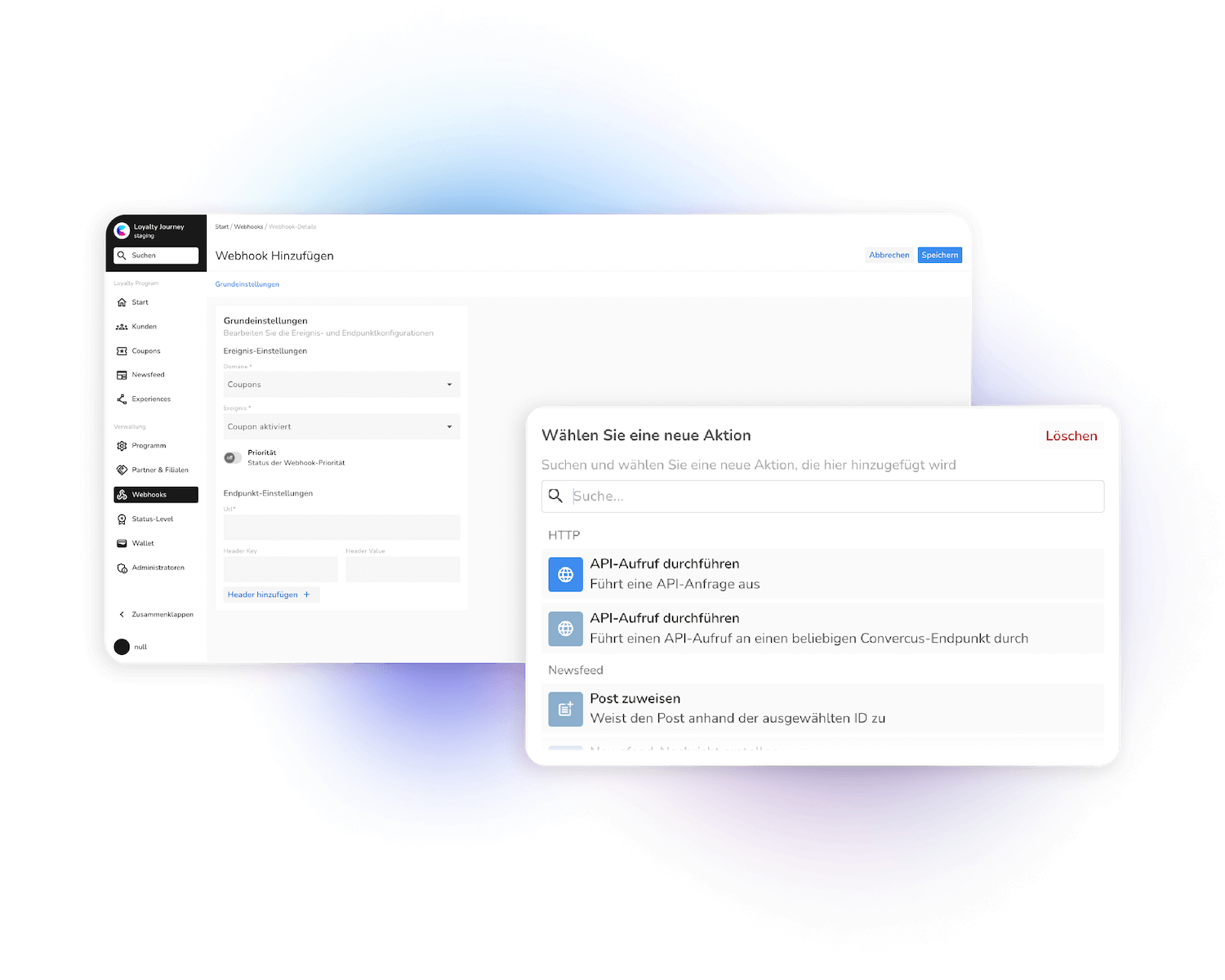
The Most Important Selection Criteria for Your Shortlist
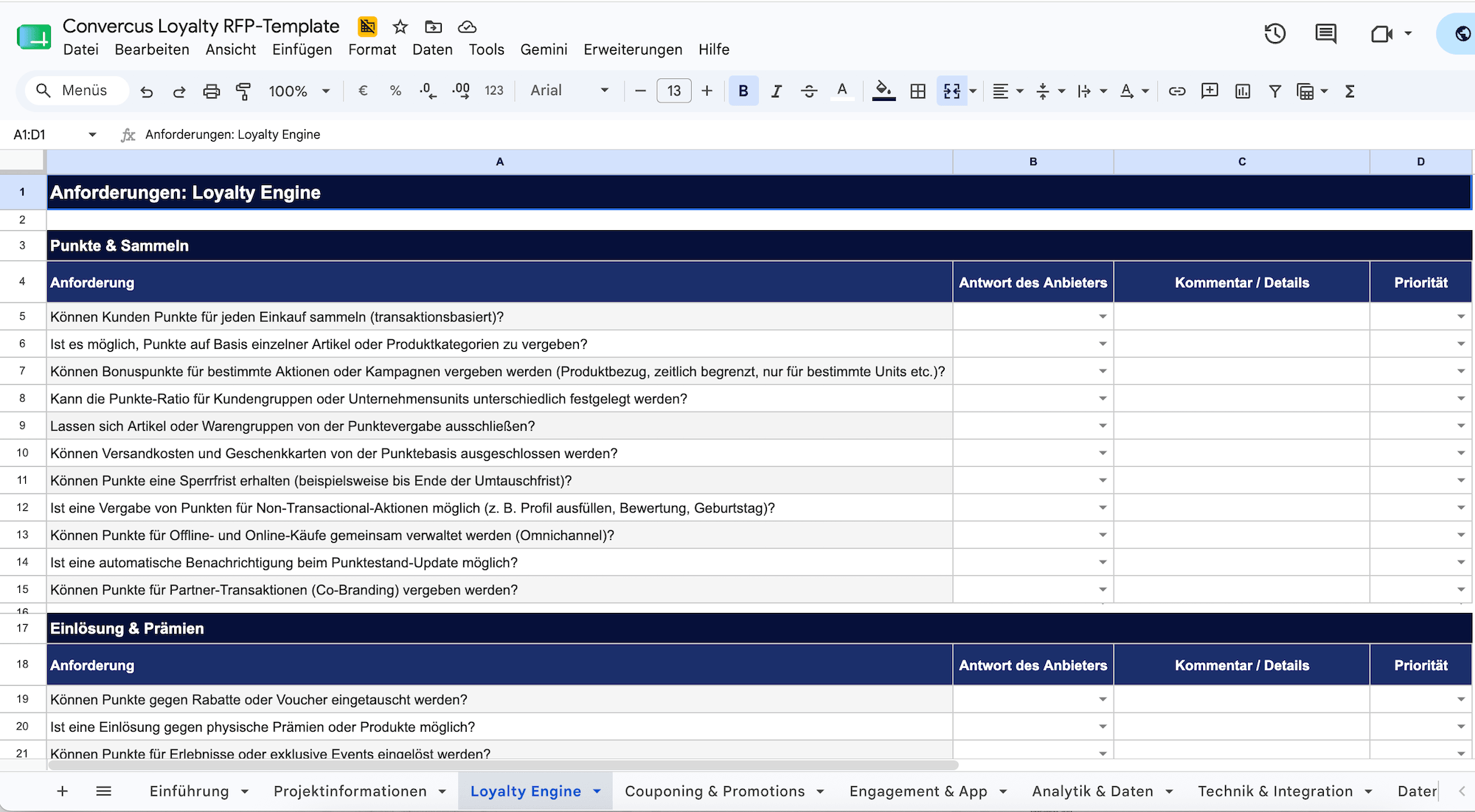
Before comparing providers, you need a robust requirements list. In practice, this is precisely the most common bottleneck: companies create a vendor longlist too early, even though they knock-out criteria, mandatory requirements, and priorities haven't clearly defined yet. This leads to unproductive demos and offers that are difficult to compare.
A sensible selection framework combines functional, technical, regulatory, and economic criteria. License price alone is not enough, because integration effort, operations, training, migration, and subsequent program changes massively impact the total benefit.
- First, check the program flexibility, i.e., whether point systems, status models, coupons, benefits, challenges, and partner mechanics can be implemented without extensive custom development.
- Evaluate omnichannel capability early on, especially the interplay between POS, online shop, app, wallet pass, and customer service.
- Treat GDPR and security as a knock-out criterion, including hosting region, role permissions, data processing agreements under Art. 28 GDPR, and technical measures under Art. 32 GDPR.
- Ask about performance under load, i.e., about uptime, transaction volume, response times, and behavior during peak scenarios like Black Friday or in-store promotions.
- Compare TCO instead of just setup costs, because cheap license models can quickly become unattractive due to expensive integrations or limited self-management capabilities.
Functionality and Program Design
The best software is of little use if the program design is too complex. Good platforms make it easy to make earning and redeeming understandable, fast, and relevant. Earn-and-burn alone is usually no longer sufficient in 2026; what's needed are hybrid models combining transactional benefits, experiences, personalization, and engagement.
Technology, Compliance, and Operations
From an IT perspective, you should ask about API documentation, sandbox, release logic, role permissions, monitoring, and data flows. From a compliance perspective, these include consent management, data minimization, and Privacy by Design firmly on the evaluation sheet. Companies that only check these points after the business unit selection often lose weeks or months in the procurement process.
Build vs. Buy: When In-House Development Pays Off – and When It Doesn't
The question "build it yourself or buy a platform?" is asked in almost every major selection process. In principle, in-house development can be worthwhile if your company has exceptional processes, very strong internal engineering resources, and a long planning horizon. In most cases, however, time-to-value is more important than maximum technical freedom.
When In-House Development Can Make Sense
A build approach is primarily realistic if loyalty is a true core process for your business model and you permanently maintain internal teams for product, backend, frontend, security, DevOps, and analytics. The real challenge is not the initial release, but the ongoing development of rule sets, monitoring, fraud prevention, data protection, and international rollouts.
Why TCO is Almost Always Underestimated
Many business cases only calculate development effort against license costs. This falls short. The true costs include migration of existing accounts, test automation, peak load scenarios, training, support, product maintenance, and adaptations to new regulatory requirements. TCO is therefore almost always higher than initially planned, especially when POS, app, and e-commerce need to run synchronously.
Those who want to systematically check the criteria will find a useful in-depth discussion for the make-or-buy decision in our article on customer loyalty software a useful in-depth discussion for the make-or-buy decision.
What Modern Loyalty Software Really Needs to Be Able to Do
The foundation of every platform includes point systems, status models, rewards, and reporting. However, it becomes truly crucial where loyalty is translated into operational reality: at the checkout, in the app, in the shop, and in automated campaigns. Omnichannel, Personalization, and Couponing are therefore not add-on modules, but usually the real levers for better repeat purchases.
Omnichannel with POS, App, and Online Shop
Customers expect to experience the same rules at every touchpoint: collecting points in-store, seeing benefits in the app, redeeming coupons online, and tracking their status across channels. According to studies, omnichannel customers buy 1.7 times more often than single-channel customers. That's precisely why POS integration, wallet pass, and digital customer cards must be checked already in the selection phase.

If you want to strategically expand your mobile channel, it's also worth looking at App-first Loyalty, because visibility, usage, and push communication converge directly there.
Personalization, Couponing, and Automation
In 2026, personalization is the most important investment area in the loyalty landscape. This doesn't just mean segmentation by revenue classes, but the intelligent derivation of relevant offers from purchase history, behavior, and context. AI should reduce friction, not merely be visible. Good software identifies which benefit makes the next purchase more likely, rather than indiscriminately offering discounts.

For companies looking to combine loyalty, couponing, engagement and API-first integrations in a DACH-compatible platform, Convercus is an obvious option. The benefit lies less in isolated point management than in a continuous orchestration of benefits, campaigns, and touchpoints.
The ROI of Loyalty Software: How to Calculate the Business Case
At the C-level, it's not about how modern a loyalty program looks, but what it achieves economically. A robust business case combines repurchase rate, average order value, redemption rates, CLV, churn, and operational costs. Enrollment alone is not proof of success, because sign-ups without activity only produce superficial success.
Example Calculation for an Omnichannel Retailer
Let's take a retailer with €250 million in annual revenue and 500,000 active members. With an average basket size of €50 and five purchases per year, this results in an annual revenue of €250 per active customer. If the repurchase rate increases by a better orchestrated loyalty program by 10%, this mathematically corresponds to an additional 0.5 purchases per customer – meaning €12.5 million in additional revenue.
Which KPIs truly matter for strategic management
Key metrics include active member rate, redemption rate, repurchase rate, CLV, churn, cost per active member, and the share of personalized revenue. ROI comes from improved behavior, not from more discounts. Therefore, you should always evaluate benefits against margin, segment value, and redemption dynamics. Those who wish to delve deeper into operational levers will find additional approaches in our article on Increasing Customer Loyalty.
The most common mistakes when choosing Loyalty Software
Many projects fail not due to a lack of budget, but due to incorrect sequencing and unrealistic assumptions. Execution beats strategy: A good selection process is often more valuable than the longest feature list.
- Mistake 1: You compare providers without a requirements catalog. Then every demo seems convincing, but no solution can be properly evaluated.
- Mistake 2: You only look at license costs. Integrations, migration, internal resources, training, and operations determine the true TCO.
- Mistake 3: You only plan omnichannel after launch. This leads to fragmented rule sets, media discontinuities, and unclear customer experiences.
- Mistake 4: You opt for an overly complicated earn-and-burn model. If the path to reward is too long or too opaque, usage quickly declines.
- Mistake 5: You forgo a Proof of Concept with real-world scenarios. Especially with POS, app, couponing, and status logic, differences only become apparent in practical testing.
The measurement logic is also crucial. Sign-ups are easily artificially inflated, for example, through one-time upfront discounts. More relevant metrics are active usage, repeat purchases, and behavior after benefits or campaigns.
Trends in the Loyalty Software Marketplace 2026
The market trend is clear: Loyalty software is becoming more technical, data-driven, and more deeply embedded in existing platform landscapes. 59.7% of surveyed companies name personalization as the most important investment area in 2026, 44.4% prioritize automation, and 32.2% omnichannel experience. The market thus primarily rewards platforms that deliver orchestration rather than individual functions.
AI Personalization, Automation, and Omnichannel
AI is valuable when it deploys suitable rewards, benefits, or reactivation impulses at the right moment. Companies with better personalization sometimes report significantly higher redemption rates than with classic segmentation models. The trend is towards more relevant interactions with less wastage, not towards increasingly aggressive discounts.
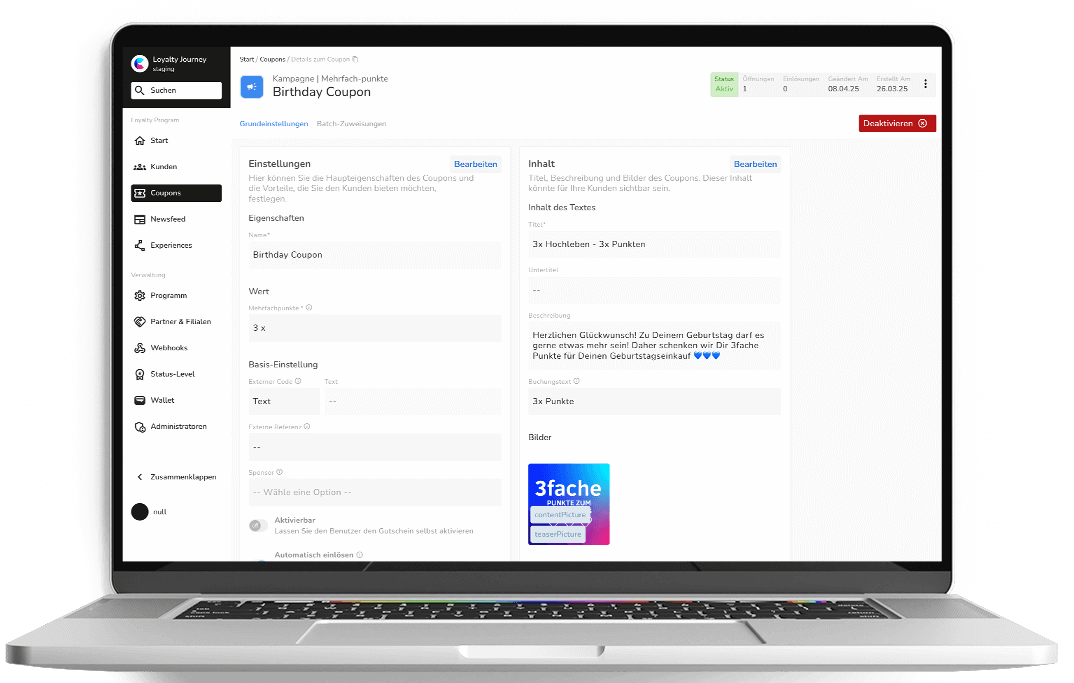
Cloud, Subscription, and Market Consolidation
While on-premise still accounts for a significant share, cloud-based API platforms are growing faster. In parallel, subscription-based loyalty is gaining momentum, while suite providers and specialists compete for the same budget. For buyers, this means that roadmap, innovation capability, and vendor lock-in must be evaluated as much as pure feature coverage. Topics such as reactivation and customer win-back are being increasingly integrated into loyalty programs.
How the selection process works in practice
A clean selection process not only shortens the sales cycle but also increases internal acceptance. A six-step approach has proven effective: define requirements, screen the market, create a longlist, create a shortlist with knock-out criteria, evaluate demos, and then conduct a PoC with 2–3 finalists. Only real-world scenarios make providers comparable.
From Longlist to Shortlist
Typical knock-out criteria include API capability, POS expertise, GDPR setup, EU hosting, multi-channel redemption, and references in your own industry. For a retailer with 100 stores and 500,000 members, different performance characteristics are relevant than for a pure D2C brand. The company's reality should therefore determine the weighting, not the loudest product presentation.
PoC, Migration, and Rollout
The PoC should map real use cases: collecting at the POS, in-store couponing, status changes, wallet passes, reporting, and a simple reactivation campaign. Additionally, it's crucial to check how cleanly legacy data can be migrated – such as points, statuses, consents, and transaction histories. Thorough testing here saves expensive corrections later in live operation.
If you want to see how a specialized loyalty engine maps these requirements in practice, it's worth taking a look at Convercus Loyalty. Especially for omnichannel retail, hospitality, mobility, and e-commerce, the added value lies in the combination of Enterprise Performance, API-first Architecture, and Operational Implementability.
Conclusion: What truly matters for Loyalty Software in the Marketplace
The loyalty software marketplace in 2026 is larger, more technical, and at the same time more complex than just a few years ago. Those who want to choose the right platform should not start with demos, but with goals, architecture, data flows, and TCO. The best loyalty software is the one that cleanly supports your business model – not the one with the longest feature list.
For mid-market and enterprise companies in the DACH market, three criteria are particularly crucial: Omnichannel capability, API-first integration, and robust personalization. If you are looking for a specialized platform that combines loyalty, couponing, and engagement in a practical setup, Convercus is a strong option. References like OBI, Takko Fashion, Euronics, or toom, as well as over 40 million loyalty accounts and over 116 million transactions, demonstrate that this topic is scalable not only strategically but also operationally.
Schedule a personal live demo with a loyalty expert and see how Convercus fits your system landscape, channels, and growth goals.
FAQ
How much does loyalty software cost?
Costs depend heavily on the operating model. Not only license or subscription fees are relevant, but also integrations, migration, training, support, and ongoing optimization. For evaluation, you should always compare the entire TCO instead of just the initial costs.
How complex is the implementation of a loyalty program?
Implementation is plannable if requirements and roles are clarified early. For near-standard setups, an accelerated rollout is possible, while complex omnichannel scenarios involving POS, app, and migration require more lead time. In enterprise projects, the selection process often takes 3 to 9 months.
Is loyalty software GDPR-compliant?
GDPR compliance is not a label, but an implementation detail. Pay attention to legal bases according to Art. 6 GDPR, consents according to Art. 7 GDPR, Privacy by Design according to Art. 25 GDPR, data processing agreements according to Art. 28 GDPR, and technical measures according to Art. 32 GDPR. Additionally, the hosting region, deletion concepts, and role rights should be checked.
Does this work with our existing POS system?
In many cases, yes, but the quality of the integration is crucial. Check whether earn and redeem processes are supported in real-time or offline, how receipt data is transferred, and whether store processes remain stable during outages. Especially in brick-and-mortar retail, POS expertise is often an underestimated selection criterion.
Can we migrate an existing loyalty program?
Yes, migration is common, but it should be planned early. Typically, member master data, points, statuses, consents, and historical transactions are transferred. Critical aspects include data quality, rule set translation, and a clear communication plan for existing customers.
How do you practically start with provider selection?
The best starting point is a weighted requirements catalog. Define goals, mandatory criteria, integrations, compliance requirements, and KPIs before contacting providers. Only then is it worthwhile to create a shortlist with demos and a PoC for 2–3 finalists.


- 5x Return on Investment
- 80% Customer Identification
- 8x Customer Interaction
- +274% Repurchase Rate

.png)

