







The topic, short and concise
- Bakery loyalty needs more than a digital stamp card. For bakery chains, the key factors are visit frequency, customer data, POS compatibility, and branch-proof processes.
- Low transaction values require the right mechanics. Visit-based rewards, targeted couponing, and quickly attainable benefits often work better in bakeries than rigid revenue thresholds.
- POS integration and GDPR are crucial. Without clean POS integration, clear legal bases, and simple operation, even a good loyalty concept will fail in daily business.
- Convercus is loyalty software with a focus on scalability. If your bakery wants to combine loyalty, couponing, engagement, and API-first integration in a professional solution, then Convercus is the right partner.
Bakery Loyalty Software: Why Customer Loyalty Will Be a Competitive Factor in 2026
The bakery industry is large but under significant pressure. According to the Central Association of the German Baking Trade, industry revenue in 2024 was €17.92 billion, while the number of businesses simultaneously decreased to 8,912. Particularly relevant for chain bakeries: only 7.1% of bakeries with annual revenues exceeding €5 million already generate 75.2% of the total revenue. For larger chains, this means customer loyalty is no longer a side project, but a lever for growth, differentiation, and profitability.
Market in Transition: Fewer Businesses, More Multi-Branch Logic
The market is visibly consolidating. While small craft bakeries are disappearing, larger chain bakeries are continuing to expand their networks. 35,000 branches and approximately 44,000 points of sale demonstrate how strongly the industry is now shaped by multi-branch models. This is precisely where loyalty software becomes relevant, as processes, rewards logic, and data utilization must function reliably across all branches.
Competition Doesn't Just Come From the Bakery Next Door
Grocery retail, self-service baking stations, convenience concepts, and grab-and-go providers compete for the same purchase occasions. At the same time, demand is shifting from traditional bread purchases to snacks, coffee, and quick meals. Visit frequency thus becomes a key metric, as daily or multiple weekly purchases determine market share.
Why Digital Customer Loyalty Is Relevant Right Now
Customers are more digital than many businesses assume. Cashless payment is gaining importance in bakeries, and Google searches and app-based touchpoints influence branch selection. Businesses that only engage regular customers with paper cards miss out on First-Party-Data, personalized communication, and measurable ROI.
Status Quo in Many Chain Bakeries: Paper Stamp Cards, Anonymous Purchases, Little Data
Many bakeries still manage customer loyalty with classic stamp cards. This is understandable because it's an easy entry point. Strategically, however, it is rarely sufficient. Paper cards get lost, are not reliably measurable across branches, and provide practically no actionable insights into purchase behavior, frequency, or preferred product categories. 300 customers per branch per day, but zero customer data is not uncommon in large networks.
The Digital Stamp Card Only Solves Part of the Problem
Digitizing the stamp card is often a sensible first step. It reduces manual effort and improves redemption. Nevertheless, the question remains whether this alone constitutes a true loyalty strategy. A pure stamp logic does not accurately represent segmentation, automated campaigns, or cross-channel engagement.
Why Low Transaction Values Create Different Requirements
In bakeries, average transaction values often range between €3 and €8. This is precisely why many models adopted from other industries fail. If the reward is only achievable after very high revenue, the program is not motivating. A mechanism that provides quickly noticeable benefits for small transaction values and high purchase frequency is crucial.

Wallet Pass as a Pragmatic Entry Point
Especially for chain bakeries, a Wallet Pass is often more sensible than an immediate app requirement. Customers don't need to install a new application, the team works with a clear scan process, and the brand still gains a digital identification point. Those who want to delve deeper can find further perspectives in the article on App-first Loyalty .
Which Loyalty Mechanisms Truly Work in Bakeries
Not every loyalty logic suits a bakery. Purchase frequency, average transaction value, number of branches, and POS process are crucial. For small businesses, a digital stamp card may suffice. For chain bakeries with multiple formats, more is usually needed: visit-based rewards, points logic, couponing, and segmented benefits. Programs that create quick successes and simultaneously provide data for later personalization are particularly effective.
The Sweet Spot: Visit-Based Rewards
If customers buy rolls, snacks, or coffee several times a week, a rewarded visit frequency is often more effective than a pure revenue model. A benefit after 5 to 7 visits is usually more motivating in a bakery than a later reward for high total revenue. A modern Loyalty-Engine should be able to flexibly map both logics.
Points, Coupons, and Seasonal Incentives
Points systems work well when rewards remain realistically achievable and are combined with the product range, times of day, or branch formats. Additionally, Couponing is useful, for example, for birthdays, lunchtime snacks, re-engagement timeframes, or reactivation offers. Discount is not the only lever here: Exclusive items, coffee upgrades, or seasonal early access can be more economically attractive.
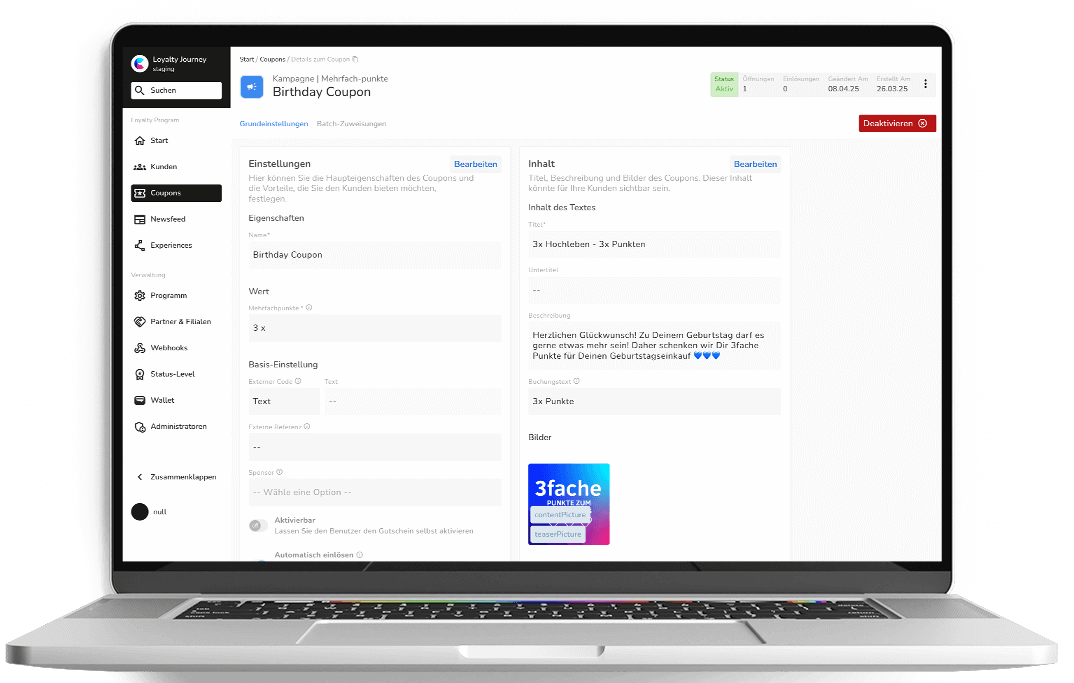
What Loyalty Software for Bakeries Must Be Able to Do
In hardly any other industry is operational viability as important as in bakeries. The program must run just as smoothly at 7:30 AM as during quiet off-peak hours. Even a few extra seconds per transaction add up noticeably during peak times. POS integration, speed, and ease of use are therefore more important than a long feature list.
POS Integration Is the Deal-Breaker
Many chain bakeries work with industry-specific POS systems or historically grown legacy environments. It is crucial that the loyalty software reliably communicates with the existing POS via API or middleware. This is where Tech & Integration becomes strategic: Without stable transaction data, identification, and redemption validation, any program remains prone to errors.
The 3-Second Test in the Morning Rush
A loyalty process must function practically invisibly in daily branch operations. If identification, point crediting, or coupon redemption takes longer than a few seconds, acceptance by staff and customers suffers. Staff acceptance is therefore not a soft factor, but the number one success factor.
- The software should apply identical rules across all branches so that customers experience the same experience at every location.
- It should also remain stable under high transaction loads, so that peak times do not become a technical risk.
- An offline or resilience strategy is important because network outages practically always occur in branches at some point.
- Wallet Pass, app, and digital customer card should be combinable as touchpoints, not an either-or.
- New employees must understand the process in a few minutes, otherwise training effort increases unnecessarily.
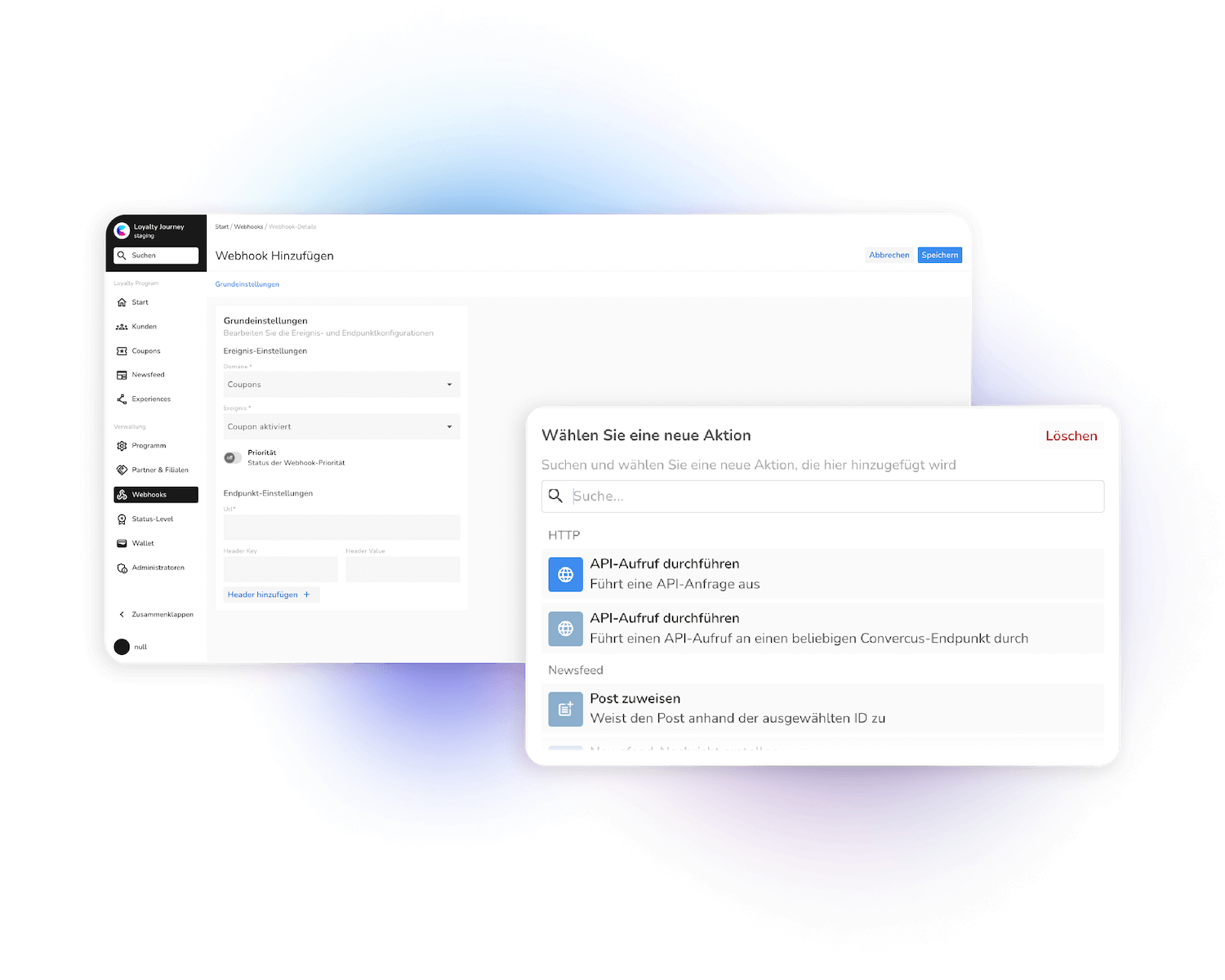
Omnichannel Instead of Pure Counter Logic
Larger bakeries often operate different formats: classic branches, cafés, train stations, front-of-store locations in grocery retail, or Click & Collect. A future-proof solution must Omnichannel capabilities to ensure that collecting, redeeming, and engaging remain consistent across all touchpoints.
From Stamp Card to Data Platform: First-Party Data, Personalization, and GDPR
The biggest strategic difference between analog and modern loyalty lies not in points or coupons, but in data. Bakeries traditionally often sell anonymously. With digital identification, reliable insights into visit frequency, product preferences, times of day, branch usage, and re-engagement potential emerge for the first time. First-Party-Data thus becomes the basis for CRM, assortment insights, and budget control.
What You Can Do With Customer Data in Practice
Even a few segments create added value: morning coffee buyers, lunchtime snackers, weekend families, inactive customers, or users of specific branch formats. Through Engagement and marketing automation, tailored messages can be delivered, such as breakfast offers before 10 AM or re-engagement coupons after 21 days without a visit. Personalization in a bakery must be simple, fast, and relevant.
Which Legal Bases You Must Observe
Legally, the GDPR and, for advertising communication in Germany, § 7 UWG (Unfair Competition Act) are particularly relevant. For the processing of personal data, depending on the setup, especially Art. 6 Abs. 1 lit. a DSGVO for consents and Art. 6 Abs. 1 lit. b DSGVO for contract-related processes are to be considered. Additionally, there are transparency obligations under Art. 13 GDPR, data minimization under Art. 5 Abs. 1 lit. c GDPR, processor agreements under Art. 28 GDPR, and security requirements under Art. 32 GDPR.

What This Means Specifically for Implementation
If you want to use email, SMS, or push marketing, consents must be clearly documented, revocable, and communicated understandably. For profiling and segmentation, a clear privacy policy is mandatory. GDPR compliance is therefore not a checkbox at the end, but part of the program design from the outset.
Implementation and ROI: How Loyalty Becomes Profitable in Chain Bakeries
A loyalty program is only profitable if it is operationally viable and properly aligned with KPIs. In bakeries, visit frequency, active participants, redemption rate, re-engagement, and additional purchases for snack or coffee combinations are particularly important. This cannot be achieved with an app alone, but with an interplay of POS process, rewards logic, couponing, and ongoing optimization. Success Management is therefore just as important as the software itself.
A Realistic Calculation Example
Assuming a chain bakery with 100 locations processes an average of 300 transactions per branch per day with an average transaction value of €5.50. If a loyalty program moderately increases visit frequency among 40% of participating customers, model calculations suggest a possible additional revenue of approximately €1.8 to €2.5 million per year. Such values must, of course, be validated against real baselines, but they indicate the magnitude.
How to Successfully Roll Out in Practice
- Start with clear KPIs such as participation rate, active users, frequency development, and redemption rate, rather than an imprecise objective.
- Plan your POS integration early, because that's where later delays and acceptance issues arise.
- Define rewards that fit into daily bakery operations, meaning they are quickly attainable, economically viable, and securely implementable across all branches.
- First, test in selected branches with high and low traffic to realistically simulate the morning rush.
- Train teams with a strong practical focus and continuously measure after launch which mechanics truly change behavior.
A market example shows the potential: According to a published case study, the bakery chain Resch&Frisch achieved 12.7% more customer visits in four months after introducing an app. For larger branch networks, Convercus is particularly interesting when not just a digital stamp card, but a scalable combination of loyalty, couponing, and data-driven engagement is required.
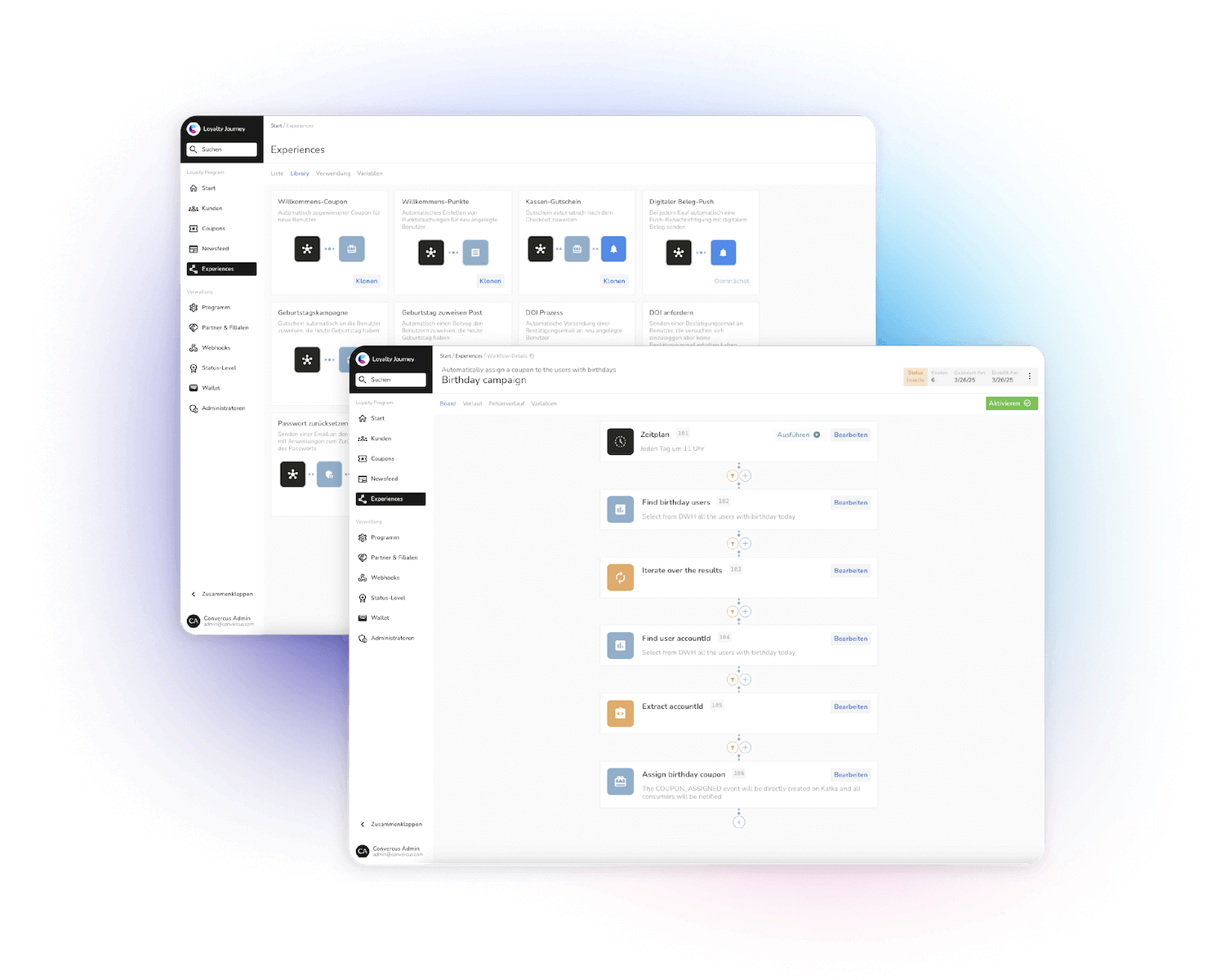
Which solution fits which business size?
Not every bakery needs the same software depth. A single operation with a few locations has different priorities than a regional chain or an enterprise retailer with many formats. Therefore, before making a choice, an honest assessment of the number of branches, data maturity, IT landscape, and target vision is worthwhile. The wrong complexity is just as problematic as too little functionality.
From entry-level solution to enterprise platform
Up to about 5 branches, a simple digital stamp logic with clear reward communication is often sufficient. From 10 to 50 branches, the demands on reporting, segmentation, and central control increase significantly. From 50+ branches, a scalable platform becomes relevant because branch formats, integrations, role permissions, and automations need to be consolidated. Those who want to get a basic overview can find further fundamentals in the guide to customer loyalty software and in the article increase customer loyalty for further fundamentals.
When a system change makes sense
If your existing program doesn't create customer segments, doesn't allow for cross-channel communication, or slows down your POS, fine-tuning is usually not the answer; a new architecture is needed. Scalability in a bakery is evident not only in the number of branches, but also in the ability to integrate every touchpoint into a unified customer profile.
Conclusion: Loyalty software is a growth instrument for bakery chains
For large and growing bakeries, loyalty is far more than just the digital version of a paper stamp card. Crucial factors are POS-compatible implementation, suitable mechanics for low transaction values, clean data usage, and a clear business case. Anyone who wants to systematically manage visit frequency, reactivation, and first-party data needs a scalable platform instead of a standalone solution.
If you want to explore how a digital customer loyalty program can be implemented in your branch network, Convercus is a sensible next step. The platform combines loyalty, couponing, engagement, and API-first integration for demanding branch structures. Schedule a personal demo and find out which setup is economically and operationally suitable for your bakery.
FAQ: Frequently Asked Questions about Loyalty Software for Bakeries
How complex is it to get started with a digital loyalty program?
The effort primarily depends on POS integration, number of branches, and desired mechanics. A wallet pass or digital stamp logic can be launched much faster than a fully integrated omnichannel program with segments and automations.
Does loyalty software work with our existing POS system?
This is a key question and should be technically reviewed early on. It's crucial whether your POS reliably supports transaction data, identification, and redemption via API, middleware, or a standard interface. POS integration is often the most important selection factor in a bakery.
Can a loyalty solution for bakeries be implemented in compliance with GDPR?
Yes, but not automatically. You need a clear legal basis under GDPR, transparent information according to Art. 13 GDPR, documented consents for advertising communication, and appropriate security measures. Data protection must be part of the concept from the start, not just part of the acceptance process.
Which mechanics work best for low transaction values?
In many bakery chains, visit-based rewards work better than purely revenue-based models. The reason is simple: high frequency beats high transaction value. Customers want to experience visible benefits quickly.
How long does implementation take?
A simple solution can be ready in a few weeks, a branch-proof enterprise setup takes significantly longer depending on integration and governance. Realistically, it's best to set up a pilot phase first and then roll it out in a controlled manner. A phased rollout significantly reduces risks.
Can we migrate an existing program?
Yes, existing stamp, card, or points solutions can generally be replaced or transferred. It's important that existing customer data, reward logic, and outstanding balances are properly assessed. A planned migration prevents loss of acceptance among regular customers.


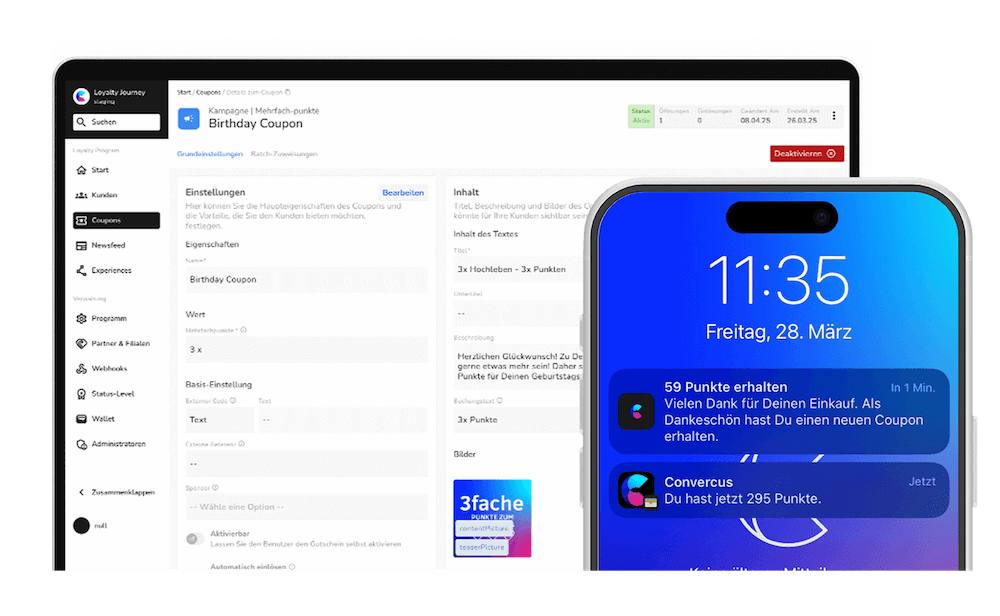
- 5x Return on Investment
- 80% Customer Identification
- 8x Customer Interaction
- +274% Repurchase Rate
.jpg)