











The topic, brief and concise
- Drugstore loyalty is a high-frequency business: Recurring everyday purchases, extensive product ranges, and high visit frequency make drugstores a particularly effective area for loyalty software.
- Couponing is often more important than points in drugstores: Customers expect immediate price benefits, while personalization and status models represent the next level of maturity for true customer loyalty.
- An app, POS integration, and GDPR compliance are essential: Successful programs combine digital loyalty cards, omnichannel processes, consent management, and an API-first architecture in a robust system.
- Convercus is loyalty software relevant for drugstores: Anyone looking to bundle couponing, loyalty engine, engagement, and technical integration into one platform will find Convercus to be a suitable solution for scalable customer loyalty in retail.
Why Drugstores Have Specific Requirements for Loyalty Software
The German drugstore market is large, highly profitable, and sees high customer frequency: In 2024, industry revenue reached €26.6 billion, while more than half of consumers regularly shop at drugstores. It's precisely this frequency that makes loyalty programs particularly effective in drugstores. Unlike many other retail segments, it's not just about rare high-value purchases, but about recurring daily needs related to beauty, baby, household, health, and increasingly, groceries.
For software, this means a drugstore solution must process a high volume of recurring transactions quickly , react in real-time at the POS, and seamlessly combine price advantages with personalization. Pure points-based logic is usually insufficient for this. Crucial elements include couponing, app-first touchpoints, agile rule sets, and robust omnichannel integration between stores, apps, online shops, and Click & Collect.
Drugstores: A High-Frequency Use Case for Loyalty
In drugstores, loyalty is primarily built through everyday relevance. Customers who regularly buy diapers, shampoo, detergent, or dietary supplements respond strongly to relevant impulses at the right time. Therefore, loyalty software must be able to recognize purchase cycles, interpret shopping carts, and deliver offers store-specifically or across channels. A coupon for baby food after buying diapers is significantly more valuable than a generic points notification.
Couponing is More Important Than Traditional Point Collection
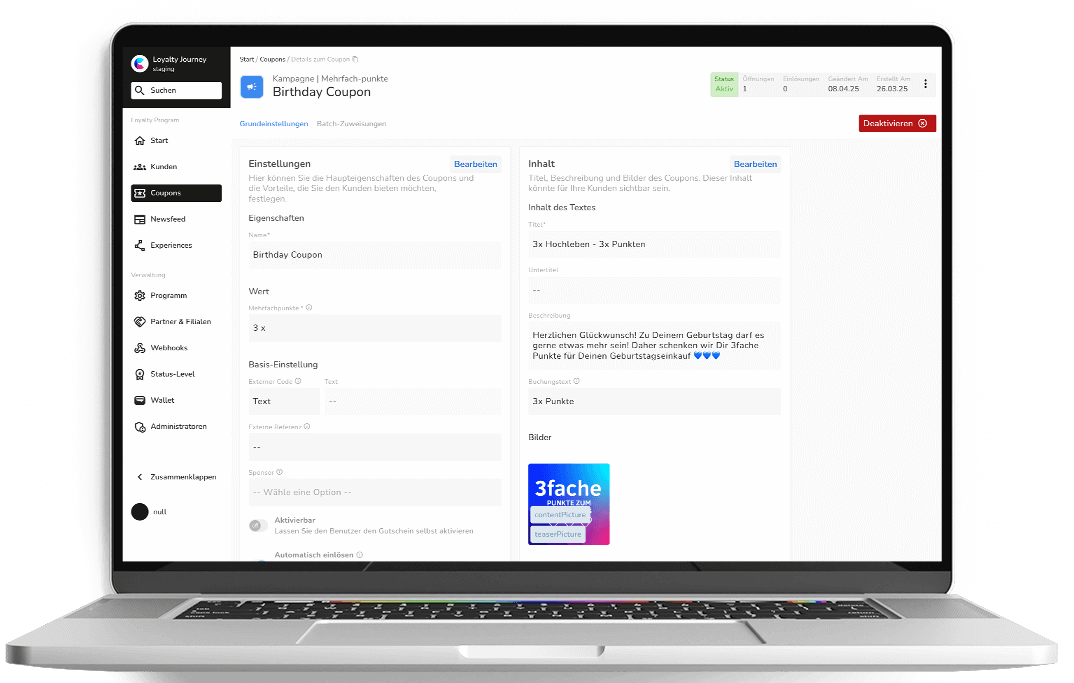
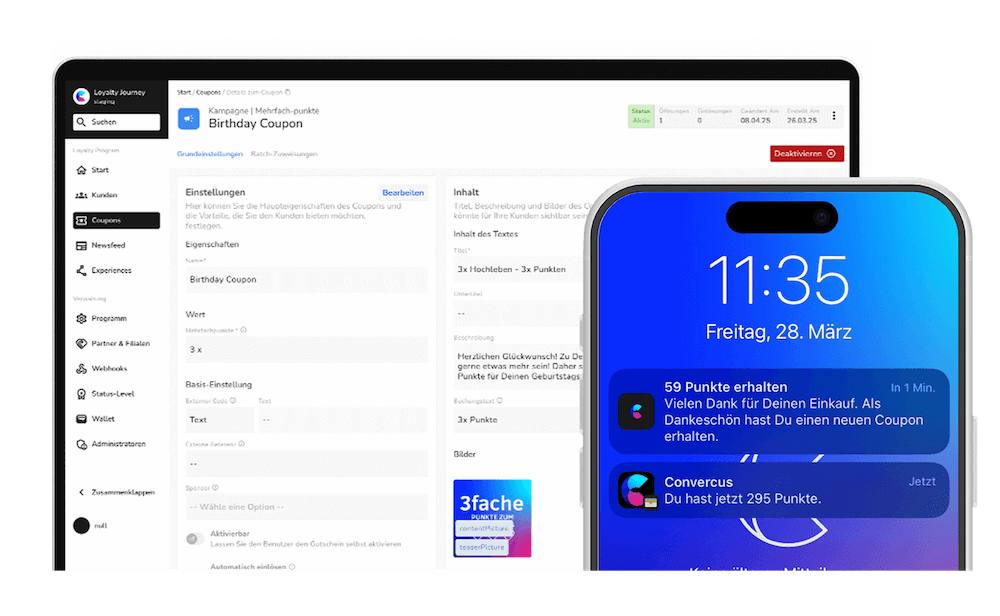
In the German drugstore market, aspirational rewards programs do not dominate; instead, immediate, tangible price advantages at checkoutare key. Digital coupons, bonus boosters, direct discounts, and hybrid programs usually work better here than pure earn-and-burn models. Good loyalty software for drugstores must therefore integrate couponing and the loyalty engine, rather than separating the two technically. How modern couponing is used as a core mechanism is the real architectural question for many retail companies today.
The Loyalty Landscape in German Drugstores
The German drugstore sector is more advanced than many other retail industries when it comes to apps and loyalty. Studies show an exceptionally high app usage rate of 96% in the drugstore context. At the same time, major players pursue different models: dm combines its own app experience with PAYBACK, Rossmann heavily relies on its own app as a digital customer card and coupon channel, while Müller and regional providers have catching-up potential. This is important for software decision-makers because these market models demonstrate which operating models are successful today.
dm, Rossmann, and Müller: Different Priorities
dm benefits from combining its own app with PAYBACK, while Rossmann relies on a very consistent in-house program logic. Rossmann's reach is particularly striking: In early 2026, approximately 11 million active app users were reported. Furthermore, surveys show dm and Rossmann clearly ahead of Müller in app usage. For software selection, this means: Successful drugstore programs don't happen by chance, but where the app, couponing, POS, and personalization seamlessly work together.

Coalition Program or Proprietary Loyalty Solution? The Core Strategic Question
For many drugstore companies, this is a pivotal decision. A coalition model like PAYBACK offers reach, familiar mechanics, and faster market access. At the same time, pressure is growing to establish first-party data as a strategic asset in-house. Because anyone who wants to control personalization, retail media, digital services, and their own customer experience needs more than just participation in a network program.
Data Protection and Data Sovereignty: Essential from the Outset
Anyone operating their own loyalty software for drugstores must process customer data in a legally compliant manner. For personalized offers, in practice, primarily Art. 6 para. 1 lit. a and lit. b GDPR are relevant, supplemented by transparency obligations from Art. 13 GDPR, demonstrability of consent under Art. 7 GDPR, and data minimization according to Art. 5 GDPR. For tracking in apps and on the web, § 25 TDDDG also comes into play. This is precisely why clean consent and profiling logic is not an add-on, but a core component of the system architecture.
Rewe's PAYBACK exit demonstrated industry-wide that transitioning to a proprietary program can be strategically attractive. For drugstores, the answer is usually not black or white. Often, a phased approach makes sense: first professionalize digital customer cards and couponing, then personalization, then build additional services and partner logics.
What Loyalty Software Needs to Deliver for Drugstores
A robust platform for drugstores doesn't just link discounts with customer profiles. It must integrate couponing, loyalty, engagement, and integration in a scalable architecture. Especially for store networks with thousands of daily transactions, the technical depth determines whether a program merely distributes coupons or truly increases sales, frequency, and retention.
- Effective loyalty software for drugstores requires a couponing enginethat handles rules, exclusions, validities, and cross-channel redemption in real-time.
- It should be able to flexibly map points systems and status management , so that in addition to price advantages, progression, membership, and exclusive benefits are also possible.
- It must support digital customer cards, wallet passes, and app logic , ideally with a phased model from anonymous to registered.
- It should consistently integrate omnichannel scenarios such as POS, online shop, Click & Collect, and returns, so that the same customer remains recognizable at every touchpoint.
- It requires robust analytics, segmentation, and marketing automation, so that transaction data can actually generate relevant campaigns.
Personalization with 15,000+ SKUs: The Ultimate Challenge
Drugstores operate with large assortments, high visit frequency, and highly differentiated purchase occasions. Therefore, simple customer segmentation is not enough. What's required are AI-powered insights, product affinities, and rule-based campaign logic, so that not every customer receives the same discount. Relevant triggers include those based on shopping cart, category, purchase interval, store, price level, or life stage. Automating this effectively not only increases relevance but also reduces wastage in the coupon budget. More on this can be found in the Engagementsection.

Omnichannel, API-First, and Performance: Non-Negotiable
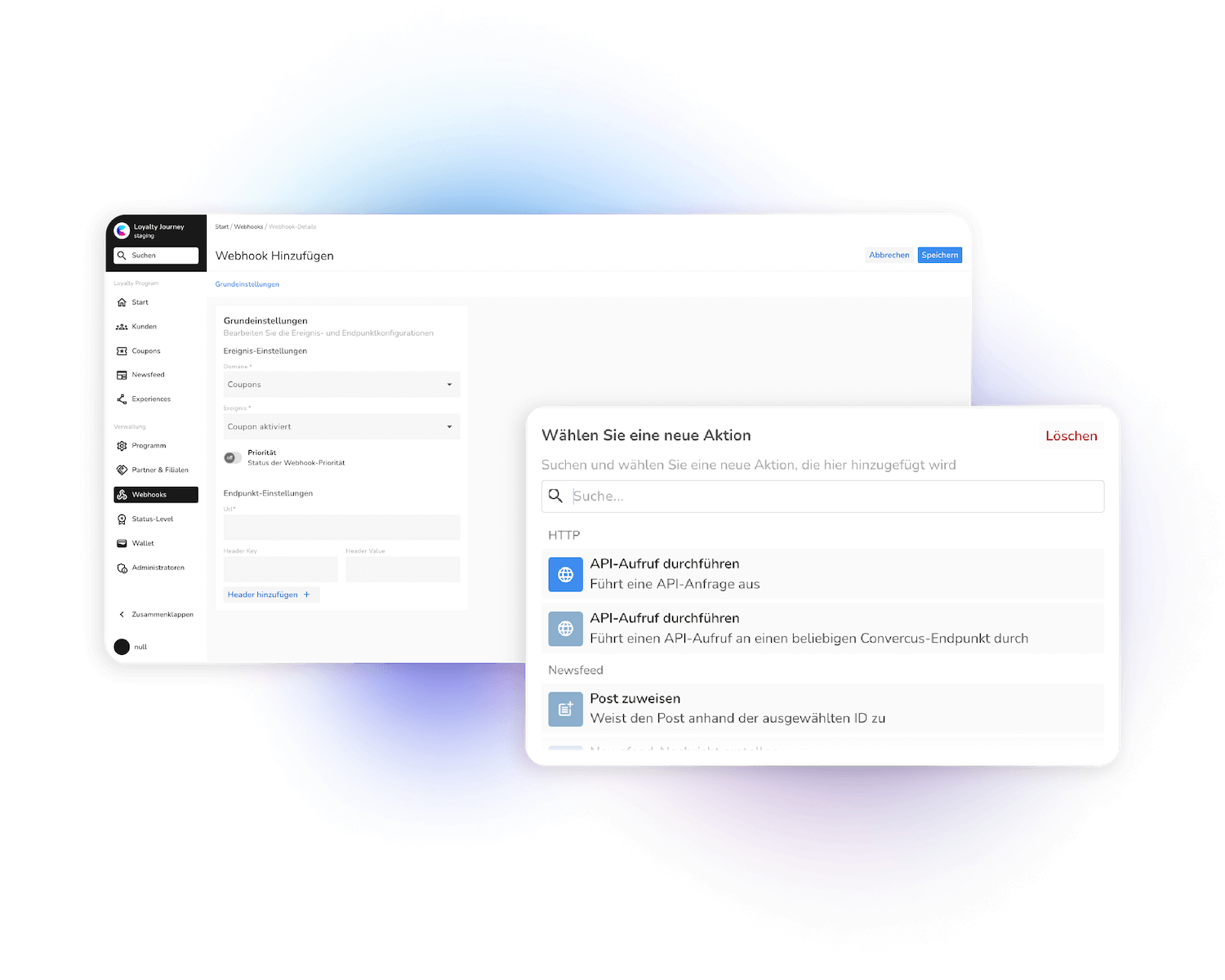
Technically, a drugstore solution must reliably connect POS, app, e-commerce, ERP, PIM, and CRM. Key requirements include API-first architecture, low latency, and high availability, because coupon redemption must not falter at the checkout. If you want to check how Loyalty Engine, Couponing, Engagement and Tech & Integration interact, Convercus is an obvious option for mid-market and enterprise retailers. Particularly relevant in the app context: According to Convercus, programs with a white-label app achieve up to 8x higher customer interaction than programs without an app touchpoint.
ROI Potential: The Economic Impact of an Effective Drugstore Program
The economic question isn't whether customers like coupons, but whether a professional program pays off. An illustrative market scenario: 200 stores, 100,000 transactions per day, an average basket value of €18, and approximately €650 million in annual revenue. If 40% of transactions are identified and thus personalizable, a robust management foundation is already established. This allows not only better control of discount costs but also systematic influence over frequency, basket size, and win-back efforts.
The Three Strongest Levers: Frequency, Basket Value, and Win-Back
If the visit frequency of the loyalty cohort increases by one additional purchase per month, this directly impacts revenue. If, in addition, the basket value of identified customers increases by 10% through relevant coupons, the example yields a projected additional revenue of approximately €26 million per year. This calculation is not a guarantee but illustrates the magnitude. Strategically, the goal is to enhance customer loyalty and, with data-driven impulses, also win back customers, instead of just distributing generic promotional discounts.
First-Party Data: Unlocking Potential Beyond Coupons
A proprietary loyalty program not only delivers direct uplifts at the POS; it also generates measurable first-party data for assortment management, media, and CLV optimization. Especially for drugstores with strong FMCG relationships, retail media thus becomes an additional value creation layer: segments can be precisely formed, more targeted campaigns can be sold, and closed-loop effects better demonstrated. Those selecting software today should plan for this perspective from the outset, even if it's only monetized in phase two or three.
Best Practices and Common Pitfalls in Drugstore Loyalty
The most successful programs in the market don't simply offer more discounts. They build a system that combines low entry barriers, clean data acquisition, and continuous relevance. The real shift in maturity lies in moving from couponing to genuine engagement . This is precisely where many implementations fail: they merely digitize the old paper coupon instead of building a learning customer retention model.
The Phased Model (Anonymous, Registered, Personalized) Lowers Barriers
A smart drugstore program doesn't need to link every interaction immediately to a full registration. Rossmann's well-known principle demonstrates how anonymous usage as an entry point and registration as the next value step can work. Users download the app, activate initial benefits, and only release data when the value proposition is clear. This improves conversion to registration and simultaneously aligns well with GDPR transparency requirements.
The app is an ecosystem, not a coupon folder
Digital customer card, shopping lists, digital receipts, push communication, gamification, click & collect, and in the future, OTC or pharmacy services: in drugstores, the app becomes the product. Therefore, anyone planning app strategies should App-First Loyalty as a platform approach understand it as a platform approach, not an isolated feature. The article on App-First Loyalty.
The most common mistakes can be avoided early on
The most costly wrong decisions usually occur before rollout, when goals, data model, and integrations are not clearly defined.
- Many programs confuse loyalty with discount pressure, creating short-term activation but no lasting engagement.
- POS, app, and online shop are often planned separately, even though cross-channel customer recognition is crucial, especially in drugstores.
- A clear KPI logic for identified purchases, repurchase rate, coupon uplift, and churn is often missing, making it difficult to reliably prove ROI later.
- Data protection is still addressed too late, even though consents, profiling notices, and tracking mechanisms need to be prepared at the architectural level.
How to find and implement the right loyalty software for your drugstore
The selection process should not start with a feature list, but with the target architecture. Do you want to professionalize couponing, build your own app ecosystem, grow out of a coalition, or prepare for retail media? Only then can you assess which platform is suitable both functionally and technically. In practice, a step-by-step approach with clear prioritiesproves effective, rather than rolling out a maximum program all at once.
- First, define your business goals, such as a higher identification rate, better frequency control, reduced discount dispersion, or more first-party data.
- Next, prioritize the essential technical criteria, especially POS integration, app integration, API capability, consent handling, and reporting.
- Evaluate providers not only by feature set but also by rollout experience, service model, enterprise performance, and omnichannel practice.
- Plan implementation and migration in phases to ensure processes at the checkout, in CRM, and in store operations remain stable.
What IT, CRM, and business departments should consider together
Typical sales and project cycles in this segment span several months. Important considerations are realistic implementation plans, clear responsibilities, and measurable pilot goals. For a chain with 50 stores and 200,000 members, for example, a phased rollout by region or touchpoint may be more sensible than a full big-bang approach. For existing programs, it should be clarified early on how points, coupon histories, wallet identities, and consents can be migrated. Here again, Article 13 GDPR for transparent information and Section 25 TDDDG for tracking setups in apps and on the web apply.
Conclusion: Loyalty software for drugstores is infrastructure, not an add-on
Drugstores represent one of the most exciting loyalty use cases in German retail: high frequency, strong app usage, a pronounced couponing culture, and the growing importance of first-party data. However, success isn't about the software with the most features, but the platform that couponing, personalization, omnichannel, and data sovereignty brings together in a robust operating model.
If you want to modernize your existing program, build your own app ecosystem, or reduce dependence on coalition structures, Convercus is an obvious partner for mid-market and enterprise retailers. The key is the tangible benefit: a scalable loyalty engine, flexible couponing logic, API-first integration, and a setup aimed at measurable ROI. The next logical step is a personal demo, where your drugstore requirements will be evaluated based on your system landscape and goals.
FAQ: Frequent Questions about Loyalty Software in Drugstores
How complex is the introduction of a loyalty program in a drugstore chain?
This primarily depends on the POS landscape, app status, and data model. Typically, the software itself is not the bottleneck, but rather the seamless integration of existing systems and processes. A phased rollout with a pilot phase reduces risk and accelerates internal acceptance.
Does loyalty software work with our existing POS system?
Yes, if the platform is API-based and properly supports POS processes such as identification, coupon validation, and posting. The quality of integration determines success at the checkout, which is why response times, fallback scenarios, and offline capabilities should be checked early on.
Is personalized coupon delivery possible in compliance with GDPR?
Yes, but only with a clear legal basis and transparent communication. Articles 6, 7, and 13 GDPR are essential , as is Section 25 TDDDG for tracking and similar technologies. Consents, purposes, and objection options must be technically and organizationally verifiable.
What does loyalty software for drugstores cost?
Costs vary depending on the number of stores, user base, app scope, integrations, and operating model. Decision-makers should not only consider licensing costs, but also evaluate the total effort and expected ROI from identification, increased sales, process simplification, and data value.
Can we migrate an existing program or a coalition solution?
Yes, migrations are possible if data, identifiers, consents, and rule sets are properly captured. A migration strategy for existing customers is particularly importantto ensure that points, coupons, and status are not lost and the transition remains as smooth as possible for customers.
How do you practically start if only app coupons exist so far?
In that case, the best starting point is usually to professionalize existing couponing. Start with identification, segmentation, and clear KPI goals and then expand to include status logic, automation, and additional app services. This way, a discount channel gradually evolves into a true loyalty program.


- 5x Return on Investment
- 80% Customer Identification
- 8x Customer Interaction
- +274% Repurchase Rate
.jpg)