







The topic in brief
- Luxury Loyalty works differently from mass-market loyalty: In luxury, access, status, and personal recognition matter more than standard discounts or pure points logic.
- The most important foundation is a unified customer profile: Only when store, e-commerce, and app data converge does true clienteling become possible across all touchpoints.
- Technology scales personalized service: API-first architecture, GDPR-compliant processes, and marketing automation help deliver VIP service consistently and efficiently.
- Convercus is relevant as loyalty software when luxury and premium brands want to cleanly orchestrate status, engagement, and omnichannel customer loyalty: Learn more at Convercus Loyalty.
Why Luxury Brands Will Rely on Loyalty Software in 2026
Luxury fashion in 2026 faces significantly different pressures than just a few years ago. The global market for personal luxury goods was €364 billion in 2024 and is estimated at around €358 billion for 2025; moderate growth is expected again for 2026. At the same time, the German market shows how selective the segment has become: luxury fashion is expected to reach approximately €6.07 billion in revenuein 2025, but will only grow slowly until 2030. For brands, this means that growth less often comes from broad expansion, but more frequently from better retention, higher customer lifetime value, and more precise clienteling.
The Luxury Market is Becoming More Selective
Since 2022, the customer base in the luxury segment has been shrinking, and compared to 2024, the industry lost around 20 million consumers. At the same time, demand is shifting from aspirational buyers to high-net-worth customers and HENRYs. In this environment, anyone who views customer loyalty merely as a discount mechanism is missing out on potential. Luxury brands need systems that can manage exclusive access, personal recognition, and status-based benefits.
Data Control Becomes a Competitive Advantage
Added to this is the dependence on multi-brand platforms, wholesale, and fragmented store data. Precisely for this reason, first-party data becomes a strategic asset in the luxury segment. Loyalty software creates the foundation for a unified customer profile across boutiques, e-commerce, and apps. Those who want to delve deeper into the basics will find the technological framework behind modern loyalty programs in the article on customer loyalty software .
What Distinguishes Luxury Loyalty from Traditional Loyalty
In the mass market, loyalty often aims to increase frequency and highlight price advantages. In luxury, the opposite is true: exclusivity is the reward. A 10% coupon diminishes perceived value faster than it generates additional sales. A private preview, a personal styling appointment, or early access to a limited collection often costs the brand less and simultaneously appears significantly more premium.
Invisible Loyalty Instead of Public Discount Logic
The most valuable luxury programs are often not prominently explained on the website but run discreetly in the background. This principle is often described as Invisible Loyalty : benefits are delivered individually, without the brand appearing like a traditional bonus club. Therefore, software must not only manage points and tiers but also orchestrate invitations, status rules, private benefits, and personal triggers for store teams.
Comparison: Mass Market, Premium, and Ultra-Luxury
Especially in luxury, loyalty must therefore digitally scale relationship management, without damaging the brand's DNA.
Overview of Program Types for Luxury Fashion
Not every luxury brand needs the same program design. The key is finding the right balance of visibility, status, and personal service that suits the brand. For premium and luxury fashion, three models are particularly effective: tier systems, experience-based rewards, and discreet invite-only formats. Points can also be useful if they are translated not into standard discounts but into exclusive services, event access, or curated benefits.
Tier Systems and Experience-based Rewards
Tier models are a good fit for fashion because they make aspiration visible. An entry-level tier can offer early access to seasonal launches, a mid-level tier provides private appointments, and the top tier grants access to limited items or events. Equally important are experience-based rewards: personal fittings, repair services, styling sessions, or cultural invitations have a much stronger impact in luxury than price reductions.
Earn beyond Purchase
Advanced programs reward not only purchases but also behavior throughout the entire journey: appointment bookings, event participation, wish lists, store visits, or in-app interactions. This is precisely where the added value of modern Loyalty- and Engagement-approaches becomes apparent. They create rules for desired behavior without pushing the brand into a discount-focused strategy.
As a rule of thumb for luxury brands: The more exclusive the brand, the more discreet the program logic should be. Premium retailers can openly communicate hybrid models; ultra-luxury brands often fare better with closed VIP structures.

Best Practices: How Luxury and Premium Brands Implement Loyalty
The most exciting examples show that there isn't one single luxury model. Chanel Privilège represents an invite-only principle with a personal concierge and exclusive previews. Burberry, in turn, links digital preferences with in-store service, allowing sales associates to provide better real-time advice during visits. Gucci focuses on a younger, culturally connected luxury target group with digital experiences, while HUGO BOSS demonstrates that a digitally supported loyalty program can also function in a brand-compliant manner in German-speaking regions.
What Can Be Learned from the Examples
There are differences between the programs, but three patterns consistently emerge: status, personal relevance, and cross-channel data. This is precisely why clienteling in luxury is no longer a separate discipline but the core of modern loyalty. Software doesn't replace the sales associate; it provides them with the context for better conversations.

The 5 Most Common Pain Points – and How Loyalty Software Solves Them
In practice, luxury loyalty rarely fails due to the idea itself, but rather due to operational realities. Stores keep customer knowledge in notes, CRM entries are incomplete, e-commerce data is separate, and VIP service relies too heavily on individual employees. Luxury brands with multiple boutiques or international touchpoints quickly realize that manual clienteling is not scalable .
Where Most Programs Falter
- Silos between online and store prevent purchase history, preferences, and service contacts from converging into a unified profile.
- VIP knowledge is lost during staff turnover, because preferences, sizes, favorite lines, or important occasions are not systematically documented.
- Too much data alone does not create personalization, if no rules, triggers, and segments are available for specific targeting.
- Mass-market mechanics damage brand perception, if luxury programs rely too heavily on standard discounts and public promotions.
- Personal service does not scale across locations, if store teams do not have real-time access to relevant customer information.
This is precisely where a suitable platform comes in: It unifies data, rules, and communication so that personal care does not depend on individual memory. This is particularly important because, in luxury, a small proportion of top customers already contribute a disproportionate amount of revenue. If these relationships are not systematically nurtured, the risk of churn and revenue loss increases unnecessarily.
Technical Requirements for Luxury Loyalty Software
For luxury fashion, an isolated bonus module is not enough. What's needed is an architecture that connects POS, e-commerce, app, CRM, and customer service. The foundation is a Unified Customer Profilethat brings together transactions, preferences, status, consents, and service history. Only then can real-time clienteling, early access, VIP segments, and cross-channel benefits be effectively deployed.
API-First, GDPR, and Real-time Capability
Technically, brands should focus on API-first architecture, low latency, multilingualism, and reliable integrations. In the DACH market, the regulatory aspect is also crucial: legal bases for personalization and marketing regularly arise from Art. 6 para. 1 lit. a GDPR for consents or from Art. 6 para. 1 lit. b GDPR for contract-related processes. Data minimization according to Art. 5 para. 1 lit. c GDPR, Privacy by Design according to Art. 25 GDPR, data processing agreements according to Art. 28 GDPR, and security according to Art. 32 GDPR are mandatory. For promotional emails, SMS, or push communication, furthermore, § 7 UWG is relevant in German practice.
- POS and shop integration is indispensable so that points, status, and benefits appear consistently online and offline.
- Offline capability increases operational reliability in stores when connections are temporarily unstable.
- Role and rights models help ensure that sensitive VIP data is accessible only to the right teams.
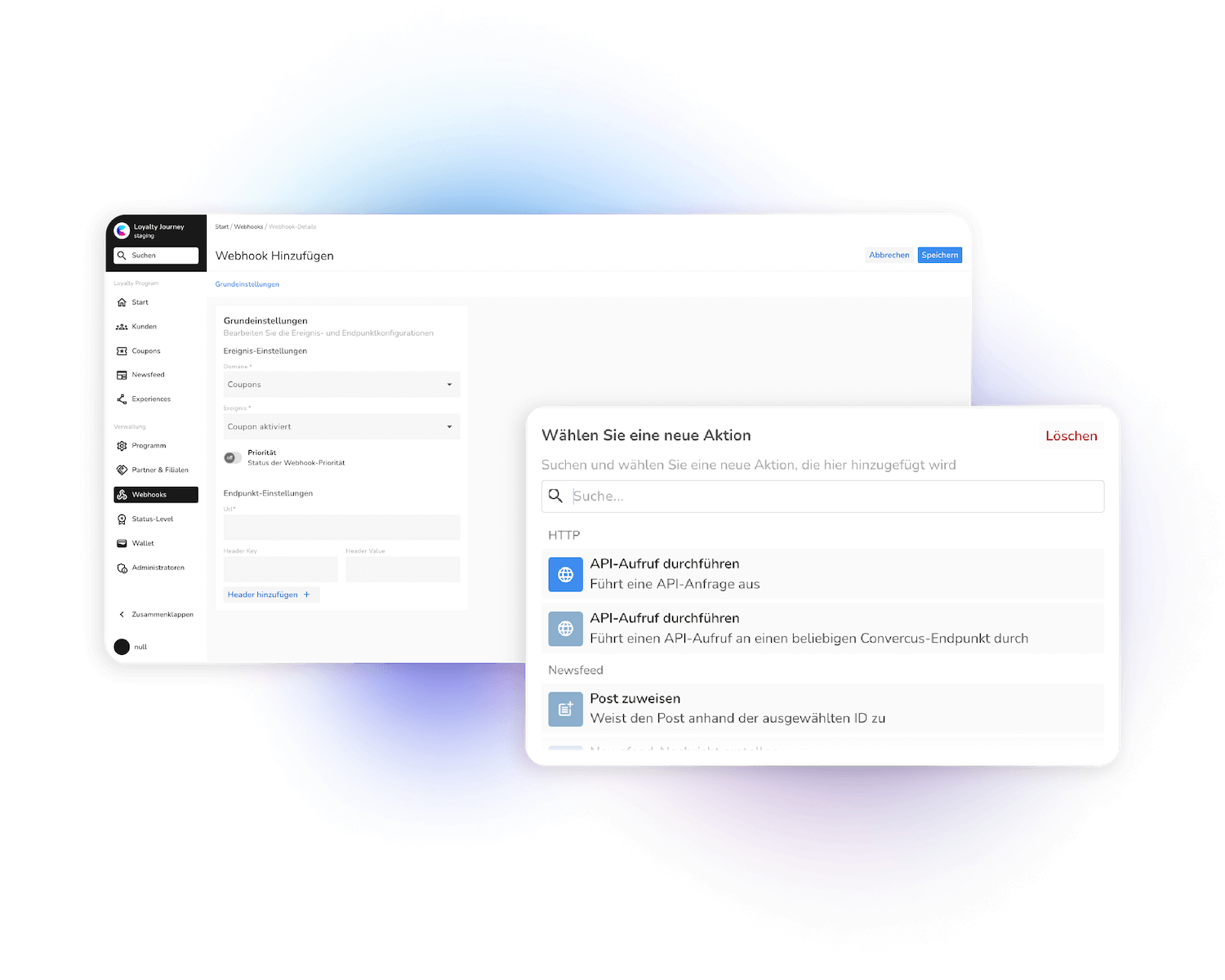
- Marketing automation should trigger based on real events, such as after a store visit, wish list activity, or status change.
Those who wish to delve deeper into the integration perspective will find on the page about Tech and Integration the central requirements for modern loyalty infrastructures.
The Business Case: Is the Investment Worthwhile?
In the luxury segment, it's not the highest number of members that matters, but the leverage on repeat purchases, CLV, and share of wallet. An illustrative scenario: A premium fashion retailer with 200,000 active customers, 40,000 of whom are in the top 20% segment, initially generates 3 purchases per year there with an average order value of €500. This corresponds to €60 million in annual revenue in this segment. If purchase frequency increases by 15% through better segmentation, clienteling, and exclusive benefits, revenue rises to €69 million – an additional €9 million.
What decision-makers should truly focus on
Assuming a gross profit margin of 60%, this would amount to approximately €5.4 million in additional gross profit. Even if software, operations, and program management are in the mid-six-figure range, the business case often remains attractive. However, it's important not to just focus on the top 1%. Tomorrow's top customers often come from the HENRY segment, which is digitally savvy and can be systematically developed through a good experience.
- Repeat Purchase Rate shows whether membership actually leads to more frequent repurchases.
- Active Member Rate reveals how many registered customers are actually using the program.
- Redemption and Benefit Usage demonstrate whether benefits are perceived as relevant.
- CLV by Segment helps understand which customer groups grow through status and experience mechanisms.
- Omnichannel Revenue Share shows whether Loyalty Store and E-commerce are truly integrated.
Anyone who wants to not just maintain loyalty, but systematically expand it, should combine these key figures with strategies for customer retention and targeted measures for customer win-back combine.
How Luxury Loyalty can be implemented with software support
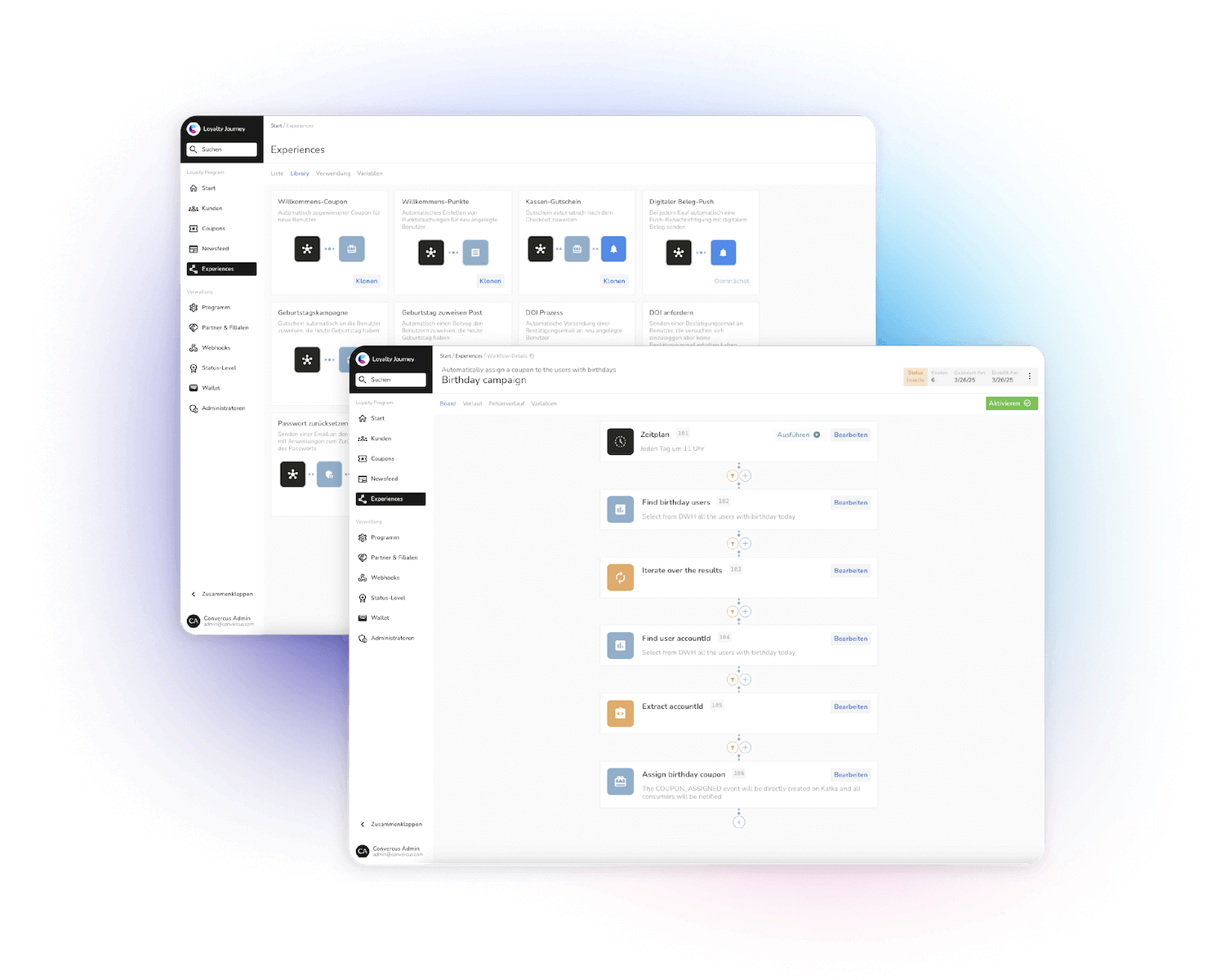
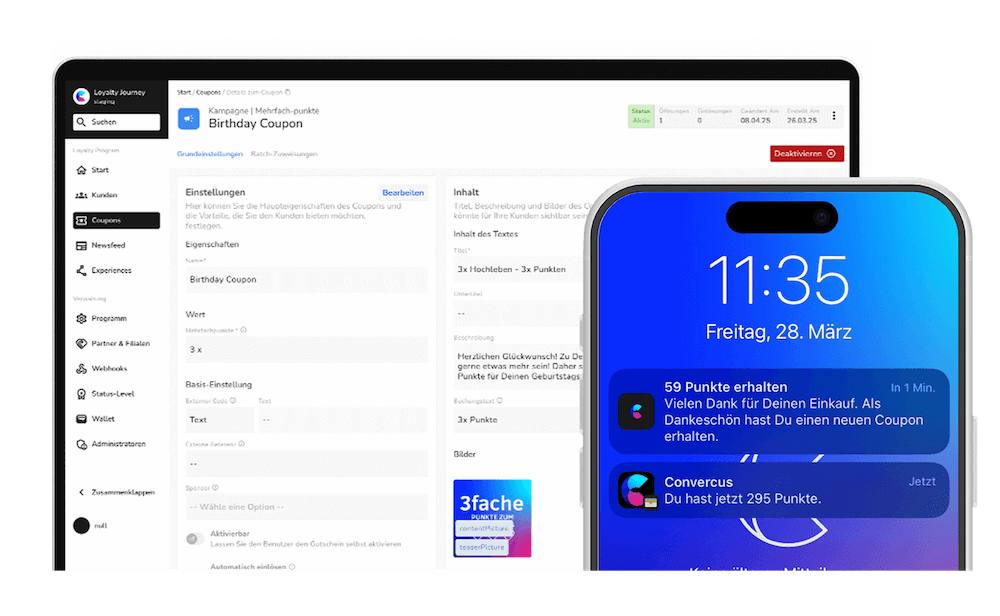
The crucial step is to bring clienteling, status management, and personalized communication together into a single operational logic. This requires a platform that not only stores rules but activates them across all touchpoints. For retail, fashion, and omnichannel brands, Convercus can be particularly suitable here if a program aims to combine status, selective couponing, event logic, and engagement with each other. The Loyalty Engine maps status and benefit rules, while marketing automation sets triggers for relevant communication.
When store service and digital orchestration need to come together
Especially in luxury, it's crucial that technology doesn't look like mass marketing. With API-first integration, Wallet Pass or whitelabel app, and a clean data model, loyalty can be managed discreetly in the background. For app-based programs, a whitelabel app can lead to 8x higher customer interaction than programs without an app. At the same time, the platform's experience with 40M+ loyalty accounts and 116M+ transactions indicates that even larger omnichannel setups can be mapped performantly. Those who wish to delve deeper into the mobile approach will find under App-First Loyalty further perspectives for high-quality digital experiences.
Conclusion: Loyalty Software in Luxury Doesn't Replace Relationships – It Scales Them
By 2026, luxury fashion won't need louder discount programs, but rather more precise relationship architecture. Successful brands focus on exclusivity, status, omnichannel data, and discreet activation instead of standardized price advantages. Therefore, anyone looking to build clienteling systematically should not just look at attractive frontends, but at the data model, integration capabilities, GDPR compliance, and the ability to make personal support consistent across stores, e-commerce, and apps.
If you want to explore how such a model with Loyalty Engine, engagement, Wallet Pass, and API-first integration can be practically implemented, then Convercus is an obvious partner. Schedule a personal live demo with a loyalty expert and find out which luxury loyalty architecture suits your brand.
FAQ
Do points programs even work in the luxury segment?
Yes, but only under one condition: Points must not look like mass discounts. In the premium and luxury segments, they work best when translated into exclusive experiences, services, early access, or status-relevant benefits.
How do I prevent a loyalty program from diluting the brand?
By linking benefits to access, recognition, and service instead of blanket discounts. Invisible Loyalty, invite-only mechanisms, and cleanly segmented communication protect exclusivity much better than publicly advertised discount logic.
Is loyalty software for luxury fashion implementable in compliance with GDPR?
Yes, if legal bases, consents, role rights, and security measures are properly implemented. Particularly relevant are Art. 6, Art. 25, Art. 28, and Art. 32 GDPR; for promotional communication in the German market, § 7 UWG also plays an important role.
Does this work with our existing POS system and e-commerce stack?
Generally yes, provided the platform is designed API-first and can cleanly synchronize transactions, customer master data, and status events. What's crucial is not the theoretical range of functions, but rather the quality of integration between POS, shop, CRM, and, if applicable, app or Wallet Pass.
How complex is it to get started with a luxury loyalty program?
Brands should ideally not start with a full rollout for all customers, but rather with a clearly defined pilot for VIP or top segments. This allows benefits, processes, and store procedures to be tested before the program is gradually extended to other customer groups.
Can we migrate an existing program without losing customer relationships?
Yes, provided master data, status logic, open benefits, and consents are systematically transferred. What's important is a clean migration plan, so that top customers lose neither their status nor their previous service expectations.


- 5x Return on Investment
- 80% Customer Identification
- 8x Customer Interaction
- +274% Repurchase Rate