.png)








The topic at a glance
- In grocery retail, loyalty is infrastructure. In food retail, POS integration, omnichannel processes, and real-time capabilities are more critical for success than an attractive mechanism alone.
- Immediate benefits often outperform abstract collection models. Cashback, personalized coupons, and instant discounts are a better fit for price-sensitive, high-frequency shopping patterns than purely long-term reward schemes.
- Data protection and data sovereignty are strategic levers. GDPR-compliant consent management, first-party data, and ethical personalization are increasingly becoming a differentiating factor for retailers.
- Convercus is the right software for retail loyalty. If you're looking to combine loyalty, couponing, engagement, and API-first integration in one platform, Convercus is a strong contender for professional retail applications.
Loyalty Software for Grocery Retail: Why it's a Top Priority in 2026
In grocery retail, loyalty is no longer just a nice-to-have add-on, but an operational competitive factor. 45% of consumers now expect a customer loyalty program in grocery retail as standard, and 55% prefer retailers with a loyalty program when choosing where to shop. Retailers still relying on isolated loyalty cards, paper coupons, or a loosely integrated app are not only losing data but also frequency, relevance, and differentiation.
The market visibly reconfigured itself in 2025/2026: REWE built its own digital benefits program with REWE Bonus, Edeka and Netto switched to Payback, and discounters are also investing more heavily in their own app-centric models. The shift from coalition models to proprietary programs demonstrates the importance of data ownership, personalization, and direct integration with checkout and apps. In parallel, the loyalty market in Germany is projected to grow from USD 2.99 billion in 2025 to USD 5.12 billion by 2030, according to Research and Markets.
For decision-makers, this means the question is no longer whether loyalty is relevant in grocery retail, but which software truly supports daily operations. Those seeking a fundamental overview can also find further insights here on modern customer loyalty software in retail.
Why Loyalty Works Differently in Grocery Retail Compared to Other Industries
In grocery retail, we encounter extremely high transaction frequency, low margins, and strong price sensitivity simultaneously. A supermarket or discounter has weekly, sometimes daily, purchase contacts with millions of receipt lines, but often only a 1-3% margin. Therefore, loyalty needs to be approached differently here than, for example, in fashion or travel: the economic leverage usually lies not in extensive rewards programs, but in precisely managed instant benefits, personalized coupons, and increased shopping frequency.
Adding to this is the technical complexity. Loyalty must function at the POS, self-checkout, self-scanning, app, online shop, and potentially delivery service. Loyalty thus becomes infrastructure and not merely a marketing campaign. This is precisely what makes the selection of the right loyalty software in grocery retail so strategic.

What Loyalty Software in Grocery Retail Must Deliver
A good solution for grocery retail must be able to do significantly more than just award points. The key is the seamless integration of loyalty logic, couponing, checkout, and customer data.In practice, programs rarely fail due to the idea itself, but rather due to a lack of integration, overly complex mechanisms, or unclear responsibilities between business departments, IT, and marketing organization.
- Real-time POS Integration is essential so that benefits can be triggered seamlessly at the checkout, self-checkout, and self-scanning.
- Omnichannel Capability ensures that the app, physical store, online shop, and digital receipts all access the same customer identity.
- Coupon Engine and Personalization must enable personalized offers based on basket, frequency, and behavioral data.
- Offline Capability and High Availability are essential for store operations because loyalty must function even with temporary network issues.
- GDPR-compliant Consent Management creates the foundation for legally compliant data usage and robust first-party data.
Technically, there's a strong case for an API-first architecture. It facilitates integration with POS systems, merchandise management, CRM, apps, and marketing systems and reduces dependencies on monolithic suite solutions. Especially in food retail with heterogeneous system landscapes, this acts as a real risk buffer.
POS Integration: The True Master Discipline
Much of the market content initially discusses points, cashback, or gamification. However, for food retail, something else is usually crucial: friction at the checkout. If loyalty doesn't work reliably at the POS, customers lose trust and employees lose acceptance. This is especially true for retailers with older POS system landscapes, as, according to EHI, the average age of POS software is 6.9 years.
A robust loyalty software must therefore support identification, coupon validation, benefit calculation, and posting in real-time. Self-checkout and self-scanning should not be an exception, but must be governed by the same rules as traditional checkouts. This is precisely where, in food retail, truly scalable platforms distinguish themselves from attractive but operationally weak apps.
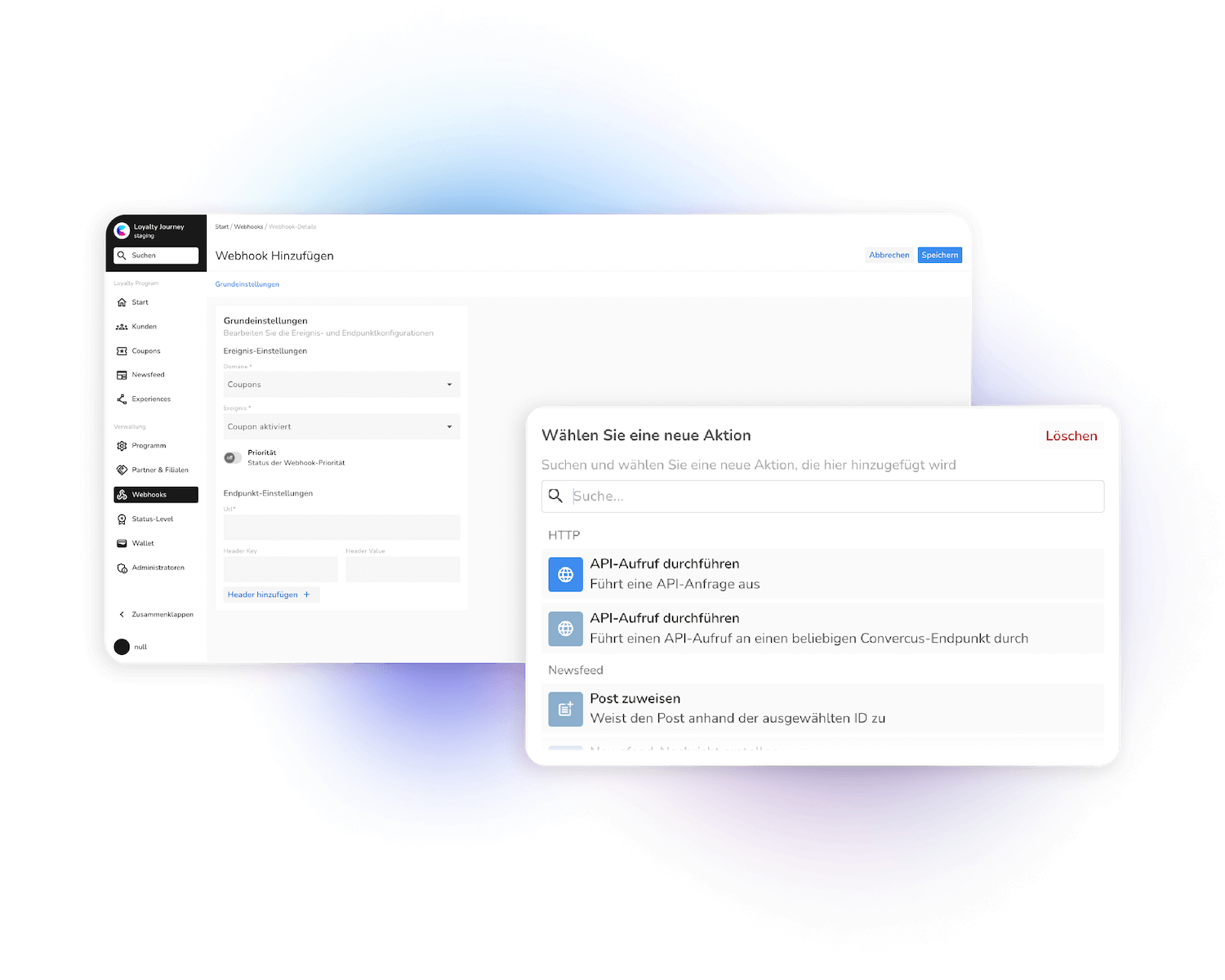
GDPR, Consent, and Legally Compliant Data Usage
In German food retail, data protection is not just about compliance, but also a trust factor. Personalized loyalty without a solid legal basis is not a viable model. The processing of individual purchase histories for personalization purposes typically requires explicit consent pursuant to Art. 6 para. 1 lit. a GDPR. In addition, there are information obligations under Art. 13 GDPR, the principle of purpose limitation from Art. 5 GDPR, and deletion obligations or the right to erasure under Art. 17 GDPR.
For promotional email or SMS communication, § 7 UWG is also relevant. Good loyalty software therefore properly manages consent acquisition, revocation, logging, and segmentation. Retailers benefit twofold: they minimize risks and can actively communicate data protection as a value proposition. This is important because 54% of non-users would be open to customer programs if their privacy concerns were addressed.
Points, Cashback, or Instant Discount? The Right Mechanism for Food Retail
The appropriate mechanism determines whether a program is used or ignored. In German food retail, many indicators suggest immediate benefits: 80% of consumers want immediately redeemable rewards, and 62% expect personalized offers instead of generic promotions. This does not mean that point systems are generally unsuitable. However, it does mean that their economic and psychological logic must be carefully aligned with the purchasing rhythm in food retail.
In practice, programs work best when saving, simplicity, and relevance converge. REWE sends a clear signal with cashback-like euro benefits, Lidl Plus combines coupons, digital receipts, and gamified activation, and tier-based models like Edeka Genuss+ can create additional differentiation. The mechanism should be derived from purchasing behavior, not from marketing's intuition.
Earn/Burn Ratio: How Loyalty Remains Profitable Despite Low Margins
Especially in food retail, the importance of precise business management is often underestimated. The Earn/Burn ratio also helps determine whether a program scales or becomes prohibitively expensive and unmanageable. If points are awarded too generously or redeemed without prioritizing high-margin product ranges, unnecessary liabilities arise. Therefore, redemption incentives should be specifically aligned with product categories, manufacturer budgets, or frequency drivers.
For many retailers, personalized couponing is a better starting point than a large-scale rewards program. It's easier to understand, simpler to test, and closer to day-to-day business operations. Additionally, an app-centric strategy can be beneficial if digital usage and repeat engagement are key priorities. You can find more on this in the article about App-first Loyalty.
Own program or coalition model? The fundamental strategic question
For many retail groups, this is a pivotal decision. An own loyalty program creates data sovereignty, differentiation, and greater control. You control identity, offer logic, customer experience, and communication channels yourself. This is particularly appealing when orchestrating multiple formats, regional banners, or additional touchpoints such as apps, wallet passes, online shops, and digital coupons.
A coalition model can still be beneficial if reach and low entry barriers are the priority, or if there isn't sufficient digital maturity internally yet. The trade-off often involves less flexibility in mechanics, customer experience, and data depth. Those who want to strategically build first-party data often encounter limitations here. This is precisely why many retailers are currently examining whether they should gradually transition from external models to their own system.
Five criteria for the decision
- Data sovereignty is crucial when personalization, basket analysis, and future retail media models are strategically relevant.
- Organizational maturity is necessary because an in-house program requires governance, campaign logic, and ongoing optimization.
- Technical connectivity determines whether POS, app, and existing systems can be seamlessly integrated.
- Brand Strategy plays a role when retailers want to clearly differentiate their customer experience from the competition.
- Economic Viability must demonstrate whether the additional control enables higher incrementality and better activation.
For mid-market and enterprise retailers, the best answer often isn't an either/or, but rather a phased approach: first digitize couponing and identification, then expand personalization, and finally add further loyalty mechanisms.
ROI of a Loyalty Program in Food Retail: How the Investment Pays Off
In food retail, what matters in the end is not the number of app downloads, but the economic impact. There are solid indicators for this: 53% of consumers shop more frequently thanks to loyalty programs, and 39% report larger basket sizes. These are not soft brand metrics, but operational levers for revenue and profit.
A practical example: A regional full-range retailer with 100 stores, 500,000 active customers, an average basket size of €35, and two purchases per week has a strong foundation for incremental effects. Even if only a portion of customers are measurably influenced by better activation, personalized coupons, and seamless checkout integration, double-digit million-euro effects per year are realistic. In the research briefing, a conservative scenario estimates around €13-15 million in additional annual revenue, depending on activation rate, actual incrementality, and promotional budgets.
Which KPIs Really Matter
For a business case to remain robust, retailers should not only look at registrations. More important are active members, redemption rates, and incremental additional revenue. Additionally, metrics such as coupon attach rate, visit frequency, average basket size, share of identified transactions, CLV development, and breakage rate help with management.
Retailers who focus customer loyalty not only on new purchases but also on reactivation should additionally monitor churn prevention KPIs. A structured look at measures that can increase customer loyalty or specifically customer win-back can be implemented.
AI and Personalization: The Next Step in Grocery Loyalty
The trend is clear: 80% of retailers are already implementing initial personalization approaches, and 96% plan to expand their use further. Nevertheless, there often remains a gap between aspiration and reality. The challenge is not collecting data, but rather its operational translation into relevant offers. This is precisely where the difference lies between mere data storage and an effective loyalty strategy.
In grocery retail, personalization primarily means delivering the right offer at the right time at the right touchpoint: such as a coupon for a frequently purchased category, an incentive to switch to a higher-margin product range, or a re-engagement when visit frequency declines. Basket analysis, frequency patterns, and trigger logics thus become the core foundation for steering operations.
What software-supported personalization looks like in practice
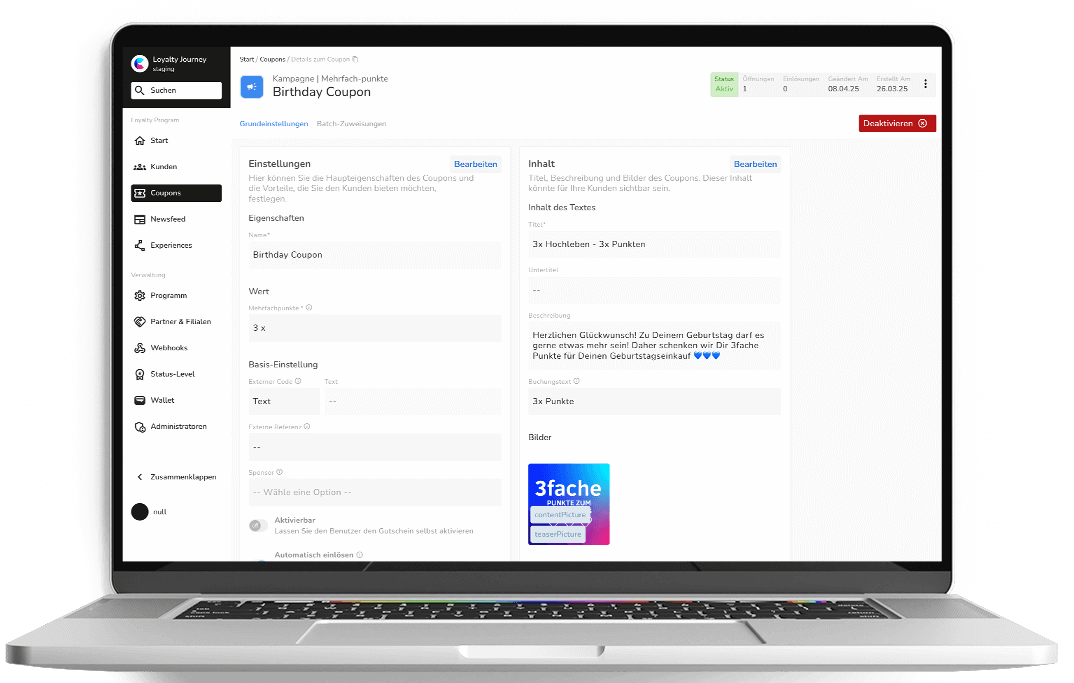
Modern platforms combine loyalty, couponing, and activation in a single workflow. For retailers who don't want to marry multiple standalone solutions, this is a clear advantage. Convercus combines Loyalty Engine, Couponing, Engagement, and API-first integration, allowing personalized offers to be delivered via POS, app, wallet pass, or digital communication. Especially for retail companies with complex touchpoints, this combination is often more important than the individual mechanics.
Another key factor is operational speed. Instead of individually recreating campaigns in multiple systems each time, rules, segments, and deployments can be centrally managed. Those who wish to delve deeper into this topic will find on the page about Engagement further insights into automation and data-driven activation.

Implementation in Practice: What Really Matters
Many programs fail not due to strategy, but due to implementation. According to a grocery study, 73% of retailers have invested in loyalty rewards, but only 49% consider these programs effective. The gap usually arises between concept, system integration, and operational use. Therefore, when selecting a platform, one should not only focus on features, but also on rollout capability, success management, and governance.
Especially in grocery retail, decentralized structures are relevant. Independent merchants, branch organizations, and diverse POS setups demand clear processes for identification, couponing, support, and training. An accelerated rollout only makes sense if store employees and IT understand the same process.. This includes testing phases, fallback logic for offline scenarios, clear receipt and discount display, and a realistic operating model post-go-live.
Typical pitfalls during implementation
- Overly complex mechanics dilute customer value if the benefit isn't immediately clear at the checkout.
- Underestimated POS dependencies lead to delays if legacy systems don't support stable real-time communication.
- Lack of market acceptance slows down the program if store teams view identification or coupon processing as extra effort.
- Isolated data silos prevent personalization if the app, CRM, POS, and campaign logic don't work together.
- Unclear KPI definitions make it difficult to prove incrementality and ROI to management and purchasing.
If retailers are looking for a platform that handles this complexity with modern architecture, then a look at Loyalty and Tech & Integration is worthwhile. What's important is not so much the longest feature list, but a system that functions stably and scalably in daily store operations.
Conclusion: The right loyalty software in food retail combines technology, relevance, and economic efficiency
The most important takeaway is clear: Loyalty software in food retail needs to offer more than just a digital points system. It must integrate checkout, couponing, personalization, consent, and omnichannel processes into a robust platform. The current market upheaval in German food retail shows that data sovereignty, app-centricity, and POS proximity are increasingly determining a program's competitiveness.
For many retailers, therefore, the crucial question is not whether to implement loyalty, but how to set it up correctly, both technically and economically. Anyone in food retail looking to systematically increase frequency, basket size, and first-party data needs a software-supported solution with a true operational focus. Convercus is a strong partner for this if you want to bundle loyalty, couponing, and engagement in a scalable SaaS platform.
Schedule a personal live demo with a loyalty expert and assess which architecture, mechanics, and rollout strategy suits your food retail business.
FAQs about Loyalty Software in Food Retail
How complex is implementing a loyalty program in food retail?
That primarily depends on your POS landscape, the number of touchpoints, and the desired mechanics. The real complexity usually lies in integration, not in the campaign idea. With an API-first architecture and a clear rollout plan, a phased approach is significantly less risky.
Does loyalty software work with our existing POS system?
In many cases, yes, but this needs to be technically verified. Key considerations are real-time capability, POS identification, and fallback scenarios for offline or legacy environments. Especially with older POS systems, the quality of the interfaces determines project risk and rollout speed.
Can loyalty software be implemented in food retail in a GDPR-compliant manner?
Yes, if consent, information obligations, and deletion processes are properly implemented. Relevant foundations are, in particular, Articles 5, 6, 13, and 17 of the GDPR; for promotional communication, Section 7 of the UWG (Unfair Competition Act) also applies. Data protection must be considered from a technical and organizational perspective from the outset, not merely as an afterthought.
How much does loyalty software for grocery retail cost?
Costs depend on the number of users, store structure, touchpoints, integration effort, and desired depth of functionality. More important than the initial price is the expected ROI, i.e., whether the solution delivers engaged customers, more identified transactions, and measurable incremental revenue. Especially in grocery retail, profitability should always be considered in conjunction with frequency and basket size effects.
Which mechanism is most sensible for getting started?
For many retailers, personalized coupons, cashback, or instant discounts are the best starting point. In price-sensitive grocery retail, they are easy to understand and quickly measurable at the POS. A points system or status model can be added later once identification and data usage are well-established.
Can we migrate an existing loyalty program?
Yes, that's a common use case. Crucial factors are data quality, mapping of old mechanisms, and clean transition logic, so that customer accounts, benefits, and consents are transferred with minimal loss. Clear communication is particularly important so that customers perceive the change as an improvement.


- 5x Return on Investment
- 80% Customer identification
- 8x Customer interaction
- +274% Repurchase Rate

.jpg)