







The topic, brief and concise
- Loyalty software is no longer a nice-to-have for perfumeries. Amidst omnichannel competition, online growth, and declining brand loyalty, customer loyalty becomes a central lever for revenue and differentiation.
- In the beauty segment, personalization, tiered programs, and samples usually work better than blanket discounts. Particularly relevant are fragrance profiles, repurchase triggers, exclusive benefits, and digital customer cards.
- Essential criteria for software selection include POS integration, API-first architecture, and GDPR compliance. Without clean data flows across stores, online shops, apps, and wallets, loyalty efforts remain piecemeal.
- Convercus is a software for loyalty, couponing, and engagement. For perfumeries with demanding omnichannel requirements, this can be a suitable foundation to build customer loyalty systematically and scalably.
Why Loyalty Software is Now Strategically Crucial for Perfumeries
The perfumery market is growing, but customer loyalty is becoming more fragile. Globally, the fragrance market was estimated at around USD 60.26 billion for 2026, while the German market is also growing and simultaneously facing massive competitive pressure. For perfumeries, this means: increased demand does not automatically lead to greater loyalty. Amidst premiumization, Gen Z-driven online growth, real-time price comparison, and strong competition from large omnichannel players, customer retention is becoming a core business issue.
Mid-sized perfumeries, in particular, feel double the pressure to act. On the one hand, international brands and retail concepts continue to expand, while on the other hand, market consolidation shows that traditional loyalty cards and blanket discount campaigns are no longer sufficient. Those who only engage customers seasonally for Christmas or Valentine's Day miss out on potential for repeat purchases, cross-selling, and first-party data.
The Market in 2026: Growth, Consolidation, and Omnichannel Pressure
Perfumeries operate in an attractive but challenging market environment. Premium fragrances account for a large portion of the market value, while the online share in the beauty and fragrance segment is continuously growing. The sensory experience remains important, but purchasing decisions are increasingly shifting between apps, online shops, and physical stores. This is precisely why in-store advice alone is no longer enough: it must be digitally extended, made measurable, and translated into a cross-channel loyalty model.
In addition, there is a structural shift from brand loyalty to retailer loyalty. Buyers are less likely to remain loyal to individual brands, but rather to the retailer who consistently combines advice, convenience, relevant offers, and exclusive experiences. For perfumeries, this is an opportunity: those who connect the physical store touchpoint with digital engagement and personalized benefits can differentiate themselves despite large competitors.
What Douglas, Sephora, and Ulta Achieve with Loyalty Programs
The most successful beauty retailers treat loyalty not as a discount function, but as a growth platform. The DOUGLAS Beauty Card has approximately 59 million members in Europe. Sephora Beauty Insider had over 38 million members as of 2025, while Ulta's Ultamate Rewards boasts 44.6 million active members and accounts for over 95% of sales impact. These figures do not indicate that only large corporations benefit, but rather that well-executed loyalty in the beauty segment has a measurable impact on frequency, basket size, and personalization.
For small and medium-sized perfumeries, the real lesson is not "get bigger," but "engage smarter." Those who systematically combine advice, fragrance profiles, samples, repurchase cycles, and omnichannel convenience build a program that doesn't feel like a plastic card, but like a true competitive advantage.
What Loyalty Software Must Deliver for Perfumeries
Loyalty software for perfumeries must be able to do much more than just manage points. It must integrate program logic, cross-channel redemption, personalized communication, and analytics into a single platform. Especially in beauty retail, tiered models, vouchers, app experiences, POS processes, and personal preferences are closely intertwined.
Seamlessly integrate point systems, tiered programs, and paid loyalty
In the perfumery sector, multi-tiered programs are practically standard. Good software must therefore be able to differentiate between redemption points and status points, map rules for revenue thresholds, and automatically deliver benefits for each tier. These include birthday benefits, early access to limited edition fragrances, exclusive events, beauty services, or even a paid premium model with additional advantages. For a deeper understanding of how modern programs are structured, refer to the overview of Customer Loyalty Software the technical foundations.
A flexible set of rules is crucial here, rather than rigid standard mechanisms. In perfumery, it's not just sales per purchase that count, but also behavior: reviewing a sample, purchasing a refill, attending a masterclass, or activity within the app and wallet. A powerful Loyalty Engine should support these logics without complicated custom programming.
Omnichannel, POS Integration, and Data Protection are Essential
In practice, many programs fail not because of the idea, but due to a lack of integration. Customers expect points to be collected in-store, viewed online, and redeemed in the app or via a wallet pass. This requires API connections to POS, e-commerce, app, and CRM, as well as a robust infrastructure for peak loads during the Christmas season. Those who want to evaluate the technical aspects should look for API-first architecture and integration capabilities .
Legally, the benchmark in the DACH market is clearly defined. For pure program administration, depending on the setup, Art. 6 para. 1 lit. b GDPR may be relevant; for personalized communication, birthday data, fragrance preferences, or skin type information, Art. 6 para. 1 lit. a GDPR usually applies. In addition, there are the principles from Art. 5 GDPR, Privacy by Design according to Art. 25 GDPR, data processing agreements according to Art. 28 GDPR, consent requirements for advertising communication according to § 7 UWG, and for tracking technologies on end devices, the provisions from § 25 TDDDG. For perfumeries, this means: A loyalty program requires not only marketing logic but also clean consent, role, and deletion concepts.
- The software should consolidate online shop, physical store, app, and wallet pass into a consistent customer account.
- It should be able to manage status logics, point systems, coupons, and benefits without manual workarounds.
- It should support GDPR-compliant consents, data minimization, and traceable permissions.
- It should remain performant even during seasonal peaks and ideally account for in-store offline scenarios.

Industry-Specific Loyalty Levers in Perfumery
Fragrance loyalty works best when it digitally extends sensory consultation. This is precisely where the industry differs from standard retail. Purchase history alone isn't enough. Relevant factors include fragrance families, preferences for specific brands, occasion-based purchases, gifting behavior, skin type, refill affinity, and reactions to samples. Loyalty software must leverage these signals to transform data into tangible experiences.
Fragrance profiles and consultation data as a basis for personalization
The best entry point for personalization is a structured fragrance profile. Even during registration, preferences such as floral, woody, oriental, fresh, or gourmand can be captured. Supplemented by purchase history and documented in-store consultations, this creates a profile that enables significantly more relevant recommendations than generic "10% off everything" promotions. This is particularly valuable for specialized perfumeries, as personal consultation knowledge is no longer tied to individual employees but lives on in the customer account.
If skin or beauty data is also incorporated, the benefit for service and sales increases. A customer who receives consultation for sensitive skin in-store and later buys suitable skincare or fragrance layering products online should be recognized within a consistent profile. This makes recommendations, services, and follow-up communication logical rather than random. For suitable mechanisms beyond mere discounts, it's worth looking at digital engagement approaches and strategies on how to systematically increase customer loyalty can be enhanced.
Intelligently leveraging samples, repurchase cycles, and seasonal triggers
The practice of offering samples is one of the most underestimated loyalty levers in perfumery. Anyone who digitally records the distribution of samples can transform a cost center into a measurable conversion channel. A clear logic would be: distribute a sample, have it reviewed in the app, then issue a personalized coupon based on that review, and attribute the subsequent purchase to the sample. This reveals which fragrance families, brands, or consultant interactions actually drive sales.
Equally important are automated triggers along the actual repurchase cycle. Fragrances are often repurchased after 2 to 4 months, and gifts follow seasonal patterns. Good programs therefore don't send random reminders, but rather at plausible times: for example, before Valentine's Day, Mother's Day, Black Week, or just before a typical refill is due. Additionally, challenges like "Try three new fragrances," "Review your sample," or "Bring back your empty bottle" are effective. For such mechanisms, personalized coupons and app-first loyalty concepts are particularly relevant.

Best Practice Analysis: What Perfumeries Can Learn from Douglas, Sephora, and Ulta
Major beauty loyalty programs demonstrate that loyalty has become an operating system for growth in the perfumery market. It's crucial not to merely copy the surface. Neither a three-tiered card nor a points system alone makes a program successful. The difference lies in data quality, cross-channel usability, clear benefits, and continuous development.
Douglas Beauty Card: From Loyalty Program to Omnichannel System
Over the years, Douglas has evolved the Beauty Card from a classic customer card model into a connected ecosystem. With approximately 59 million members, the program is one of the largest in European beauty retail. What's relevant is not just its size, but the logic behind it: points, status tiers, digital card, app integration, omnichannel benefits, and personalized rewards. For perfumeries, this is a clear indication that consumers today expect to use their benefits identically both online and offline.
Sephora and Ulta: Personalization, Services, and Community Instead of Discount Fixation
Sephora and Ulta clearly demonstrate that emotional and service-based benefits often have a stronger impact than mere price reductions. Sephora Beauty Insider boasts over 38 million members and closely links loyalty with personalization and digital beauty experiences. Ulta reports 44.6 million active members; there, loyalty has immediate revenue relevance. The lesson for mid-sized perfumeries is clear: Those who only send out vouchers remain interchangeable. Those who combine quality advice, digital services, and exclusive access create a compelling reason for customers to return.
The actual best practice, therefore, is not 'more discount,' but 'more relevance.' Those who combine samples, service appointments, personal recommendations, gift occasions, and digital convenience within a loyalty framework create a positioning that endures even alongside large chains.
The 5 Most Common Mistakes in Perfumery Loyalty Programs
Many programs lose their effectiveness because they are conceived too generally and are technically poorly implemented. Especially in perfumery, mistakes often only become apparent late: While the program is used, it increases neither customer loyalty, data quality, nor profitability. Five patterns are typical and repeatedly emerge in projects.
- Mistake 1: Loyalty is reduced to discounts. Relying solely on general price advantages trains price orientation instead of loyalty and even weakens brand perception in the premium segment.
- Mistake 2: Online and physical stores remain separate worlds. If points, coupons, or status benefits don't work at every touchpoint, frustration arises instead of convenience.
- Mistake 3: The customer card lacks digital integration. A plastic card without an app, wallet, or personalized communication is too passive for modern beauty customers.
- Mistake 4: Samples and consultations are not made measurable. This means the specific added value of perfumeries, which could differentiate specialist retailers from marketplaces and drugstores, is lost.
- Mistake 5: Clear KPIs and win-back strategies are missing. Without visibility into churn, repurchase rate, and CLV, it remains unclear whether the program is merely being used or is truly effective.
It becomes particularly expensive when inactivity goes unnoticed. Then campaigns are run for already active buyers, while valuable customers quietly churn. This is precisely where loyalty becomes closely linked with retention and customer win-back connected: The best software not only recognizes purchase activity but also declining engagement and sets appropriate triggers to counteract it.
ROI of a Loyalty Program for Perfumeries: A Sample Calculation
For budget approval, what ultimately matters is not a concept paper, but a robust business case. Therefore, a simple model calculation is worthwhile. Let's take a regional perfumery chain with 50 branches and 200,000 active buyers per year. The average shopping cart value is €55, the average purchase frequency is 4 purchases per year, and the annual churn rate is 25%.
Assuming 40% of active buyers join the program and the program moderately improves shopping cart value, frequency, and churn. Then a considerable effect already arises. The following calculation is simplified and must be validated on a case-by-case basis, but it shows the magnitude at which loyalty becomes economically relevant for perfumeries.
In addition, there's a value that is still underestimated in many business cases: first-party data. If perfumeries know which customers like floral niche fragrances, who regularly buys gifts, or who responds particularly well to samples, this not only improves campaigns but also, in the long term, assortment management, media efficiency, and negotiation position with brand partners.
Checklist: How to Choose the Right Loyalty Software for Your Perfumery
The best loyalty software is not the one with the most features, but the one with the best fit for your business model. Especially in the perfumery sector, selection should not be driven solely by marketing, IT, or purchasing. Successful decisions are made when specialist departments, branch processes, data protection, and technical architecture are evaluated together.
- First, check the program's flexibility. Can the solution manage points, status levels, paid loyalty, vouchers, events, and individual benefits within a consistent set of rules?
- Evaluate integration capabilities early. Key are API connections to POS, e-commerce, app, CRM, and, if applicable, existing consent or BI systems.
- Test the omnichannel logic realistically. A coupon must work in-store just as it does online, and a member's status must not be delayed or differ depending on the channel.
- Ask specifically about data protection and governance. How are consents stored, what deletion concepts exist, and how transparent are role and rights concepts?
- Consider scalability and operations. Seasonal peak loads, parallel branch promotions, and international rollouts must not be exceptions.
- Do not evaluate the commercial framework in isolation from the ROI. A low license price is of little help if personalization, couponing, or migration ultimately don't work properly.
Many teams find a structured evaluation matrix with must-have, should-have, and nice-to-have criteria effective. This turns a confusing tool comparison into a genuine selection decision. Particularly important is the migration question: Can an existing customer card or points system be transferred to the new platform without friction?
The path to implementation: from concept to go-live
A loyalty project in the perfumery sector rarely fails due to the idea itself, but rather due to a lack of implementation discipline. Therefore, a clear rollout path is needed. First, goals are defined: Should the program primarily increase repeat purchases, build first-party data, boost store frequency, or improve online conversion? Only then are the program mechanics and KPI set determined.
Phase 1: Target Vision and Program Architecture
In this phase, the tier model, points logic, benefits, opt-in journeys, and core segments are defined. For perfumeries, a setup that rewards both service and purchasing behavior is almost always recommended, such as purchases, consultation bookings, app activity, and sample feedback.
Phase 2: Software Selection and Technical Scoping
This is where it becomes clear whether a platform truly fits the omnichannel model. Solutions like Convercus are particularly relevant when perfumeries want to implement loyalty, couponing, and engagement in an API-first environment without committing to rigid suite logics. For mid-market and enterprise setups, this combination of flexibility, POS proximity, and scalable implementation is often the decisive difference.
Phase 3: Integration, Testing, and Branch Readiness
Before going live, real processes must be tested. These include point allocation at the checkout, coupon redemption in the online shop, status changes, wallet updates, consent flows, and failure scenarios. Especially in branch networks, testing with real store processes is more important than any PowerPoint demo.
Phase 4: Rollout and Continuous Optimization
The program is not finished after launch; it only begins to learn. Successful teams continuously analyze adoption, active members, redemption, churn, and segment reactions. Then, triggers, coupons, challenges, and tier benefits are iteratively adjusted instead of letting the program run unchanged for years.
Conclusion: Loyalty Software Becomes a Competitive Advantage for Perfumeries
Perfumeries today don't need another discount mechanism, but rather a connected loyalty infrastructure. Those who combine consultation, samples, repurchase cycles, omnichannel convenience, and first-party data build a program that simultaneously strengthens sales, customer loyalty, and service quality. This is precisely the difference between a customer card and a true loyalty strategy.
If you want to replace an existing system or build a new program, Convercus is an obvious next option. The platform combines loyalty, couponing, engagement, and API-first integration in a setup designed for complex retail environments. If you want to see how this could specifically look for your perfumery, book a personal demo.
FAQ
What's the best way to start a loyalty program for my perfumery?
Don't start with the technology, but with the target vision. First, define whether you want to increase repeat purchases, store frequency, first-party data, or omnichannel usage. Then, derive the points logic, benefits, segments, and integration requirements.
Does loyalty software work with our existing POS system?
In most cases, yes, if the platform is built for integration. Crucial are clean APIs, clear data flows, and a realistic testing phase. It becomes particularly critical with legacy POS systems that lack standardized interfaces.
Can loyalty software be implemented in a GDPR-compliant way for perfumeries?
Yes, but only with a clean consent and data model. Particularly relevant are Art. 5, Art. 6, Art. 25, and Art. 28 of the GDPR, as well as § 7 UWG for advertising communication. For preference data such as date of birth, fragrance profile, or skin type, the legal basis should be clearly documented and technically traceable.
How complex is the implementation of a loyalty program?
The effort depends less on the number of branches than on the system landscape and program complexity. A clearly scoped project with defined processes can be implemented much faster than an implementation with unclear responsibilities or many special logics. Structured onboarding with the specialist department, IT, and branch operations is important.
What does loyalty software for perfumeries cost?
There is no reliable flat rate without considering usage, integrations, and rollout depth. It is relevant whether the provider bills on a license basis, transaction basis, or hybrid model, and what services for migration, support, and further development are included. For decision-makers, the ratio of total investment to expected revenue and retention impact is what matters in the end.
Can we migrate an existing customer card or points system?
Yes, this is a common starting point in practice. Important are a clean transfer of customer data, point balances, status levels, and consents, as well as a migration plan for the branch, online shop, and app. The better the legacy system and target architecture are documented, the smoother the transition will be.


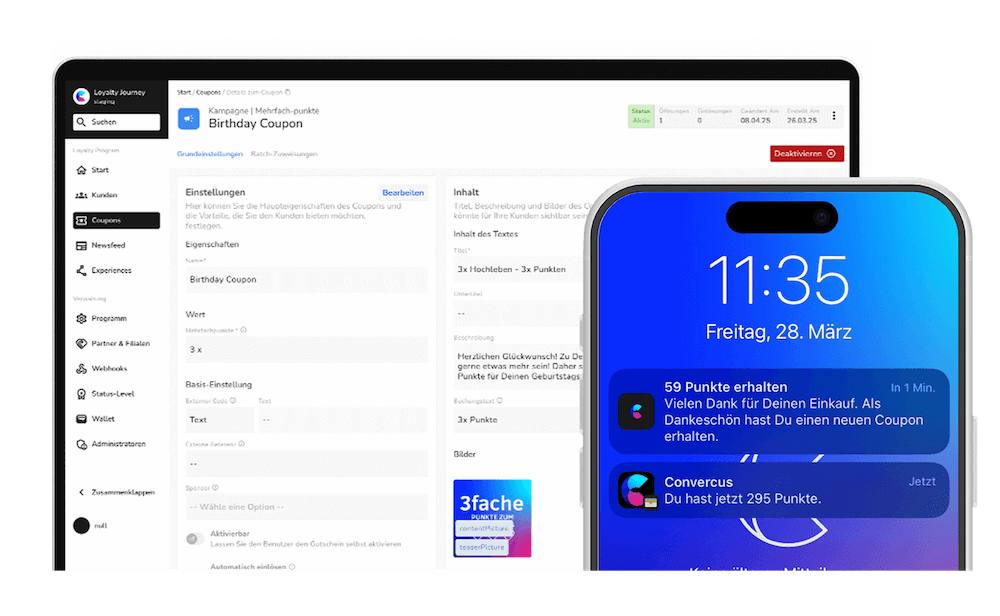
- 5x Return on Investment
- 80% Customer Identification
- 8x Customer Interaction
- +274% Repurchase Rate
.png)