







The Topic at a Glance
- Entertainment loyalty needs a different approach. Infrequent visits, strong emotions, group dynamics, and seasonality require different mechanics than in traditional retail.
- Successful programs combine multiple models. Points, status, subscription, gamification, and experiential rewards are significantly more effective when combined than pure discount mechanisms.
- The ROI in entertainment is clearly demonstrable. Even small increases in repeat visits, additional revenue, or opt-ins can unlock millions in potential.
- Convercus is a powerful loyalty software when omnichannel, couponing, engagement, and API-first integration need to come together. Especially for companies with complex customer journeys, this is a significant lever for scalable customer loyalty.
Why do entertainment companies need their own loyalty strategy in 2026?
Entertainment companies today face double pressure: guests expect personalized experiences instead of generic mass communication, while demands for economic efficiency, data protection, and technical integration are simultaneously increasing. This is precisely where loyalty software in entertainment becomes a strategic lever. According to Fortune Business Insights, the global loyalty management market is projected to grow from USD 15.19 billion in 2025 to USD 51.65 billion by 2034. For Germany, the market is already estimated at USD 3.55 billion in 2025.
For theme parks, cinemas, live events, sports clubs, or streaming providers, the logic is particularly clear: those who don't digitally identify guests cannot systematically increase repeat visits, additional revenue, or first-party data. At the same time, according to Queue-it, 77% of consumers withdraw their loyalty faster than three years ago. Loyalty is therefore not a marginal bonus program, but a tool for retention, CLV, and profitable growth.
Unlike pure ticketing or CRM, loyalty software is about strategically incentivizing behavior: returning, using upgrades, buying F&B, bringing friends, using an app, or giving consent for marketing. Those who want to delve deeper into the fundamentals of customer loyalty software can also find further perspectives in the Convercus article on Customer Loyalty Software.
Why don't standard loyalty programs work in entertainment?
Many loyalty concepts are adopted from retail. For entertainment, this falls short. A supermarket sees its customers weekly, while a theme park or arena often only sees them a few times a year. Visit frequency is lower, but individual visits are more emotional and generate higher revenue. That's why pure earn-and-burn models often don't work on their own.
Added to this is a fragmented system landscape. Many operations have separate solutions for ticketing, F&B, merchandising, CRM, and newsletters. Without clean identification across all touchpoints, there is no unified customer profile , and therefore no reliable personalization.
- Seasonality changes program mechanics. Theme parks, open-air venues, or sports clubs need incentives for off-peak times, pre-season, and weekdays.
- Group logic is central. Families, groups of friends, or fan communities often decide together and should also be activated together.
- Experiential rewards are more important than pure discounts. Early access, VIP areas, Fast Lane, or exclusive content often have a stronger impact in entertainment than a 5% discount.
- Engagement between visits is crucial. Without an app, wallet pass, challenges, or trigger communication, contact with the brand can be lost for months.
Precisely for this reason, loyalty software in entertainment is not a standard add-on, but a specialized infrastructure for identification, incentivization, and omnichannel communication.

Which types of loyalty programs work in entertainment?
In entertainment, there isn't one single right model. Successful programs usually are those that combine points, status, subscription, and gamification. According to Open Loyalty, 42.1% of surveyed loyalty managers name gamification as a top trend for the coming years, while 59% primarily aim to improve customer lifetime value in 2026.
Points programs remain relevant because they are easy to understand. What's crucial, however, is what gets rewarded: not just ticket purchases, but also F&B, merchandise, app usage, content interactions, or referrals. Tiered models create additional motivation because guests work towards a status. Subscription approaches like annual passes, season passes, or membership clubs are particularly well-suited for theme parks, streaming, or sports. Gamification in entertainment is not an add-on, but a natural fit.
Those who want to delve deeper into the mobile perspective can find helpful food for thought in the article on App-First Loyalty.
Loyalty Software for Theme Parks, Cinemas, and Streaming: What fits which segment?
Theme Parks, Cinemas, and Venues
For theme parks and cinemas, visit frequency and additional revenue per visit are the central levers. Programs that combine ticket purchases, F&B, and merchandise into a single logic work well here. For parks, annual passes plus status benefits are suitable, supplemented by bonus points for visits on less busy days. Cinemas benefit from rewards on tickets, snacks, and upgrades, ideally linked to digital customer cards or wallet passes.
For event venues, it's particularly important that loyalty doesn't end at the entrance. Those who only reward tickets miss out on potential. Pre-event and post-event communication, merch offers, exclusive presales, or upgrades to hospitality areas create additional relevance.
Streaming, Sports, and Fan Engagement
Streaming services need different mechanics than physical venues. Here, what counts is usage depth, content preferences, and subscription stability. Loyalty can be driven by exclusive content, community features, challenges, or referral programs. In sports, fan loyalty is central: ticketing, merch, matchday, sponsor activation, and member communication should all contribute to a common data basis.
Especially in fan- and community-driven models, it's worth looking at engagement solutions, because as many digital interactions as possible need to be generated between actual visits or match days. For F&B or merchandise activation, intelligent couponing is also a strong lever.
Best Practices: From AMC to Caesars – and what DACH providers can learn from them
What makes AMC Stubs and Six Flags Pass Perks so successful?
AMC Stubs is considered a strong example of how ticket purchases, concessions, and membership can be intelligently connected. The program operates with tiers, clear values, and a subscription-like premium model. Six Flags demonstrates in the theme park context how season passes and benefits can be expanded beyond the actual admission.
The lesson here: A good entertainment program not only rewards revenue but builds a relationship that lasts beyond individual visits.
What can DACH providers learn from Disney+ and Caesars Rewards?
Disney combines digital content, physical experiences, and brand world into an ecosystem with high recognition value. Caesars Rewards is one of the most sophisticated examples of experiential rewards: status, upgrades, exclusive access, and cross-property redemption create genuine added value. As a result, loyalty is not bought through discounts but through relevance.
For DACH companies, the message is clear: even without Disney's scale, similar patterns can be adopted, for example, with Fast Lane benefits, family benefits, presales, or exclusive members-only experiences.
How to calculate the ROI of loyalty software in entertainment
In board discussions, it's not the prettiest app that counts, but the business case. Loyalty software in entertainment must demonstrate how it influences visit frequency, spend per visit, and retention influences. A plausible example: A regional theme park with 1 million visitors and an average spend of €55 per visit generates €55 million in annual revenue. If 300,000 guests are identified loyalty members and only 20% of them make one additional visit per year, this results in 60,000 additional visits. This corresponds to €3.3 million in additional revenue.
If the spend per visit among loyalty members additionally increases by €5.50 due to personalized F&B or merchandise offers, another €1.65 million is added from 300,000 visits. Together, the potential is around €5 million in additional revenue. Actual results vary, but the principle is robust: even small behavioral changes have a disproportionately large impact in entertainment.
- For parks and venues, the repeat visit rate is usually the most important key performance indicator.
- For cinemas, ticket frequency, snack revenue, and app usage are particularly insightful.
- For streaming and sports, subscription stability, engagement depth, and churn are even more critical.
What technical requirements must loyalty software in entertainment meet?
Integration, Performance, and Offline Capability
Entertainment companies should not choose software based on its interface alone. What's crucial is whether the platform is built API-first and can be cleanly integrated with ticketing, POS, CRM, apps, webshops, or access systems. Equally important is scalability during peaks: season openings, match days, premieres, or holidays generate load peaks that a platform must withstand in real-time. Furthermore, for parks or large venues, offline capability is relevant if individual areas do not have stable network coverage.
GDPR, Consent, and Legally Compliant Communication
In the DACH market, compliance is not a side issue. Those who process personal data for loyalty purposes need a clear legal basis according to Art. 6 para. 1 GDPR. For personalized communication and many profiling-related use cases, consent according to Art. 6 para. 1 lit. a GDPR in conjunction with Art. 7 GDPR is often the cleanest path. Additionally, there are information obligations according to Art. 13 GDPR, rights of access according to Art. 15 GDPR, deletion obligations according to Art. 17 GDPR, and a data processing agreement according to Art. 28 GDPR.
For email marketing in Germany, additionally, § 7 UWG is relevant. If information is stored or read from end devices, then also § 25 TTDSG an important role. Good loyalty software must therefore not only document consent but also make it operationally usable.
Personalization and Omnichannel Delivery
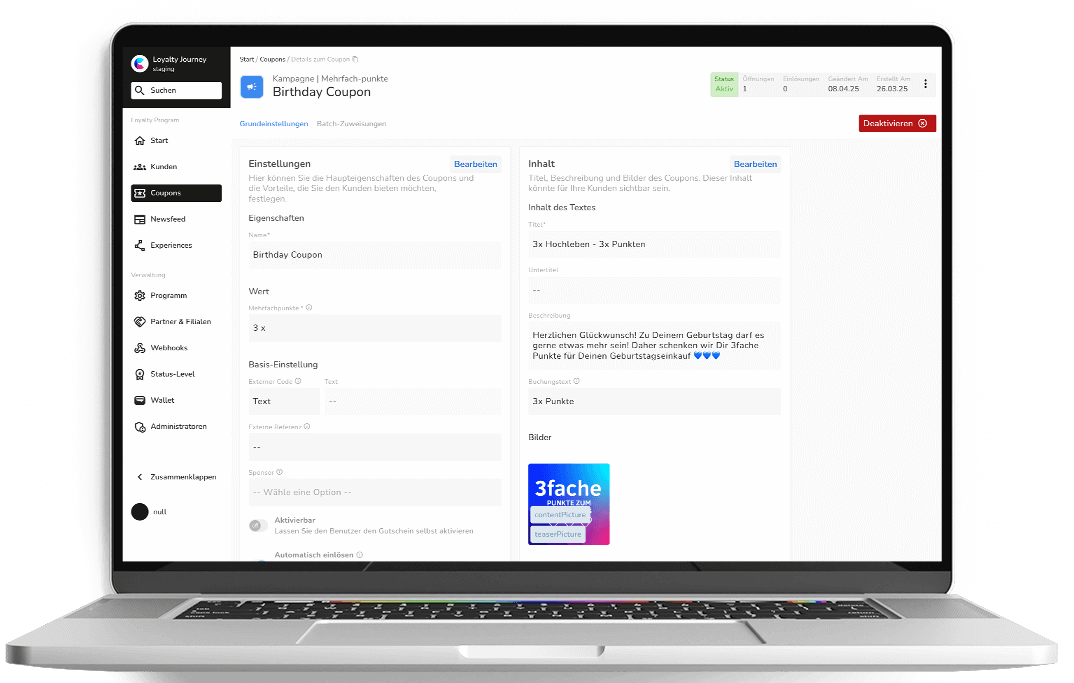
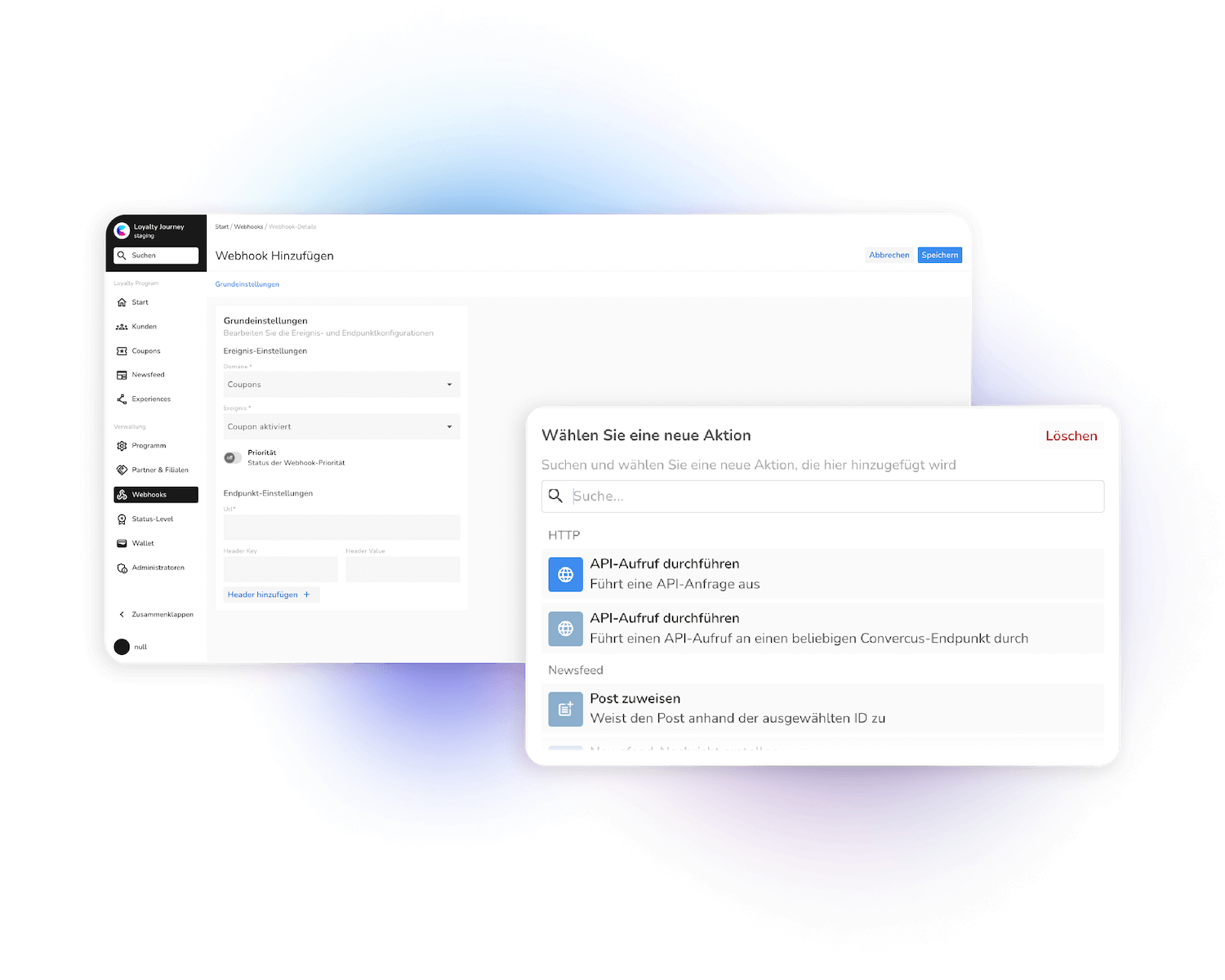
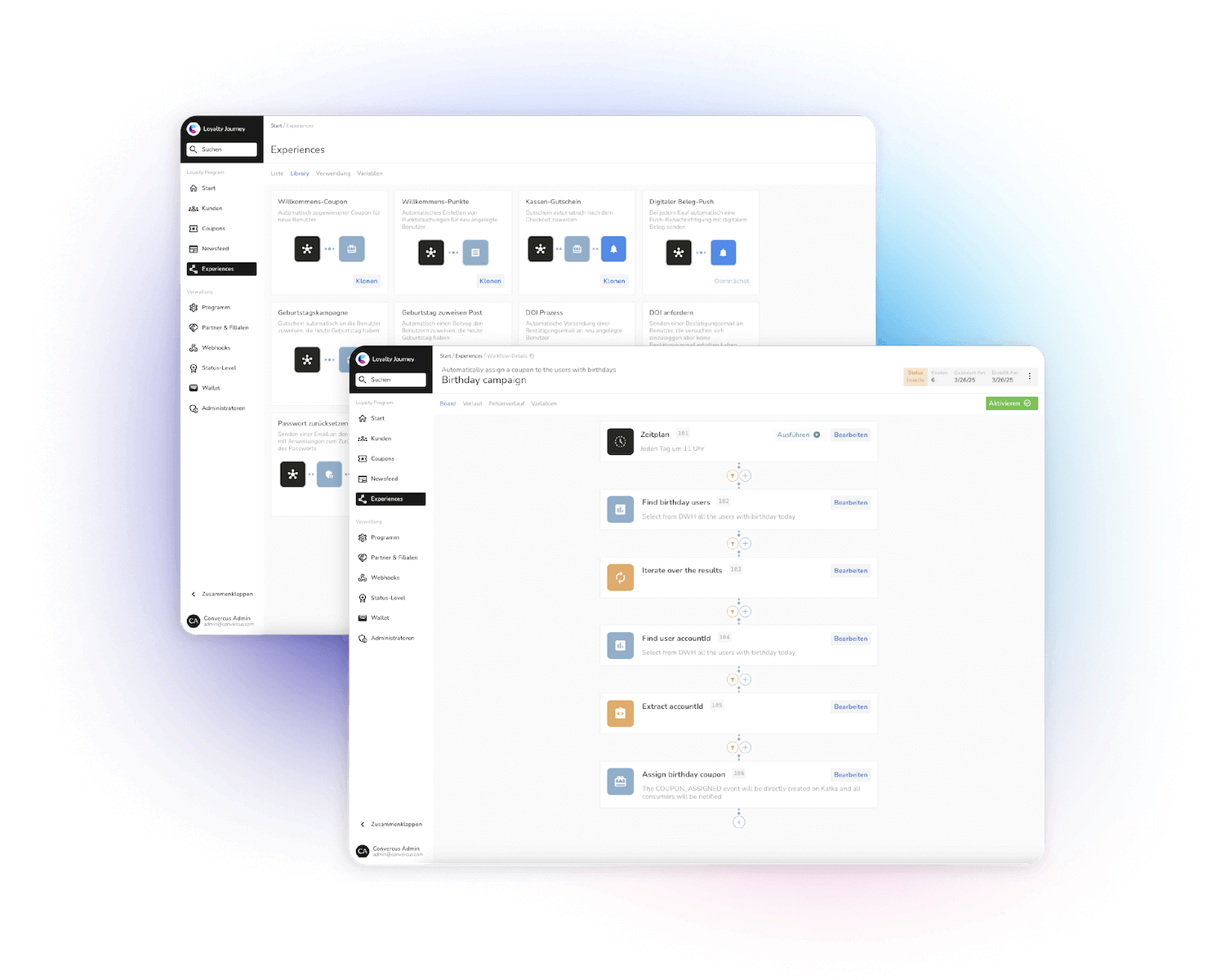
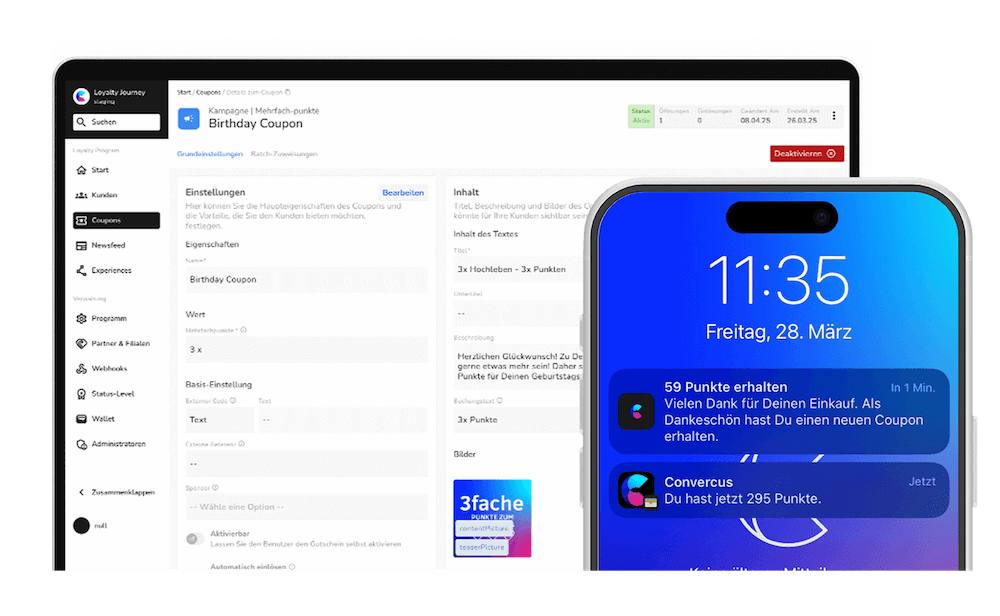
A modern platform should not only collect data but also make it usable. This is precisely where Segmentation, Marketing Automation, and Couponing crucial: birthday offers, pre-season reactivation, upgrades after repeated visits, or family offers during holiday periods. Those looking for a technical perspective should consider Tech & Integration .
How to Successfully Roll Out a Loyalty Program in Entertainment: A 4-Phase Plan
The most common reason for weak programs is not a lack of creativity, but a lack of implementation depth. A successful rollout begins with clear goals: more identified guests, more repeat visits, more additional revenue, or more consent. Only then do the mechanics follow. Those who immediately discuss point values before the data model and touchpoints are clearly defined usually fall short.
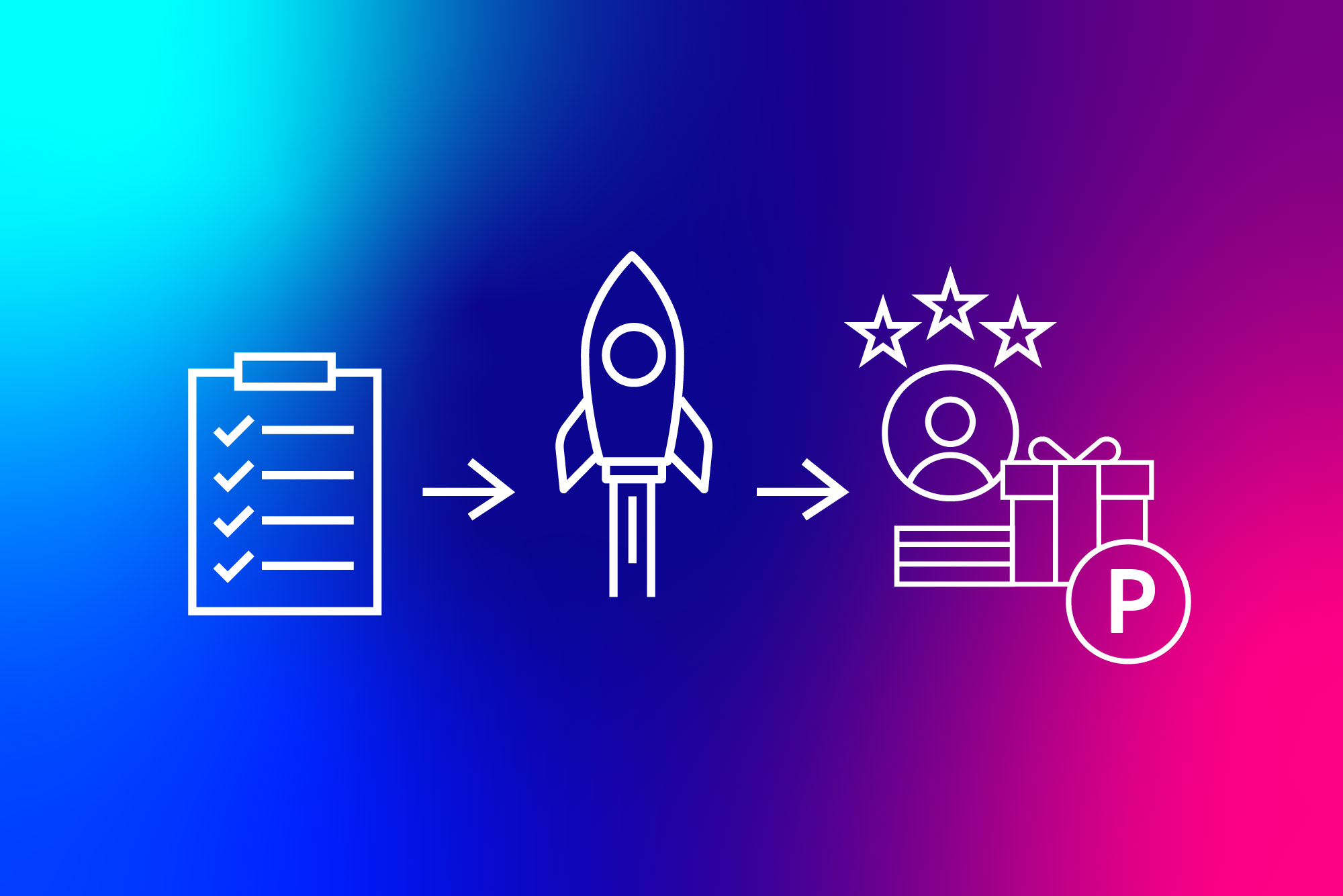
- Phase 1: Define Target Vision and Data Model. Define target groups, relevant touchpoints, success measurement, and consent logic.
- Phase 2: Develop Program Architecture. Determine which combination of points, status, couponing, challenges, and benefits makes sense.
- Phase 3: Connect and Test Systems. Prioritize interfaces to POS, CRM, app, web, and, if applicable, ticketing.
- Phase 4: Launch, Optimization, and Automation. Start lean and improve triggers, segments, and rewards based on data.
If companies are looking for a platform that combines Loyalty, Couponing, Engagement, and API-first integration in one environment, then a look at Loyalty, Couponing and Engagement makes sense. Convercus is particularly relevant when omnichannel processes, wallet passes, marketing automation, and low IT friction need to come together. The platform already manages 40M+ loyalty accounts and 116M+ transactions, bringing the necessary enterprise perspective for scalable programs.
Conclusion: Loyalty Software Transforms Individual Visits into Robust Customer Relationships
Loyalty software in entertainment is effective when it brings together experience, data, and operational excellence . Pure discount cards are not enough. Crucial elements include digital identification, suitable program design, clean integrations, GDPR-compliant consent processes, and a mechanism that remains active even between visits.
For decision-makers, this means: Firstly, entertainment programs must be designed differently from classic retail models. Secondly, the ROI can be clearly derived from repeat visits, additional revenue, and better use of first-party data. Thirdly, a platform wins when it not only manages rules but truly supports personalization, couponing, and omnichannel delivery.
If you'd like to explore how such a setup could look for your company, a conversation with Convercus is worthwhile. Schedule a personal live demo and discover how you can enhance your customer loyalty with a modern loyalty engine.
FAQ
How complex is the implementation of loyalty software in entertainment?
This primarily depends on the existing system landscape. A lean start with a digital customer card, basic rules, and a few core touchpoints is usually much faster to implement than a full rollout with many integrations. It's important to start with a clear scope and not try to launch all use cases simultaneously.
Does loyalty software also work with our existing POS or ticketing system?
In many cases, yes, provided the solution is built API-first or supports standardized interfaces. During the selection process, you should specifically check which data can be transferred in real-time and how transactions, vouchers, or status information are synchronized between systems.
Is loyalty software GDPR-compliant?
The software alone does not automatically make a program GDPR-compliant. Crucial factors include role distribution, consent processes, documentation, and technical functions for information access, deletion, and consent management. Relevant legal bases include, in particular, Art. 6, 7, 13, 15, 17, and 28 GDPR, as well as § 7 UWG and § 25 TTDSG, depending on the communication channel.
Which model is better for entertainment: points, status, or subscription?
A hybrid model usually works best. Points create clarity, status boosts motivation, and subscriptions ensure predictable revenue. Which combination makes sense depends on your company's visit frequency, business model, and touchpoints.
How do you practically start a loyalty program?
Start with three questions: Which customers should be identified, which behavior should be reinforced, and which KPI determines success? Then, define a Minimum Viable Program that can be cleanly integrated technically and already generates measurable effects on repeat visits, spend, or opt-ins.
Can an existing program be migrated to a new platform?
Yes, in many cases, this is more sensible than a complete restart. Typical migration components include the transfer of member data, point balances, status logic, coupon histories, and consents. It is important to thoroughly check data quality, legal bases, and target architecture before migration.


- 5x Return on Investment
- 80% Customer Identification
- 8x Customer Interaction
- +274% Repurchase Rate