








The topic in brief
- Loyalty in furniture retail is not a standard retail case. Long purchase cycles, high basket values, and omnichannel journeys require different mechanisms than in fashion or food.
- Successful programs reward more than just purchases. Consultation, app usage, reviews, recommendations, and services keep customers engaged even between two major purchases.
- The business case is real. Even an increase in the repurchase rate by a few percentage points can generate significant additional revenue for 50 stores and 200,000 known customers.
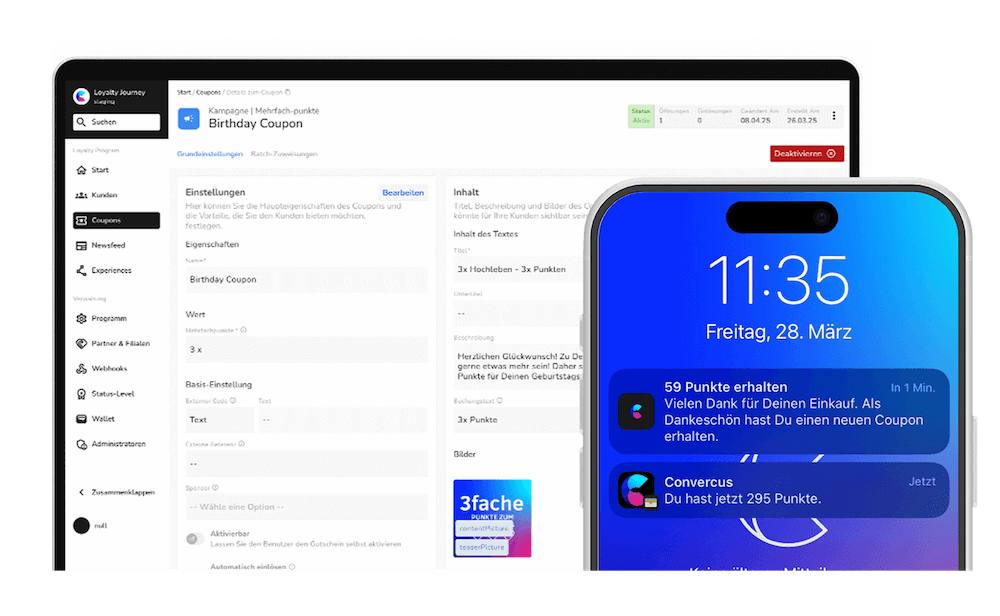
- Convercus is the relevant loyalty software for this purpose. The platform combines loyalty engine, couponing, engagement, and API-first integration for furniture retailers who want to seamlessly integrate POS, online shop, and mobile touchpoints.
Loyalty Software in the Furniture Market: Why This Topic Will Be Strategic in 2026
The German furniture retail sector is under pressure: In 2024, industry revenue fell by 6.1% to approximately €23.9 billion.At the same time, the online share continues to grow, most recently reaching 14.6%. For furniture retailers, this means less demand combined with increased competition for attention, data, and repeat purchases. This is precisely why loyalty software in the furniture market is transforming from a nice-to-have into a strategic tool.
Furthermore, a new benchmark is emerging. IKEA Family has over 14 million members in Germany and is consistently being developed into a classic bonus program since 2024/2025. This sends a clear signal to the market: customer loyalty in the furniture retail sector is becoming more digital, data-driven, and measurable. Those who continue to rely solely on promotional discounts, flyers, and analog customer cards will lose relevance.
The key here is a shift in perspective: In the furniture market, loyalty is not primarily about discount logic, but a first-party data strategy.Retailers today want to identify who researches online, who books consultations, who buys accessories, and who is considering renovation or moving. If you want to delve deeper into the fundamentals of modern customer loyalty software , the furniture retail sector, in particular, clearly demonstrates why specialized platforms are becoming more important than isolated individual tools.
The particular challenge: Customer loyalty with long purchase cycles
In the furniture retail sector, classic loyalty approaches often fail due to industry logic. Major purchases typically only occur every 5 to 10 years, and even a 10% repurchase rate can already be strong in this environment. A pure points system that almost exclusively rewards purchases therefore remains invisible to many customers for a long time.
The real challenge lies between purchases. Someone who configures a dining table online, gets advice in a furniture store, and only buys months later expects a cohesive experience. In practice, however, data silos, generic newsletters, and communication that practically ends after delivery often dominate.
- Many furniture retailers still rely on discount promotions instead of true retention. This lowers margins but rarely creates sustainable loyalty.
- In-store purchases and online research are often not linked. This means a 360° customer view is missing for personalization and follow-up communication.
- Post-purchase communication is underestimated. Especially after delivery, assembly, or kitchen handover, valuable touchpoints emerge for service, reviews, and cross-selling.
- Referrals are hardly systematically utilized. According to customer surveys, around 82% would recommend their furniture store.
- Analyses are often still performed manually. Without automation, segmentation, trigger campaigns, and CLV management remain fragmented.
For furniture retailers, this means: Loyalty software must not only count sales, but also consultations, store visits, services, and referrals translate into a long-term customer relationship.
Which Loyalty Mechanics Truly Work in the Furniture Retail Sector
In the furniture market, programs that combine low purchase frequency with high emotional involvement work particularly well. A points system alone is rarely sufficient. Successful models are those that bring together purchases, interactions, and services and provide customers with recognizable added value even without an immediate furniture purchase.
Setting up Points Systems and Status Models Correctly
Points remain useful if they are not solely tied to transactions. Furniture retailers can award points for purchases, consultation bookings, app logins, wish lists, configurator usage, or reviews. Additionally, status models like Bronze, Silver, and Gold create a long-term sense of progress that endures for years. Especially for kitchens, bedrooms, or complete solutions, a status program can provide additional motivation for repeat purchases and service utilization.
Incorporating Non-Purchase Engagement, Referrals, and Services
The strongest mechanics in furniture retail are often non-monetary. Design consultations, space planning, early access to promotions, workshops, care tips, or prioritized appointment scheduling often have a stronger impact than the next 10% coupon. In addition, there are referral programs: If satisfaction is high, the program should systematically reward referrals instead of leaving them to chance.
Lifecycle Marketing in Furniture Retail: Staying Relevant Between Purchases
The most effective answer to long purchase cycles is well-structured lifecycle marketing. The customer doesn't just buy a sofa, but goes through living phases: moving in, initial furnishing, supplementary purchases, children's rooms, renovation, relocation, or home office expansion. This is precisely where years of relevant touchpoints emerge that a loyalty program can systematically activate.
Cross-Category Strategy and Services as Frequency Drivers
Accessories, textiles, lighting, and care products close the frequency gap. They ensure that the program is visible not only during rare major purchases. Supplemented by consultations, assembly services, workshops, or interior design appointments, a model emerges that resembles a living ecosystem rather than a simple customer card.
Omnichannel instead of Data Silos
Approximately every second customer uses online sources before making an in-store purchase. Loyalty software must therefore integrate POS, online shop, app, and CRM. A customer who plans online and completes the purchase in-store must not end up as an anonymous walk-in customer. For retailers who want to think more mobile-first about loyalty, the approach of App-first Loyalty is particularly relevant. Equally important are strategies on how to increase customer loyalty and reactivate lost contacts with trigger journeys.
In practice, this means: After delivery, care instructions follow; after 90 days, a review request; after 6 months, a personalized accessory coupon; and after 24 months, an impulse for supplementary or replacement products. This way, the brand remains present even without an immediate major purchase.

Best Practices: What IKEA, POCO, and porta Show
The most important reference case currently is IKEA. The further development of IKEA Family into a bonus program shows that even the market leader is rethinking customer loyalty in the furniture retail sector. Crucial is not just collecting points, but the combination of prices, services, app usage, events, and community elements. This precisely matches the 2026 trend: high-tech in the backend, high-touch in the frontend.
IKEA Family as an Industry Benchmark
With over 14 million members in Germany , IKEA sets a standard that the market inevitably follows. It is particularly instructive that not only purchases are rewarded, but also interactions. For furniture retailers, this means: A modern program must foster belonging and depth of engagement, not just offer discounts.
POCO and porta as Operational Learning Cases
Other examples also show what is possible. POCO publicly announced that within a few weeks of the launch more than 85,000 users registered and over 25 million points awarded were. Case studies also show how much clean profiles and cross-touchpoint data consolidation improve the basis for personalized targeting. porta, in turn, represents the insight that programs should start pragmatically and then be iteratively expanded. The best start is rarely the most extensive set of rules, but a clear MVP with clean store integration.

What Matters When Choosing the Right Loyalty Software
When selecting loyalty software for the furniture market, it's not about the most features on a slide, but the best fit for the existing system landscape. API-first, Omnichannel Capability, and Rule Engine Flexibility are usually more important for mid-market and enterprise retailers than a rigid standard package. The platform should bring together points, status, couponing, wallet, app, trigger communication, and reporting, without unnecessarily complicating store processes.
Technical and Functional Criteria
Check whether POS, online shop, app, and CRM can be connected in real-time or near real-time. Without clean integration, loyalty remains merely a frontend promise. Also important are role-based coupon rules, segmentation, marketing automation, and scalability for high transaction volumes. If you want to delve deeper into omnichannel architecture, the topics of Tech and Integration, Couponing and Engagement are key benchmarks.
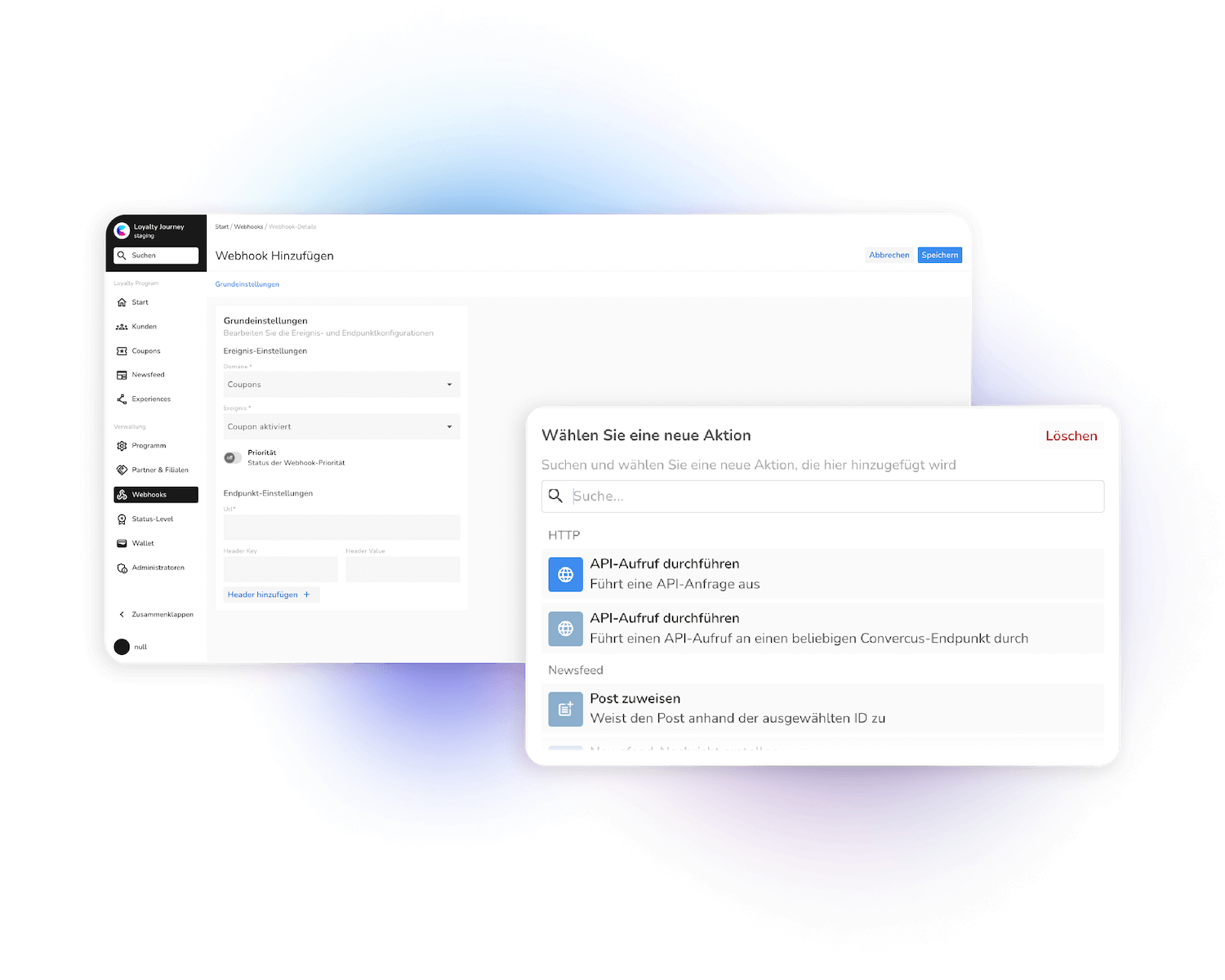
For retailers looking for a specialized platform instead of a cumbersome suite, Convercus is relevant. The combination of Loyalty Engine, Couponing, Engagement, and an API-first approach is particularly well-suited for furniture retailers who want to connect stores, online shops, and mobile touchpoints in a modular architecture.
Data Protection and Legal Compliance
GDPR compliance is not an add-on, but a basic requirement. In practice, particularly relevant are Art. 6 Para. 1 lit. a GDPR for consent in marketing communication, Art. 5 GDPR for purpose limitation and data minimization, and Art. 28 GDPR for data processing agreements with software providers. For email and push advertising, retailers should also observe §7 UWG. Those who do not properly set up consents, preference centers, and opt-out processes risk not only legal issues, but also data loss and declining trust.
ROI of Loyalty Software in the Furniture Market: Example Calculation for 50 Stores
Decision-makers rightly ask about the business case first. A simplified example shows why loyalty is also economically viable in the furniture retail sector. Scenario: 50 stores, 200,000 known customers, average basket value €800, with a purchase cycle of 4 years. Currently, there are around 50,000 transactions per year and a repurchase rate of 15%.
Even just 5 percentage points more in repurchase rate can, in this scenario, mean around €2 million in additional revenue per year. Additionally, there are accessory and add-on sales, better response rates through personalization, reduced wastage, and more first-party data for future campaigns. In furniture retail, ROI rarely comes from a single large repurchase, but rather from the sum of reactivation, cross-selling, referrals, and more efficient communication.
The effect on existing customer activation is particularly underestimated. By targeting buyers with data-driven communication after 12, 24, or 36 months, you can specifically address topics such as renovations, seasonal changes, children's room updates, or home office additions. That's precisely where a one-time transaction turns into an ongoing relationship.
5 Steps to a Loyalty Program for Your Furniture Store
Implementation doesn't have to start with a large-scale project. A clearly prioritized rollout is usually more successful, one that respects store realities and system limitations. What's important isn't perfection at launch, but a robust operating model.
- First, define your objectives. Decide whether repurchase rate, known customer ratio, accessory sales, referrals, or first-party data should be the priority.
- Create a clean data foundation. Without clear customer attribution across POS, shop, and app, personalization remains unreliable.
- Start with a few clear mechanics. A lean points system, plus personalized coupons and a service benefit, is often more effective than an overloaded set of rules.
- Involve store teams early. POS staff play a role in deciding whether registration, identification, and redemption work in daily operations.
- Measure and optimize from day one. Relevant KPIs include active members, redemption rate, repurchase rate, average order value, coupon response, and referral rate.
Expansion follows: App or Wallet Pass, non-purchase engagement, status models, referrals, and automated reactivation journeys. For many retailers, it's also worth looking at systematic customer win-back, because significant value is often hidden in inactive existing customers in the furniture market.
Conclusion: Loyalty in the furniture market needs a different approach
Loyalty software in the furniture market is effective when it actively shapes the years between two major purchases. Successful programs combine points logic with services, personalized coupons, omnichannel identification, and lifecycle marketing. Those who merely digitize discounts will hardly build lasting loyalty.
If you want to explore how such an architecture can be specifically implemented for your company, then Convercus, as specialized loyalty software for mid-market and enterprise, is an obvious choice. Through a personal demo with a loyalty expert, you can assess how the Loyalty Engine, couponing, engagement, and API-first integration fit your store and e-commerce landscape.
FAQ
Is a loyalty program worthwhile in furniture retail despite long purchase cycles?
Yes, especially then. Because new customers are expensive and repurchases are infrequent,every additional relevant touchpoint has high economic value. The key is to reward not only purchases, but also consultations, services, referrals, and accessory purchases.
How complex is the implementation of loyalty software?
That primarily depends on POS integration, data quality, and process clarity. An MVP with a few mechanics can often be implemented in a significantly shorter time than a fully developed program with an app, status model, and complex rules. A clearly prioritized rollout is important.
Does this work with our existing POS system and online shop?
In many cases, yes, provided the solution is built API-first. Stable interfaces are crucial for customer attribution, receipt data, points booking, and coupon redemption.Before starting the project, retailers should carefully check which data is available from POS, shop, and CRM, and in what quality.
Is loyalty software GDPR compliant?
It can be operated in a GDPR-compliant manner if processes and technology are properly set up. Particularly relevant are consents according to Art. 6 GDPR, data minimization according to Art. 5 GDPR, and data processing agreements according to Art. 28 GDPR.For advertising communications, §7 UWG (German Unfair Competition Act) is also important.
What does loyalty software cost in furniture retail?
Costs vary depending on the number of stores, user base, channels, and desired depth. What's crucial is not so much the license price, but the expected ROI:Even moderate improvements in repurchases, accessory sales, and data quality can make the investment economically viable.
Can we migrate an existing customer card or bonus program?
Yes, that's a common starting point. Important aspects include data cleansing, rule mapping, and a clear communication strategy for existing members.In many projects, a migration makes more sense than a complete restart, because existing customer data and habits can be leveraged.


- 5x Return on Investment
- 80% Customer Identification
- 8x Customer Interaction
- +274% Repurchase Rate
.png)