








The topic in a nutshell
- Knowledge gap: Over 92% of German retail companies consider AI in loyalty to be useful, yet less than 20% are already using it (EHI Whitepaper, Nov 2024).
- What AI changes: Traditional loyalty programs treat all members the same. AI transforms mass communication into individual, perfectly timed outreach that reacts to the behavior of the individual.
- Four levers: Analyze behavioral data, deliver personalized messaging, automate campaigns, and use your platform more efficiently. These are the concrete starting points.
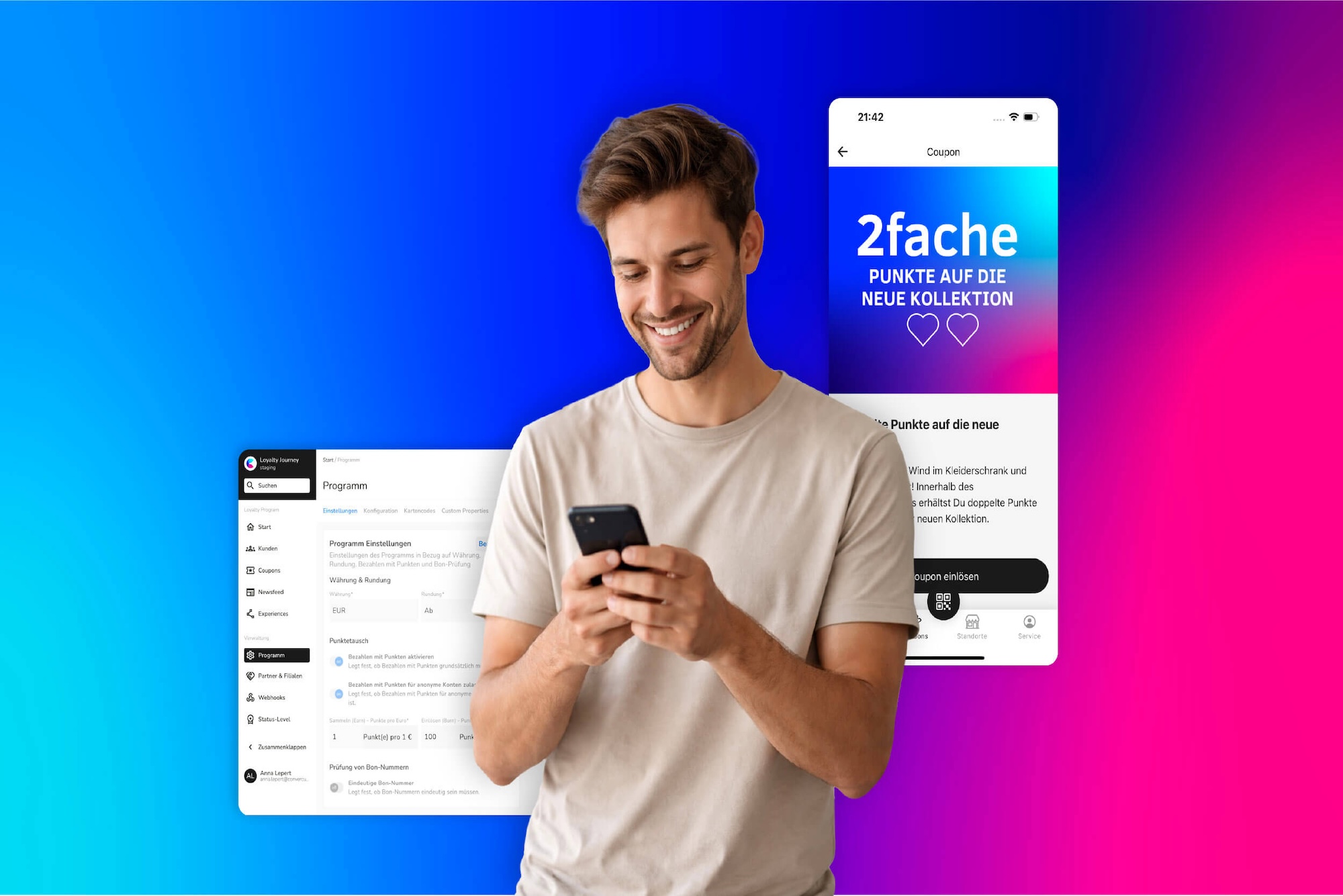
- Loyalty software from Convercus: The Convercus Loyalty Engine comes with native AI data insights. CRM and loyalty managers can answer analytical questions and identify trends without needing a BI tool or prior expertise.
40% of members haven't made a purchase in six months. The program knows this. But who is worth winning back? With what offer? And when? AI answers exactly these questions: not as an abstract technology project, but as a practical tool that loyalty managers uses to answer three questions that previously required either gut instinct or a BI department.
AI in loyalty: Concrete advantages over traditional programs
Traditional loyalty programs operate on static rules: spend X euros, get Y points. Communication follows a calendar, not behavior. AI fundamentally changes this. It analyzes behavioral data in real time, identifies patterns, and derives decisions from them before the manager even has to ask.
Why is now the right time for AI loyalty?
According to the EHI white paper "AI and Customer Loyalty in Retail" (Nov 2024, 232 respondents from 179 German retail companies), 92.4% of companies consider AI in a loyalty context to be useful, but only 19.8% are already using it. Those who start today gain an advantage before the market catches up. AI doesn't require new infrastructure. If you use a modern loyalty platform, you already have the technical foundation. It’s a question of whether you activate the data you already have.
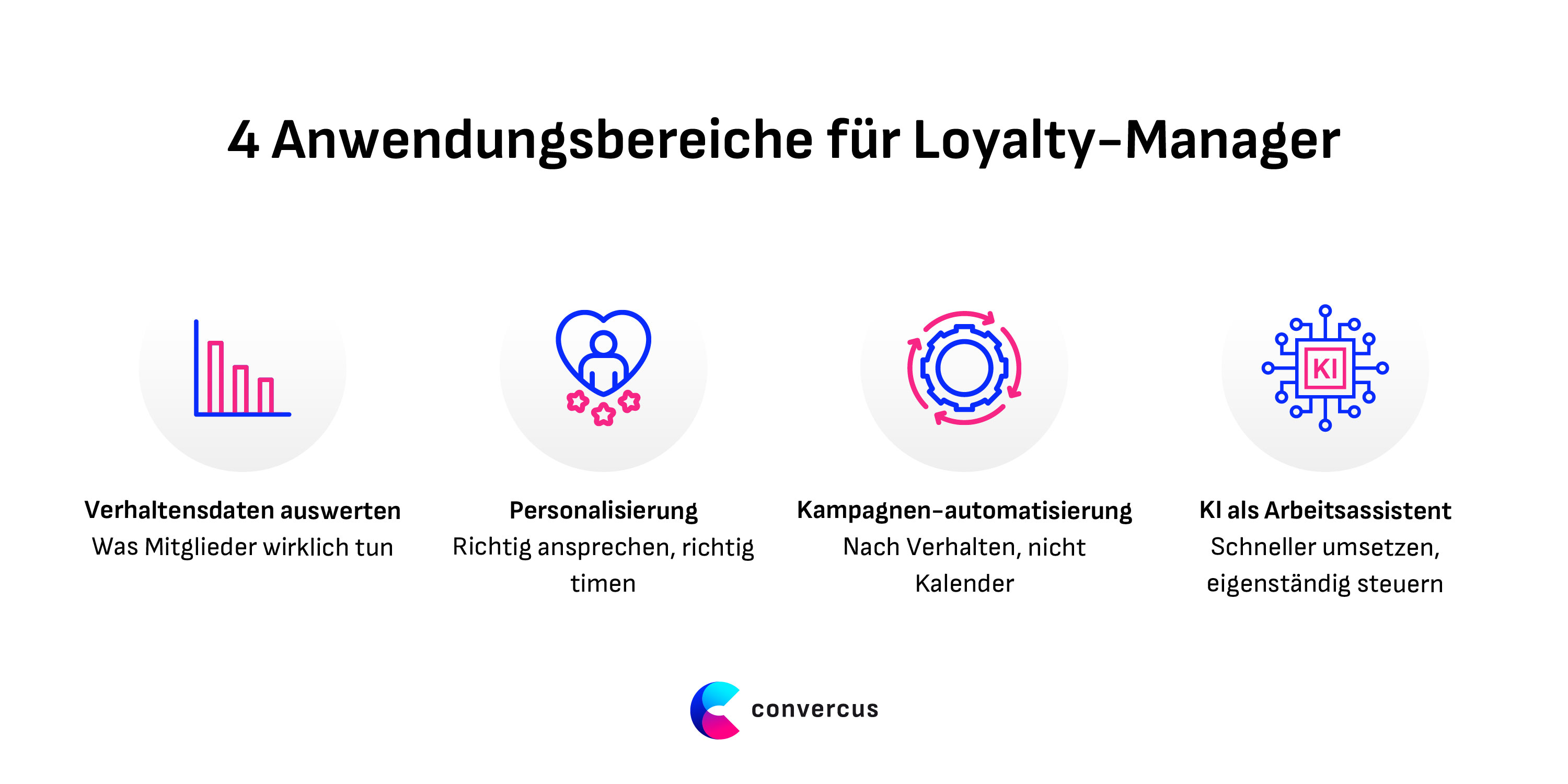
AI loyalty in practice: Four application areas for loyalty managers
AI targets four specific areas in loyalty programs. Three of these concern communication with end customers: understanding data, personalized engagement, and automated action. The fourth concerns the team's internal work. Each area builds on the previous one.
Analyzing behavioral data: What your members are really doing
Loyalty programs are gold mines of data: purchase history, redemption behavior, app activity, channel usage. Most companies use barely 20% of it. AI changes this by turning raw data into structured insights without an analyst needing to formulate the questions.
Specific questions that AI can answer today:
- Which members are showing churn signals in the next 30 days?
- Who responds to discount offers, and who responds to status points?
- Where does the loyalty journey typically break down?
The top AI use case in German retail according to EHI 2024: behavioral analysis and customer forecasting with 42 mentions from 232 respondents, just behind direct marketing personalization (46 mentions). Convercus AI Data Insights makes exactly that possible: loyalty managers formulate analytical questions in natural language and receive reports, trends, and segmentation suggestions—no BI tool, no prior knowledge, and no IT tickets required.
Personalization: The right offer at the right time
The difference between segmentation and hyper-personalization is the difference between "women over 35 from the south" and "this customer shops on Fridays, responds to percentage discounts, and is 200 points away from the next tier." Classic segmentation targets groups. AI targets the individual at the right moment: just before a status threshold, after a period of inactivity, or when they are near a store.
For loyalty managers, this means defining rules once, and the AI continuously optimizes the rest. First-party data from your own loyalty program provides a GDPR-compliant foundation: members have actively consented, so no third-party tracking is necessary. For the loyalty manager, this means less manual segmentation work and more time for strategic decisions.
Campaign automation: Build scenarios once, AI handles the rest
Campaign automation in a loyalty context means trigger events automatically initiate the appropriate communication. Not based on a calendar, but on behavior. Three concrete scenarios that can be implemented immediately:
What this means for the loyalty manager: moving away from manual campaign tinkering toward strategic management. According to the Adobe 2025 Digital Trends Report , 51% of retailers rely on personalized promotions based on customer data. Campaign automation requires a functional data foundation. Those who start with clean insights achieve better results from automation right away.
AI as a work assistant: Implement faster, understand better
AI doesn't just change what the loyalty program does for end customers; it also changes how the team works with it. Three areas benefit directly:
- Implement campaigns faster. The marketer describes their requirements in natural language. The AI translates this into a campaign journey, automation logic, and target group filtering. No developer tickets, no endless coordination meetings.
- Manage performance independently. The marketer asks a question: "Which campaign has had the highest CLV impact in the last 90 days?" The AI builds the metric, the visualization, and the report. The BI department stays out of the loop.
- Fully leverage the platform. The Product Owner asks about how an automation rule or integration setup works. The AI explains and suggests solutions. This reduces reliance on support tickets and documentation. Marketers, Product Owners, and management benefit directly, without needing technical expertise.
Practical Guide: Launching an AI-Powered Loyalty Program in a Few Steps
AI in loyalty programs isn't a big-bang project. It’s about one pilot, one result, then the next step.
AI Loyalty with Convercus: Data-Driven Loyalty Programs
Convercus is a modular loyalty and couponing engine for mid-market and enterprise brands and retailers. The platform combines points, status management, couponing, and engagement mechanics with AI data insights as a native analytics layer.
What CRM and loyalty managers actually get: reports and insights without needing BI resources, analytical questions answered in natural language, trends identified, and target groups pinpointed. All without IT expertise, training, or going through the data department.
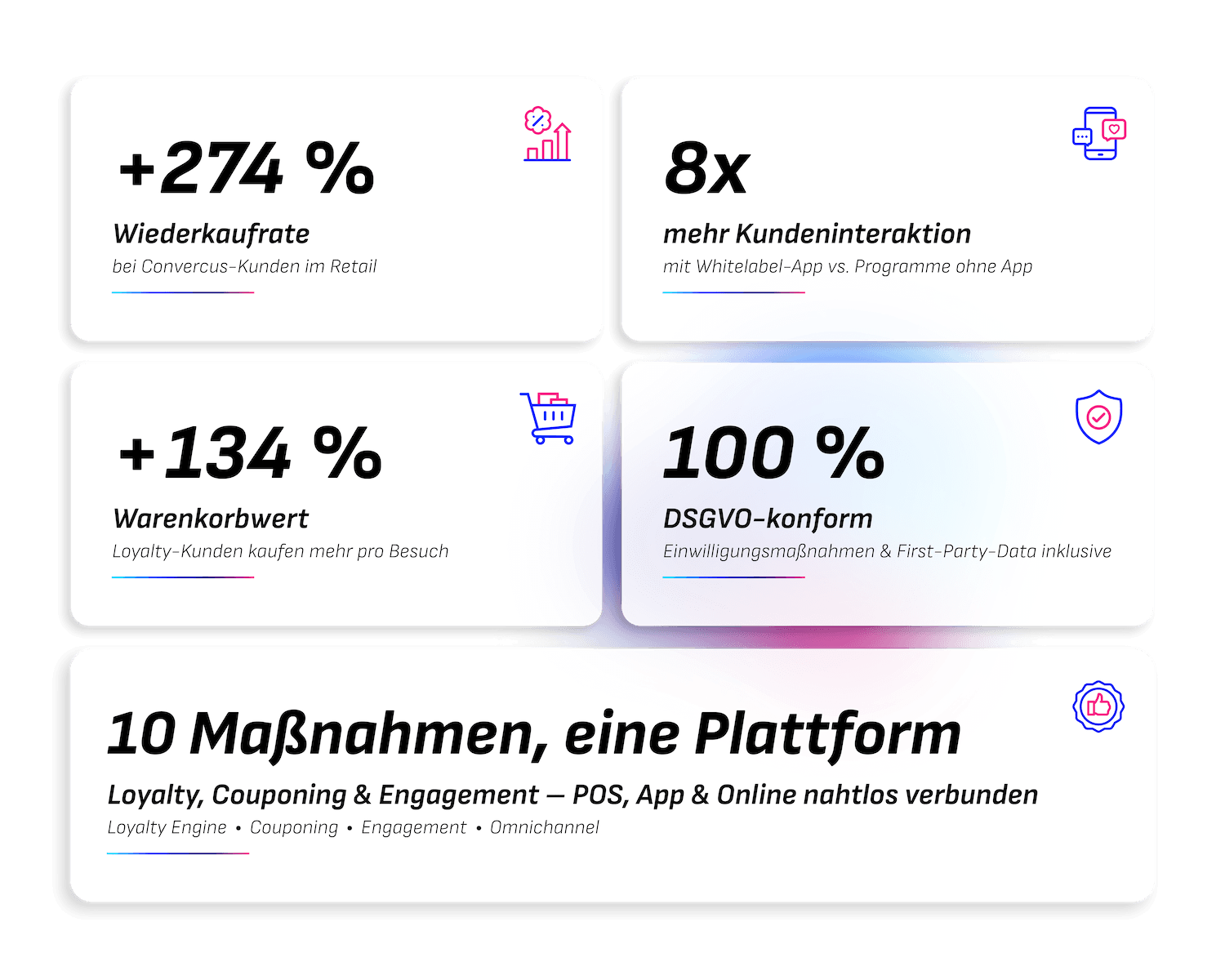
Platform results demonstrate the power of data-driven loyalty programs: 5x ROI, +274% repeat purchase rate and +134% higher average order value in Convercus projects.
Data-driven loyalty programs require a platform that features insights and automation as integrated layers, rather than separate tools that have to be connected later. Convercus provides both in one platform. Get started with your first AI data insight.
FAQ
Which AI features should retail loyalty managers implement first?
The best place to start is data analysis. Without a clean data foundation—such as purchase history, redemption behavior, and activity data—personalization and automation won't deliver reliable results. Using a loyalty platform with a native AI analytics module allows you to start immediately, without needing to integrate an external BI tool.
How can CRM managers use AI to identify loyalty members who are about to churn?
AI identifies churn patterns from behavioral clusters: purchase frequency drops, redemption rates decline, and the time since the last purchase increases. By combining these three signals, AI continuously calculates a churn score for every member, eliminating the need for manual analysis. The result is a prioritized list of members for whom reactivation is still worthwhile.
What data do omnichannel retailers need before integrating AI into their loyalty program?
First-party data from the loyalty program itself is sufficient: purchase history, redemption behavior, and activity data. Purchasing external data or using third-party data is unnecessary. This also provides a GDPR advantage: members have actively shared this data, so no tracking without consent is required.
Is AI-based personalization in loyalty programs GDPR-compliant?
Yes, when it is based on first-party data from your own loyalty program. Members actively consented to share their data for personalized communication during registration. No third-party tracking, no cookies, and no external data sources are required. This fundamentally distinguishes loyalty-based personalization from retargeting approaches.
What AI features does Convercus offer for loyalty programs?
Convercus offers AI Data Insights as a native feature of the platform. Loyalty managers can ask analytical questions in natural language and receive instant reports, metrics, and visualizations—without the need for BI tools, prior expertise, or IT support. This enables independent performance management directly from within the loyalty platform.
How do loyalty managers measure the success of AI-supported campaigns?
The most important KPIs are redemption rate, repurchase rate, CLV delta, and campaign response rate compared to the baseline. A control group is essential: only by measuring the difference between members with and without AI-supported communication can you evaluate the actual contribution of the AI. This also forms the basis for the next scaling step.
Convercus brings AI data insights natively into your loyalty platform. Get started with your first insight—no IT project or BI department required.

- 5x ROI on your loyalty budget
- 8x higher customer engagement
- +274% repeat purchase rate