








The topic, short and concise
- Loyalty in beauty salons is primarily about rebooking management. Successful programs reward not only revenue, but also rebooking, regular visit intervals, referrals, and suitable product purchases.
- The digital punch card is a starting point, but rarely the end goal. Customer loyalty truly becomes effective when points, status, couponing, personalization, and omnichannel data work together.
- Retention directly impacts revenue and profitability. In the beauty industry, loyal customers spend more over time, and retaining existing customers can be significantly more cost-effective than constantly acquiring new ones.
- Convercus is a scalable loyalty software. For beauty retailers, spa chains, and multi-location concepts, Convercus combines a loyalty engine, couponing, engagement, and API-first integrations into a professional customer loyalty program.
Why are punch cards and birthday vouchers no longer enough in the 2026 beauty market?
For many studios, customer loyalty still begins with a punch card and ends with occasional birthday vouchers. In the 2026 beauty market, that's often no longer sufficient. Between online booking, in-studio treatments, product sales, and mobile communication, customers expect a consistent, digital loyalty experience. That's precisely why loyalty software for beauty salons is transforming from a nice-to-have extra into a business-critical system.
The economic relevance is high: The German cosmetics and personal care market generates around €19 billion in revenue, while tens of thousands of studios, salons, and spa concepts compete for loyal regular customers. Without structured retention, many beauty businesses unnecessarily lose revenue, even though retaining existing customers can be up to 5 times cheaper than acquiring new ones. For those who want to delve deeper into the fundamentals, the overview on customer loyalty software provides the broader strategic framework.
What problems arise in daily beauty salon operations due to a lack of customer loyalty software?
Unlike traditional retail, revenue in beauty salons heavily relies on regularity. If customers don't book their next appointment immediately after a treatment, it leads to gaps in the calendar, fluctuating capacity utilization, and less predictable revenue. Furthermore, clean data on skin type, treatment history, preferences, or purchased products is often missing, so personalization is rarely implemented systematically in daily operations.
- Physical loyalty cards are forgotten, lost, or not consistently redeemed.
- No-shows and missed rebookings cause directly measurable revenue losses.
- Product sales and service history are often not linked in a unified customer profile.
- Marketing is untargeted instead of using behavior-based, relevant triggers.
Why Beauty Salons Need Different Loyalty Mechanics Than Retailers
In the beauty sector, it's not just about the next purchase, but about the next appropriate treatment appointment. Facials, manicures, brow, or waxing services follow natural intervals. Good loyalty software for beauty salons therefore rewards not only revenue but also behavior: rebooking immediately after a treatment, reviewing after a visit, recommending to friends, or purchasing suitable home care products.
This is precisely where the difference lies between simple discount logic and true customer loyalty. A blanket "10th treatment free" might work, but it controls neither frequency, nor basket size, nor timing. A data-driven program, however, can translate treatment cycles into measurable rebooking sequences and thus simultaneously improve capacity utilization, loyalty, and CLV.
What is the typical customer retention rate in the beauty industry – and what does poor retention cost?
The beauty industry is considered emotional and consultation-intensive, yet according to published benchmarks, typical customer retention is often only around 20% to 30% retention. At the same time, loyal customers spend an average of 30% more per order after 6 months, and even 45% more after 36 months. Therefore, improving retention impacts not only repeat visits but also basket size and profitability.
Furthermore: 83% of companies with loyalty initiatives report a positive ROI, and tiered programs achieve, according to market benchmarks, an up to 80% higher ROI than non-tiered models. For beauty salons, this means loyalty is not a decorative feature, but a lever for more predictable revenue and reliable first-party data.
What Loyalty Software Should Specifically Do in a Beauty Salon
The best loyalty software for beauty salons not only replaces the paper card but connects rebooking, rewards, couponing, and personalization in one system. Getting started can be deliberately simple, for example, via a digital customer card or Wallet Pass. Programs that are usually more successful in the long run are those that combine points, status benefits, and individual offers, instead of just distributing blanket discounts.
From Digital Loyalty Card to Membership Model
For small studios, a digital loyalty card often works as a first step. Growing chains or beauty retailers, however, usually need more: status tiers for VIP customers, membership logic with monthly benefits, or treatment-related rewards. Particularly interesting is the so-called Beauty Bank or Membership Model, where customers build up a monthly credit and thus return more regularly.

Couponing, Rebooking, and Personalized Incentives
Offers that match actual needs are particularly effective: birthday vouchers, seasonal skincare packages, an upgrade to a new treatment, or a coupon for a suitable product after a facial. That's precisely why digital couponing is important because it allows offers to be tailored by time period, target group, and behavior instead of by gut feeling.
Even more crucial than the discount, however, is the trigger. In a beauty salon, it's usually not the cheapest offer that wins, but the most relevant reminder at the right time. Good software recognizes when a treatment cycle typically ends and then automatically initiates rebooking incentives. This way, a voucher doesn't become a mass promotion, but rather a concrete revenue driver at the right moment.
Intelligently Link Service and Product Sales
Many studios give away margin because they view service and retail separately. Yet, loyalty often arises precisely when in-studio treatments are extended through suitable home care. For example, recommending suitable products after an acne or anti-aging treatment and integrating them into the loyalty program simultaneously increases relevance and basket size. Beauty benchmarks show that cross-sell and upsell are significantly higher among loyalty members than among non-members.
Loyalty in the Beauty Salon: What it Looks Like in Practice
Whether a single studio or a chain concept: What's crucial is not how modern a loyalty program sounds, but how smoothly it functions in daily operations. Customers don't want to study complicated rules, and staff at the reception and in the treatment room don't want additional burdens. Successful setups are therefore easy to explain, quick to redeem, and directly embedded into existing workflows.
Use Case: The Single Studio with 300 Active Customers
An owner-operated studio usually starts with a digital card and simple rules: points for every visit, a bonus for direct rebooking, a birthday voucher, and a small reward for Google reviews. Even this basic setup reduces media breaks. Instead of paper chaos and WhatsApp reminders, it creates a measurable process for repeat visits and reactivation.
Use Case: The Beauty Chain with 20+ Locations
In a chain, complexity quickly becomes a problem: different POS systems, various teams, changing promotions, and fragmented customer data. Centralized control is needed here. A customer should be able to collect points in Munich, redeem them in Hamburg, and see the same status online. Only then does it create a true omnichannel experience across all locations.
Treatment Cycles as Program Logic
This is precisely where loyalty in the beauty sector becomes strategically interesting. Facials often run in 4- to 6-week cycles, manicures more in 2- to 3-week intervals, and seasonal treatments follow weather, holidays, or event occasions. If the software knows these cycles, reminders, coupons, and benefits can be precisely tailored to them. This not only improves the rebooking rate but often also reduces the no-show rate through more relevant communication.
Which Functions and Integrations Are Truly Crucial
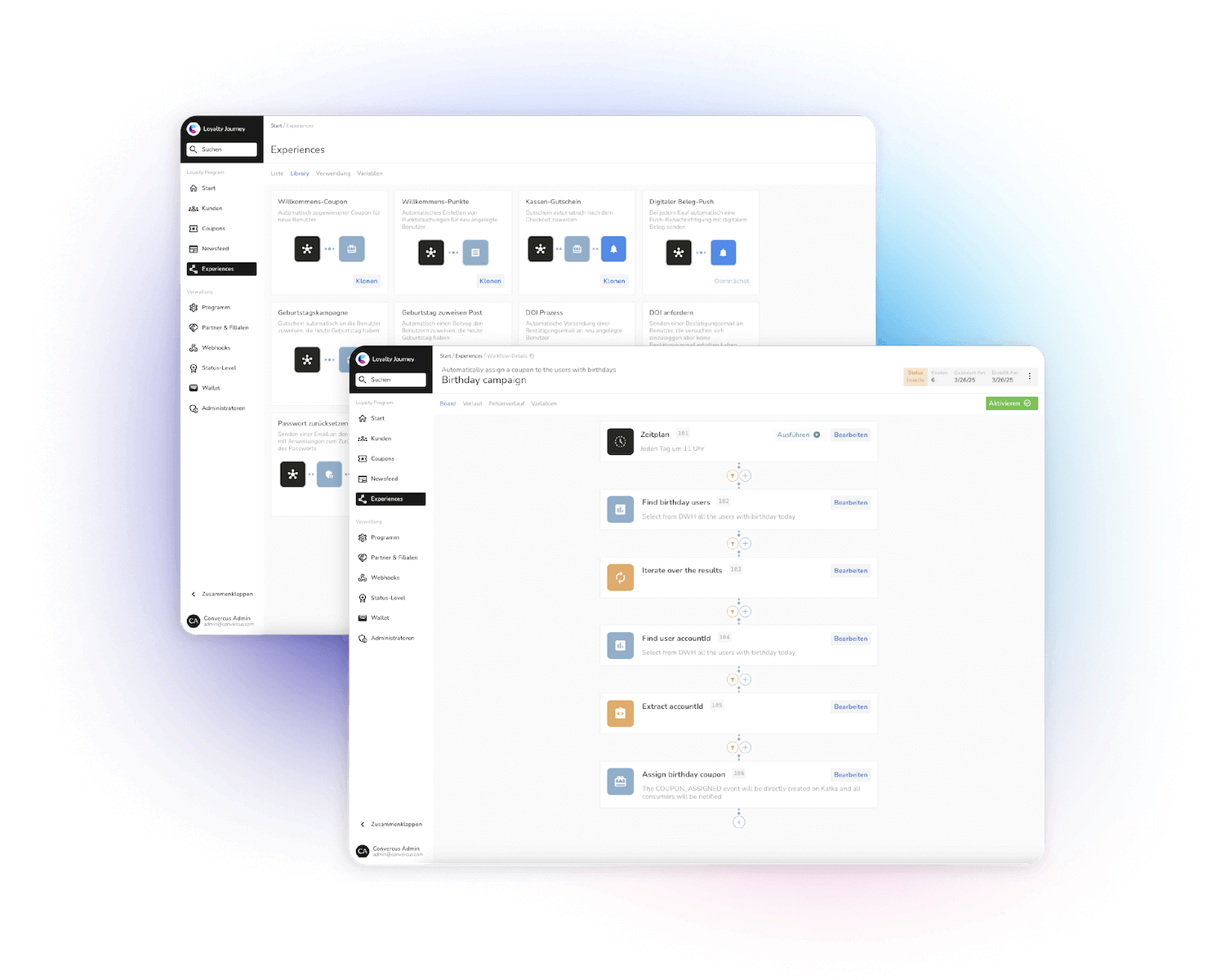
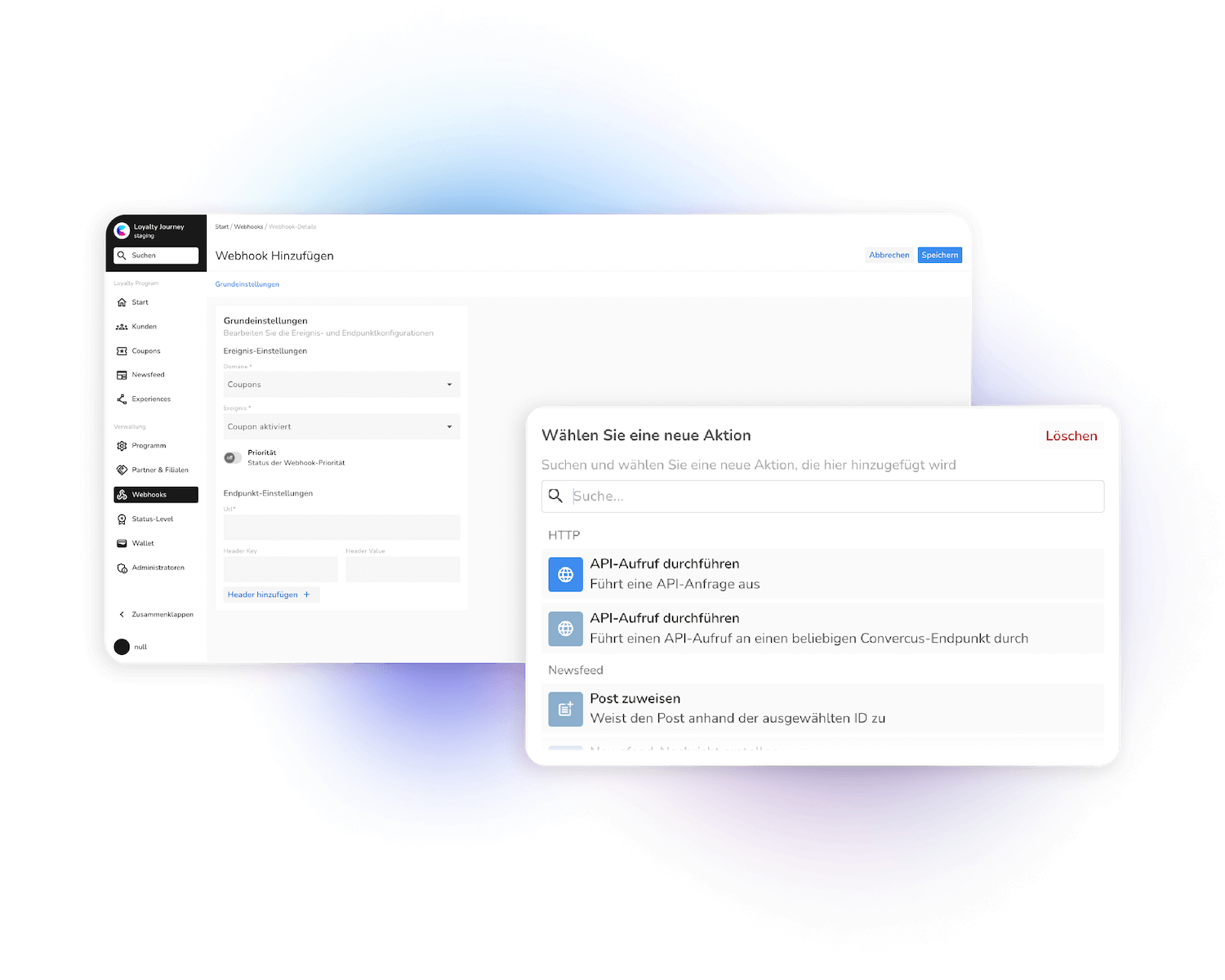
Many tools can book points. However, loyalty software for beauty salons only becomes truly relevant when it seamlessly integrates into booking, POS, and communication. Without integration, points, coupons, and profiles remain isolated solutions. Therefore, for multi-location setups, franchise models, or beauty retailers with treatment offerings, an API-first architecture with clean data transfer is usually more important than a colorful interface.
Integrate POS, Booking, and Omnichannel Thinking
Ideally, points are automatically recorded upon payment, status benefits are directly recognized, and coupons are deployed across all channels. Customers book online, appear at the studio, redeem a Wallet Pass, and then purchase a product. If all of this is not connected, the unified customer profile is missing. Anyone who wants to delve into the technical fundamentals will find an overview of modern loyalty architectures under Tech and Integration .
Personalization Needs Good Data, Not More Campaigns
Skin type, treatment history, frequency, preferred times of day, product preferences, or response patterns to offers: These are the data points from which relevant communication in the beauty sector arises. Good loyalty software thus generates valuable first-party data and makes personalization scalable. Anyone who wants to not just manage but actively increase customer loyalty should also consider the topic of Engagement .

GDPR and Legally Compliant Communication
As soon as a loyalty program processes personal data, preferences, or purchase histories, clear regulations apply. For marketing via email or SMS, in many cases, effective consent according to Art. 6 para. 1 lit. a GDPR is necessary; additionally, § 7 UWG (German Unfair Competition Act) is relevant for promotional communication. Customers must be transparently informed according to Art. 13 GDPR, data processing by a third party requires a contract according to Art. 28 GDPR, and technical and organizational measures must be secured according to Art. 32 GDPR.
- The software should be able to document consents, opt-ins, and changes in an audit-proof manner.
- Customer data should only be processed for specific purposes and cleanly segmented.
- Multi-location models require clear role and rights concepts.
- Offline capability and fail-safety are not a bonus in POS-related operations, but a practical requirement.
Does Loyalty Software Pay Off? An Honest ROI Consideration
The economic leverage of loyalty rarely lies in a single voucher, but in a chain of improvements: higher retention, more rebooking, larger basket sizes, and more efficient marketing. That's precisely why market studies report 83% of companies report a positive ROI from their loyalty initiatives. For beauty salons, it's particularly relevant that loyal customers spend more over time and are significantly cheaper to activate than new contacts.
Why Does Increased Retention in a Beauty Salon Directly Impact CLV and Profitability?
If a studio sees the same customer not just 4 times, but 5 times a year and additionally sells a skincare product, the CLV increases without proportional additional costs. At the same time, wastage decreases because campaigns no longer go to everyone, but to defined segments. The key metric is therefore not just revenue, but Customer Lifetime Value combined with Rebooking Rate and No-Show Rate.
Example Calculation for a Beauty Salon Chain with 20 Locations
Assume a chain serves 10,000 active customers, the average treatment value is €85, the current retention rate is 25%, and the visit frequency is 4 appointments per year. Then, the annual revenue from existing customers is 10,000 × 0.25 × 4 × €85 = €850,000. If retention conservatively increases to 35%, frequency to 5, and the average value through cross-selling to €97.75, the result is 10,000 × 0.35 × 5 × €97.75 = €1,710,625.
This example is deliberately conservative and does not replace individual calculations. However, it shows why loyalty in the beauty sector should often not be viewed as a marketing expense, but rather as a lever for utilization and predictable revenue .
Key KPIs Beauty Businesses Should Track
- The Retention Rate shows how many customers remain active after a defined period.
- The Rebooking Rate measures how many customers book their next appointment directly.
- The No-Show Rate reveals whether reminders and incentive systems are effective in practice.
- CLV, redemption rate, and cross-sell rate show whether the program is economically successful and not just cosmetically.
When a Digital Punch Card Is No Longer Enough – And When Does a Beauty Salon Need a Scalable Loyalty Platform?
Most beauty businesses don't need to start with a complex VIP system. A maturity model approach is more sensible: first a digital card and simple rules, then segmentation and automated communication, followed by omnichannel capability across locations and channels. This way, an analog loyalty idea gradually transforms into a robust loyalty operating model.
When a Simple Salon Tool Is No Longer Enough
Especially when multiple locations, franchise structures, retail revenues, or partner programs are added, the built-in mini-loyalty functions of many salon tools reach their limits. Then a platform is needed that intelligently integrates POS-related processes, couponing, status logic, and marketing automation. For larger beauty retailers, spa chains, or omnichannel brands, this is precisely the point where Convercus as loyalty software becomes relevant: with a Loyalty Engine, couponing, engagement, an API-first approach, and the ability to process high volumes efficiently.
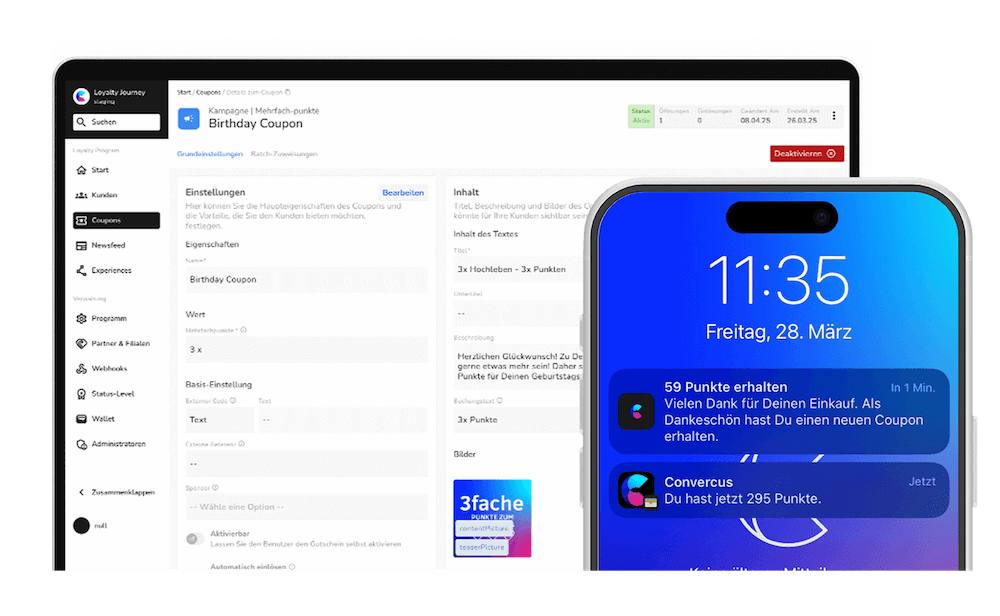
What's important is not just the technology, but its practical implementation. A white-label app or a Wallet Pass can significantly simplify access for customers; Convercus observes in programs with an app up to 8x higher customer interaction than in setups without an app. For growing organizations, it's also crucial that campaigns can be centrally controlled yet deployed locally. Those interested in the mobile loyalty approach can find further insights under App-first Loyalty .
What are the most common mistakes beauty salons make when introducing a loyalty program?
- Too complex rules confuse customers and employees and lower participation rates.
- Discounts without behavioral logic may temporarily increase redemptions, but not necessarily loyalty.
- Without integration into POS and booking systems, data silos are created instead of a usable customer profile.
- If in-studio teams are not trained, even good software will fall short of its potential in daily operations.
Beauty Best Practices: What Successful Programs Do Right
The strongest industry references clearly show that loyalty should not be confused with discounts. Sephora Beauty Insider is an international benchmark because the program combines status, exclusivity, product launches, and community experiences. In North America, according to published figures, around 80% of sales are attributed to the loyalty program. Ulta goes even further, achieving approximately 95% of its revenue from members of the program.
What can German beauty salons learn from Sephora Beauty Insider and Ulta?
Of course, an international retail program cannot be transferred 1:1 to a salon. However, the mechanics are transferable: clear status logic, easy redemption, exclusive benefits instead of permanent discounts, and a strong connection between service and product offerings. Smaller concepts also benefit when rewards are not just monetary but have an emotional impact, for example, through early access, VIP slots, limited treatments, or masterclasses. The key takeaway is: Experience trumps price, when the target audience understands the added value.
Especially in the German-speaking market, the significant role of loyalty in building first-party data is often underestimated. Those who professionally implement customer loyalty not only improve revenue and frequency but also gain the data foundation for personalization, win-back strategies, and more efficient marketing. In this context, it's also worth looking at strategies for boosting customer retention and for customer win-back.
Conclusion: Loyalty software for beauty salons is particularly worthwhile when it combines rebooking, personalization, and omnichannel capabilities
The most important insight is simple: In a beauty salon, customer loyalty is not determined by a punch card, but by the ability to intelligently link rebooking, product sales, and relevant communication. Anyone looking to reduce no-shows, increase CLV, and build first-party data today needs more than a discount model. What's crucial are clear program logic, clean data, and an integration that truly works in everyday operations.
For individual salons, a simple setup may suffice. For chains, spa groups, franchise systems, or beauty retailers with multiple touchpoints, a scalable platform is worth considering. If you want to explore what a modern loyalty program could look like for your business, then Convercus as a loyalty partner is a natural next option. This way, a Loyalty Engine, couponing, engagement, and integrations can be translated into a solution that not only enables campaigns but also makes sustainable customer loyalty measurable.
FAQ
How complex is it to implement a loyalty program in a beauty salon?
That primarily depends on salon size, system landscape, and program complexity. A simple digital card model can be implemented much faster than an omnichannel program with POS, booking, and app integration. For larger setups, thorough scoping, a data model, and team onboarding are crucial.
Does loyalty software work with our existing POS or booking system?
In many cases, yes, provided the solution has APIs or standardized interfaces. It's important that points, redemptions, coupons, and customer profiles are synchronized across systems. Especially in multi-location environments, integration should be prioritized over feature aesthetics.
How much does loyalty software for beauty salons cost?
Costs vary significantly depending on the number of locations, user numbers, desired program logic, and integration effort. Simple models often suffice for individual salons, while chains invest more in omnichannel, automation, and scalability. What's crucial is not just the license price, but the expected ROI through retention, rebooking, and average basket size.
Is loyalty software GDPR compliant?
Software can create the conditions for GDPR-compliant processes, but the program only becomes legally compliant through its specific implementation. Relevant articles include Art. 6, 13, 28, and 32 of the GDPR, as well as § 7 UWG for promotional communication. Documented consents, transparent data protection notices, and clear responsibilities are important.
Do we need our own app, or is a digital customer card sufficient?
For many businesses, a digital customer card or a Wallet Pass is a sensible starting point. An app becomes particularly interesting if you want to integrate push communication, regular interaction, personalized content, or additional service functions. Whether an app is necessary therefore depends less on trending pressure and more on your strategic vision.
Can we migrate an existing loyalty program?
Yes, generally, existing points, status levels, or customer segments can be transferred to a new solution. Crucial are the quality of existing data and a clean migration logic. The better the old program, POS, and customer data are documented, the smoother the transition will be.


- 5x Return on Investment
- 80% Customer Identification
- 8x Customer Interaction
- +274% Repurchase Rate