











Das Thema kurz und kompakt
- Optiker brauchen Loyalty für lange Kaufzyklen. Weil viele Kunden nur alle 3 bis 5 Jahre eine neue Brille kaufen, muss die Software vor allem relevante Touchpoints zwischen zwei Käufen organisieren.
- Status, Service und personalisiertes Couponing sind meist wirksamer als reine Punkte. In der Augenoptik funktionieren Service-Benefits, Mehrbrillen-Kampagnen und mobile Kundenkarten oft besser als klassische Sammelmechaniken.
- Integration und DSGVO sind keine Nebenthemen. Loyalty-Software muss POS, Branchensoftware, App und Online-Touchpoints verbinden und Marketingdaten sauber von sensiblen Seh- oder Gesundheitsdaten trennen.
- Convercus ist eine passende Software für Loyalty im filialisierten Fachhandel. Für größere Optiker-Gruppen, die Loyalty Engine, Couponing, Engagement und API-First-Integration in einer skalierbaren Plattform bündeln möchten, ist das ein naheliegender Ansatz.
Loyalty Software for Opticians: Why the Industry Operates Differently
Optical retail is a special case in retail: The market is large and stable, yet the purchase cycle is exceptionally long. New glasses are, on average, only purchased every 3 to 5 years, while brick-and-mortar specialist stores continue to dominate the market. This is precisely why traditional promotional advertising rarely suffices for optician chains. Those who want to build customer loyalty strategically need a digital solution that manages customer relationships between purchases and doesn't just become active again at the next eye exam.
The industry generates revenues of more than €5 billion. At the same time, the ten largest companies hold 24.8% of the establishments, but 53.8% of the industry's revenue. Anyone who delves deeper into the fundamentals of modern customer loyalty software will quickly see: In optical retail, it's less about more discounts and more about relevant touchpoints, more first-party data, and better repurchase rates.
The 3-5 year purchase cycle is the real loyalty challenge
In many industries, loyalty is built through high frequency, whereas in optical retail, it's built through intelligent communication between two infrequent purchase events. This is precisely where many existing programs fail: After a purchase, nothing happens for months or even years. Therefore, loyalty software for opticians must not primarily manage points, but rather control reminders, services, post-purchase communication, and reactivation along a multi-year cycle.
The 85% Fallacy: High Satisfaction Is Not Active Customer Loyalty
According to industry studies, around 85% of spectacle wearers would buy their next pair of glasses from the same store. While this sounds reassuring, it is strategically dangerous. Between an expressed intention and an actual repurchase often lie several years, new competitors, price comparisons, relocations, and changing vision needs. Without systematic touchpoints, even a very satisfied customer loses contact with the brand.
Branch Expansion, Online Research, and Skilled Labor Shortage Increase the Pressure
The pure online share of eyewear sales remains only around 0.5%, but the customer journey has long since become digital. Customers research online, expect mobile services, compare offers, and want to receive reminders or appointment prompts digitally. At the same time, a shortage of skilled workers makes it difficult to manually manage large customer bases. For medium-sized and large optician groups, loyalty software thus becomes an operational relief and a strategic growth instrument.
What Loyalty Software for Opticians Needs to Do
For customer loyalty to work in optical retail, the software must be capable of more than standard bonus logic. Crucial is the combination of automation, personalization, omnichannel capability, and clean data management. Especially for chain stores and larger groups, these requirements are relevant:
- Purchase cycle-based automation ensures that customers automatically receive the appropriate communication after a purchase, pickup, service case, or extended inactivity.
- Omnichannel connectivity connects branches, POS, online shop, app, and Wallet Pass, so that benefits and coupons work consistently everywhere.
- Segmentation with first-party data uses purchase history, product interests, service behavior, and opt-ins for relevant campaigns instead of spray-and-pray marketing.
- API-first integration is important so that existing industry software, CRM, or ERP landscapes are not replaced, but rather meaningfully complemented.
- Enterprise performance becomes crucial as soon as many branches, large customer databases, and seasonal campaigns run in parallel.
Purchase Cycle-Based Automation Replaces the Spray-and-Pray Principle
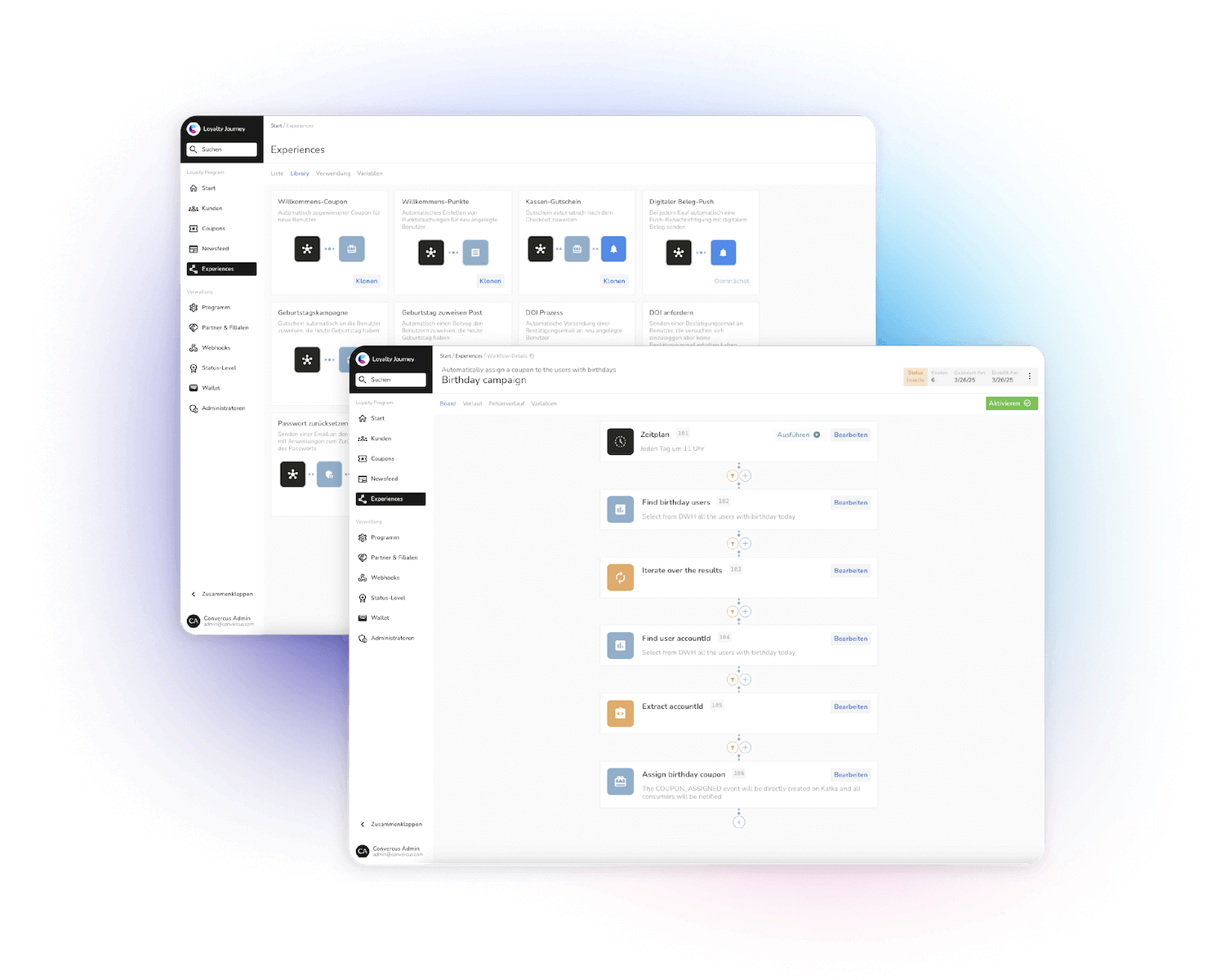
Many opticians still work with annual mailings, brochures, or blanket discount promotions. More effective is a trigger-based journey: a satisfaction survey after glasses pickup, a service prompt after a few months, later a second pair of glasses campaign, and an eye exam reminder after 24 to 48 months. Such journeys can be managed much more efficiently via modern engagement workflows than manually.
Integration into POS, Industry Software, and Digital Touchpoints
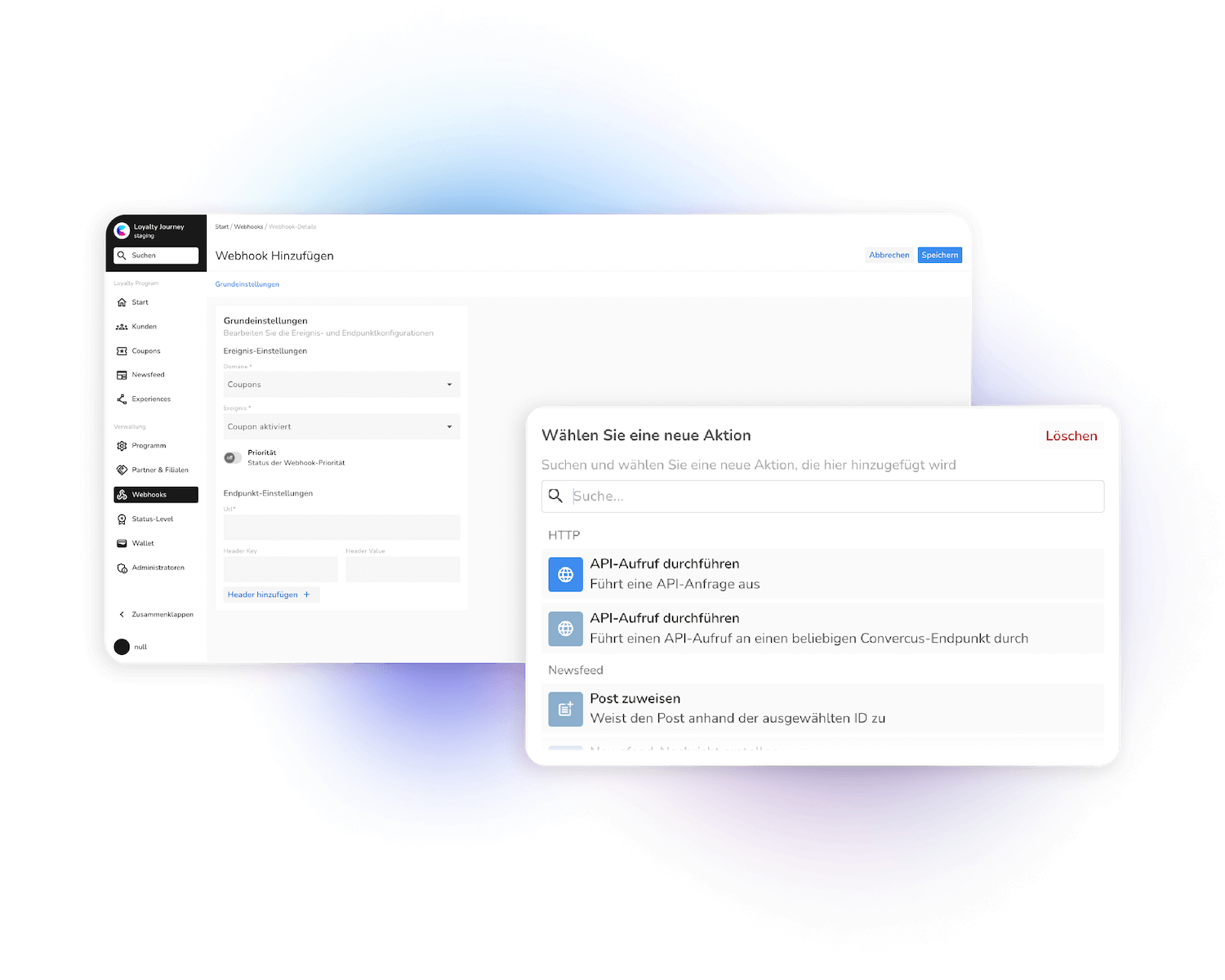
Opticians often use evolved system landscapes with POS, ERP, and industry software like Ipro, AMPAREX, or prisma. A loyalty solution must be able to integrate into this reality, instead of building another data silo. Therefore, open interfaces, stable APIs, and a clean role and rights model for branches, headquarters, and marketing are important.
Especially for omnichannel models, it is relevant that customer cards, coupons, status, and communication history are available at every touchpoint. More about how an API-first architecture can be connected with existing systemsusually becomes apparent during the evaluation phase.
GDPR-Compliant Data Processing Is Particularly Important in Optical Retail
Not all customer information is equally sensitive. Transaction data, redemptions, or appointment histories can often be assessed separately under Art. 6 para. 1 and Art. 9 GDPR, depending on whether pure contract and marketing data or health-related information is processed. As soon as vision values, optometric findings, or indications of eye health are involved, explicit consent according to Art. 9 para. 2 lit. a GDPR is regularly advisable in practice.
For email communication and many promotional push notifications, additionally § 7 UWG is relevant. Good loyalty software therefore cleanly separates marketing consents, service communication, and particularly sensitive data from each other and documents approvals comprehensibly.
Which Loyalty Mechanics Truly Work for Opticians
Opticians need mechanics that suit low frequency, high consultation depth, and comparatively high basket values. Not every classic loyalty logic makes sense in a low-frequency industry. Choosing the wrong mechanic primarily fosters discount dependency rather than loyalty.
Status Models Often Work Better Than Pure Points Programs
A customer who only buys glasses every four years rarely accumulates enough transactions for a classic points system. Status models like Bronze, Silver, or Gold are therefore often a better fit: They reward belonging, service usage, multiple glasses purchases, or contact lens subscriptions over longer periods. This creates emotional loyalty without having to push customers into frequent, artificial purchases.
Service Benefits Strengthen Trust and Protect Margins
In optical retail, expert consultation is a key value driver. Free glasses cleaning, express repair, priority appointment booking, or exclusive collection previews therefore often have a stronger impact than blanket 10% discounts. The advantage: perceived appreciation increases, while margins are less burdened than with continuous discounting.
Personalized Couponing Is Ideal for Multiple Glasses Sales
Many spectacle wearers still own only one pair of glasses, even though sunglasses, sports glasses, or computer glasses are obvious additional needs. Couponing works well in optical retail when it is linked to product interests and timing. For example, after purchasing everyday glasses, a personalized prompt for sunglasses can follow in spring, while after office glasses, an offer for workplace or additional solutions is more suitable.
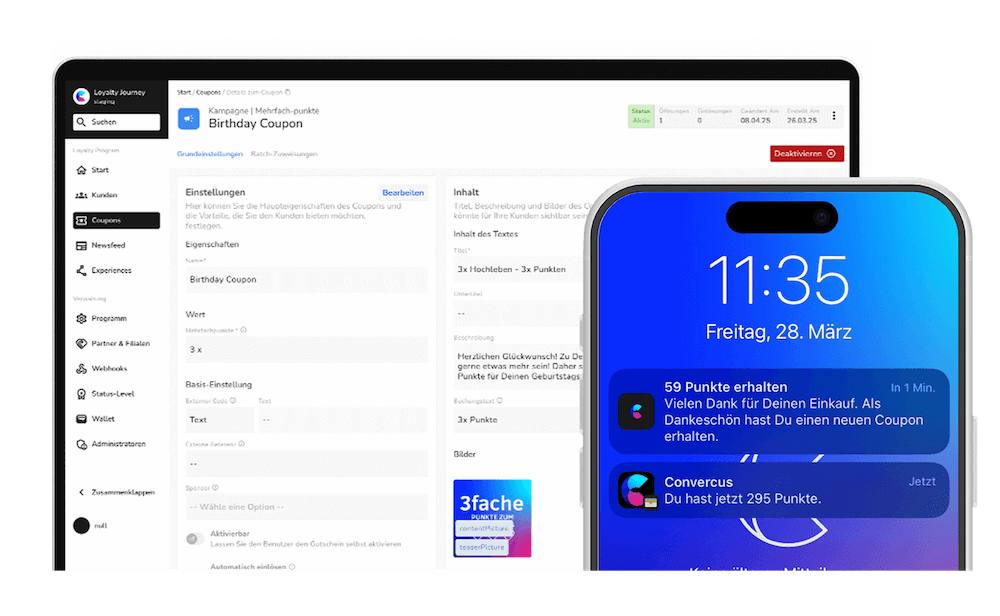
How such journeys can be technically mapped cleanly is shown by modern couponing with segmented rules and omnichannel delivery. It is crucial that offers are not sent to all customers simultaneously, but to the relevant target group.
Digital Customer Card, Wallet Pass, and Contact Lens Subscription Create More Frequency
In optics, the digital customer card is more than a replacement for plastic. It becomes a mobile service hub for benefits, status, coupons, service notifications, and the next activation impulse. The model becomes particularly powerful in combination with contact lens subscriptions or regular services, because this suddenly creates monthly or quarterly touchpoints out of a 4-year purchase cycle.
Those who think strategically about this mobile access also benefit from better visibility on smartphones. More about the logic behind it is shown by the approach of App-First Loyalty, where Wallet Pass and app not only inform but actively support relationship management.

The 5-Year Funnel: How the Purchase Cycle Becomes an Opportunity
The long purchase cycle is not just a problem, but also a predictable funnel. Those who set the right touchpoints over 48 to 60 months, increase repurchase rates, multiple glasses sales, and service revenue without constantly having to rely on discounts. Particularly effective is a combination of service, knowledge, reminders, and selective incentives.
Phase 1: Day 1 to 30 after purchase
Immediately after purchase, perception and willingness to recommend are determined. In this phase, a satisfaction survey, pickup information, and digital program onboarding process are most important. Anyone who additionally integrates a review request or a hint about service benefits here creates active loyalty early on instead of passive satisfaction.
Phase 2: Month 2 to 12
After the adjustment period, there is room for cross-selling. Multiple glasses prompts work particularly well when they tie into life situations, such as vacation, sports, screen work, or driving. Instead of blanket campaigns, opticians should segment here by purchase history, product type, and season.
Phase 3: Year 2 to 4
Now it's about maintaining relationships and relevance. Service communication, care tips, contact lens reminders, and information on additional optometric services keep the brand present in everyday life. Especially offers like screening appointments or tear film analyses can act as trust-based engagement drivers.
Phase 4: From Month 48
Active reactivation begins now at the latest. Eye test reminders, exchange impulses, and targeted win-back incentives should be triggered data-based, ideally depending on the last purchase, store history, and reaction to previous campaigns. Those who delve deeper into this phase will find further approaches in strategies for customer win-back.
Business Case: What Loyalty Software Can Specifically Offer an Optician
For management, CRM, and IT, the economic leverage is what matters in the end. In optometry, ROI is primarily generated through higher repurchase rates, additional multiple-glasses sales, and reduced reliance on expensive new customer acquisition. This is precisely why loyalty here is more than just marketing convenience.
Example Calculation for a Chain with 50 Stores
Assume an optician group operates 50 stores with 200,000 active customers, an average glasses price of €500, and a purchase cycle of 4 years. If the repurchase rate is currently 75% and increases to 82% through better customer loyalty, 14,000 additional customers will be retained over the cycle. This corresponds to approximately €7 million in additional revenue over 4 years, solely from the reduced loss of existing customers. The calculation is illustrative but shows how strongly even a few percentage points difference in retention can impact results.
Multiple-Glasses Sales and Contact Lenses Increase Customer Lifetime Value
Many customers still only buy one pair of glasses. This is precisely where one of the biggest, often untapped, revenue levers lies. Systematically offering sunglasses, sports glasses, office glasses, or contact lens subscriptions not only shortens the transaction interval but also builds a significantly higher Customer Lifetime Value. Impulses along the purchase cycle are much more efficient than general seasonal promotions.
First-Party Data Reduces Waste and Acquisition Costs
The better an optician knows their own customers, the less they have to rely on expensive broad reach. First-party data and opt-ins thus become a strategic asset. By effectively utilizing purchase history, reaction data, and service preferences, opticians can more precisely activate their existing customer base and sustainably increase overall customer loyalty, instead of constantly having to acquire new contacts.
This is what a scalable software-supported implementation looks like
The success of a loyalty program in daily store operations is determined between the idea and the rollout. What matters is not the sheer number of features, but a stable interplay of loyalty, couponing, engagement, and integration. This is precisely where enterprise-ready platforms differ from isolated promotional or card solutions.
From Loyalty Engine to Wallet Pass
For larger optician groups looking to connect stores, online touchpoints, and mobile customer communication, Convercus is an obvious choice. The platform combines Loyalty Engine, Couponing , and Engagement in an API-first architecture and is designed for scalable omnichannel scenarios. Relevant for decision-makers are 40 million+ loyalty accounts and 116 million+ transactions, which underscore the necessary enterprise performance for larger store structures.
Personalization is the Lever Against Calendar Marketing
Instead of sending the same campaign to everyone every spring, opticians should segment by product ownership, purchase date, service history, and opt-in status. This can be particularly effective in app- or wallet-based programs; according to platform data, Convercus programs with a white-label app achieve up to 8x higher customer interaction than programs without an app.
This is important for marketing and IT teams because better relevance not only increases conversion but also internal acceptance. By integrating app, Wallet Pass, and automation, rigid promotional days are replaced by ongoing, measurable customer engagement.

Conclusion: Loyalty for Opticians is Relationship Management Over Years
Successful loyalty software for opticians doesn't just organize discounts, but the entire period between two purchases. By combining purchase cycle automation, service benefits, personalized couponing, and clean data processes, opticians can better secure repeat purchases, unlock multiple-glasses potential, and manage the competition for existing customers much more professionally.
For larger optician groups and multi-store specialized retailers who want to set up customer loyalty, couponing, and omnichannel communication scalably, Convercus is a sensible next step. If you would like to explore what a suitable solution for your system landscape and purchase cycle could look like, please arrange a personal live demo.
FAQ on Loyalty Software for Opticians
The following questions frequently arise during selection processes. Especially with long purchase cycles, a sober evaluation of effort, data situation, and business case is worthwhile.
Which loyalty mechanic is best suited for opticians?
In many cases, status models, service benefits, and personalized couponing are more effective than a pure points system. Points tend to work well where purchases are made regularly, such as for contact lenses or accessories. For classic glasses purchases, a combination of status, service, and reactivation is usually more appropriate.
Does loyalty software work with existing industry software and our POS?
Yes, provided the solution can be cleanly integrated. API-first and standardized interfaces are more important here than industry labels. In practice, it is checked which data from POS, ERP, CRM, and possibly online shop or app are needed for status, coupons, and communication.
Is the topic GDPR-compliant when vision values are involved?
Yes, but only with clear data logic. Transaction data and health data must not be indiscriminately mixed. As soon as vision values or optometric information are processed, the requirements of Art. 9 GDPR are particularly relevant; additionally, marketing consents must be properly documented.
How complex is the implementation of a loyalty program?
This primarily depends on the system landscape, number of stores, and desired omnichannel depth. A clearly defined MVP with status, a digital customer card, and a few automations can be implemented much faster than a full expansion with an app, complex campaigns, and extensive segmentation. Structured onboarding with clear responsibilities between marketing, IT, and store operations is crucial.
What does loyalty software for opticians cost?
Costs depend on the number of users, transaction volume, integration effort, and functional scope. What matters less is the license price and more the expected retention and additional revenue leverage. Therefore, when evaluating, opticians should consider not only software costs but also repurchase rate, multiple-glasses quota, opt-ins, and process savings.
Can we migrate an existing customer loyalty program?
In most cases, yes. Typical migrations include old cards, previous points, customer segments, and consents, provided data quality and legal bases have been thoroughly checked. Especially with older programs, a cleanup is worthwhile so that the new setup doesn't simply perpetuate old weaknesses digitally.


- 5x Return on Investment
- 80% Customer Identification
- 8x Customer Interaction
- +274% Repurchase Rate


.png)